









A customer does not buy your average; they buy every load. A stockpile that averages on-spec but swings load to load fails just as surely as one that is consistently wrong — and the cure is not a better crusher but better blending. Stockpile blending is the cheapest variability-reduction tool a plant owns.
This article explains why blending works, quantifies how variability falls with the number of layers reclaimed, and lays out the stacking and reclaiming methods that turn a swinging feed into a steady product.
Why blending works
Blending averages. If a reclaimed cut draws from many independently varying layers at once, their fluctuations partly cancel, and the standard deviation of the blended output falls as the square root of the number of layers:

where  is the effective number of layers a reclaim cut crosses. Cross four layers and you halve the variability; cross nine and you cut it to a third. This is the same statistics that steadies any average — put to work on a pile of rock.
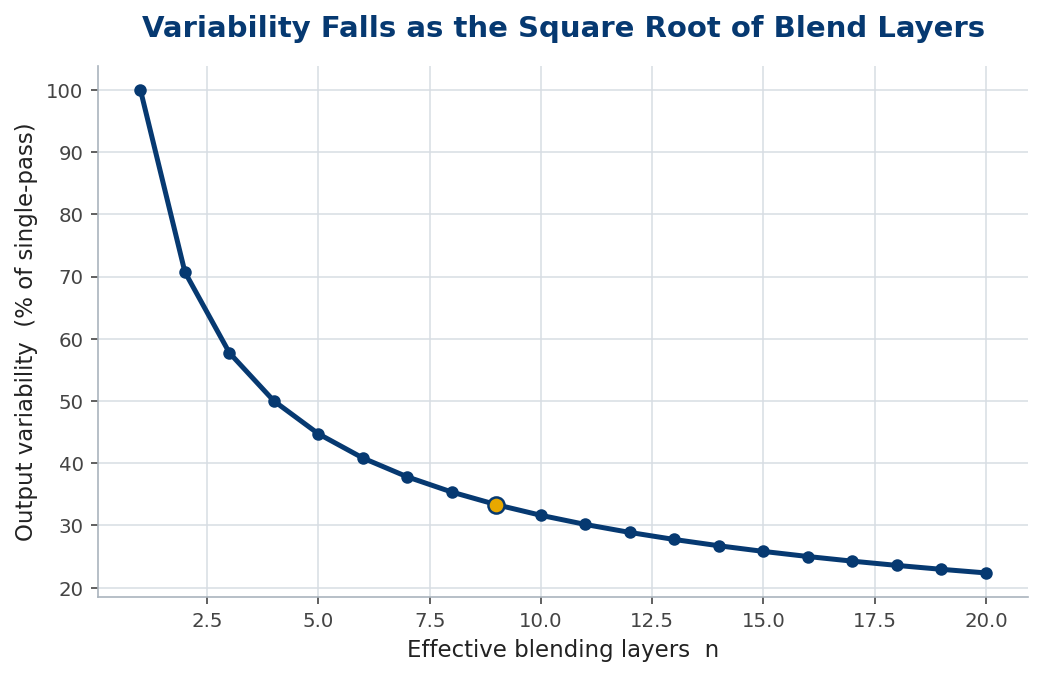
Worked example 1 — how many layers
A feed varies with a standard deviation of 1.8% in some quality (say fineness modulus spread, or grade). The customer needs it held to 0.6%. The required effective layers are

A stockpile built and reclaimed so each cut crosses about nine layers brings the swing inside spec — no change to the crusher required.
It is how you stack and reclaim
The square-root law only pays out if the geometry delivers the layers. Chevron stacking (building a triangular ridge in many thin passes) lays down the layers; reclaiming across the end of that pile cuts through them all at once. Stack one way and reclaim the wrong way and you get no blending — or even segregation, where coarse rolls to the toe and fines stay at the core.
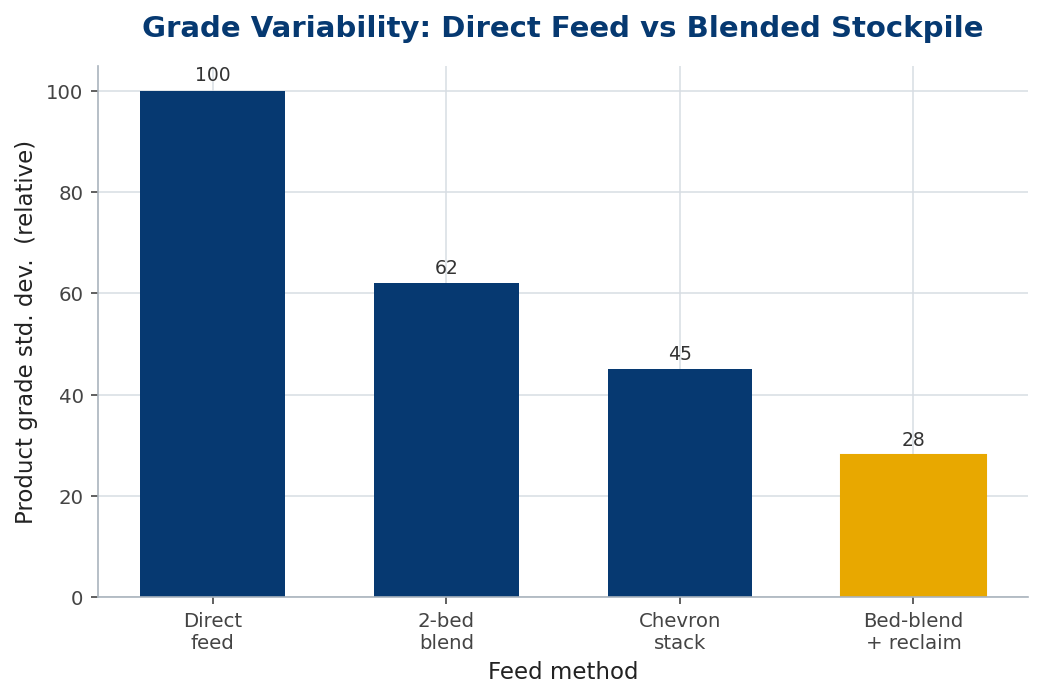
Worked example 2 — defeating segregation
A plant builds a single-point cone stockpile and feeds from a draw-down hopper beneath it. Far from blending, the cone segregates: coarse particles roll to the base while fines stay near the drop point, so the reclaim swings from fine to coarse as the pile draws down. Switching to a chevron stack reclaimed across the end — or to multiple draw points blended on the reclaim belt — turns the same material into a steady feed. The variability problem was never the rock; it was the pile geometry.
| Method | Blending | Note |
|---|---|---|
| Single cone + base draw | none / segregating | coarse rolls to toe |
| Chevron stack | good | many thin layers |
| Chevron + end reclaim | very good | cut crosses all layers |
| Multiple draw points | good | blend on reclaim belt |
In practice
Decide the target variability first, back out the layers you need from the square-root law, and then build the pile to deliver them — thin chevron passes, reclaimed across the end. Beware segregation in any single-point pile; it is the silent enemy that makes a ‘blended’ stockpile worse than the feed. And remember blending cuts random variation, not a steady bias — if the mean is off-spec, fix the process; blending only steadies the swing around the mean.
Common mistakes
- Single-point cone piles. They segregate rather than blend; coarse rolls to the toe.
- Stacking right, reclaiming wrong. Reclaim must cut across the layers (the pile end), not along them.
- Expecting blending to fix a bias. It cuts random swing, not a wrong mean — fix the process for that.
Engineered bed-blending and the homogenising factor
Where blending must be guaranteed rather than hoped for — feeding a kiln, a wash plant or a tightly specified product — the chevron pile grows up into an engineered bed-blending bed: a long stockpile built in many hundreds of thin, overlapping layers by a travelling stacker, then cut across its full end face by a bridge or boom reclaimer. Because the reclaim face intersects every layer at once, the number of effective layers is large and controlled, not incidental.
The performance of such a bed is described by its homogenising factor — the ratio of the incoming variability to the outgoing,  . It follows directly from the square-root law: a bed reclaimed across the equivalent of 100 layers has a homogenising factor of about ten, cutting a 5% input swing to roughly 0.5%. Stacking and reclaiming method set the effective layer count, so the homogenising factor is a design output, not a happy accident.
Two refinements raise it further. Stacking in a chevron or windrow pattern, and reclaiming the full height of the end face in one pass, ensures the cut samples every layer; reclaiming only part of the face, or from the side, throws the count away. And building two beds in parallel — one stacking while the other reclaims — lets the plant run continuously without ever drawing from a partly built, unblended pile.
The investment is justified by what consistency is worth downstream. A kiln or a concrete customer pays for steadiness, and a bed-blending bed converts a variable quarry feed into a product whose swing is a known, designed fraction of the input. Where the square-root law is a principle, the bed-blending bed is that principle built in steel — variability reduction you can specify and guarantee.
The bottom line
Stockpile blending steadies a swinging product by averaging:  . Pick the variability you need, back out the layers, and build a chevron pile reclaimed across its end to deliver them.
Mind segregation in single-point piles, match the reclaim to the stack, and remember it cures swing not bias — and the cheapest machine on the plant, a well-built stockpile, turns a variable feed into a consistent, saleable product.
Frequently asked questions
How much does blending reduce variability?
By the square root of the effective layers: crossing n layers cuts the standard deviation by a factor of sqrt(n) — four layers halve it, nine cut it to a third.
Why do cone stockpiles segregate?
Building a pile at one point lets coarse particles roll to the base while fines stay at the core, so a base draw-down swings from fine to coarse.
Can blending fix an off-spec mean?
No — it reduces random swing around the mean, not a steady bias. A wrong average is a process problem to fix upstream.
Key takeaways
- — variability falls with the square root of layers.
- Chevron stacking plus end-reclaim delivers the layers; single cones segregate.
- Back out the layers needed from your target variability, then build to suit.
- Blending cures random swing, not an off-spec mean.
