
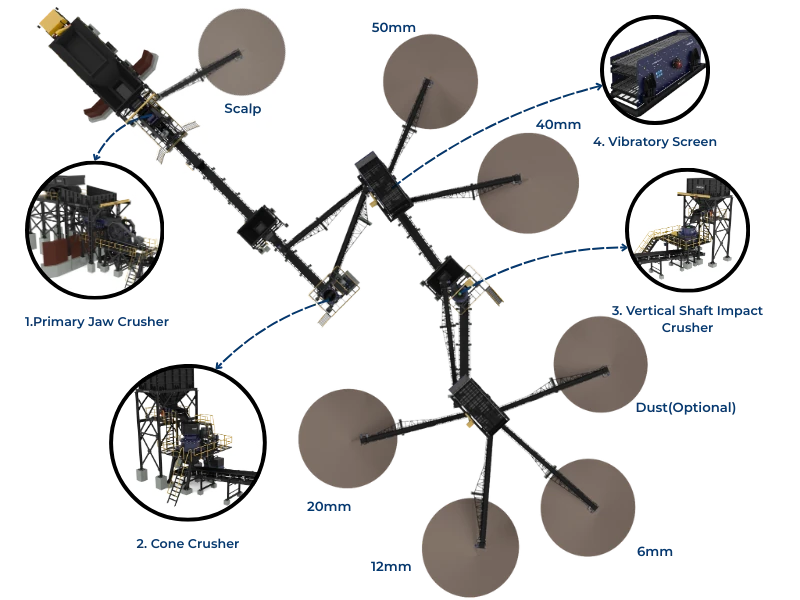
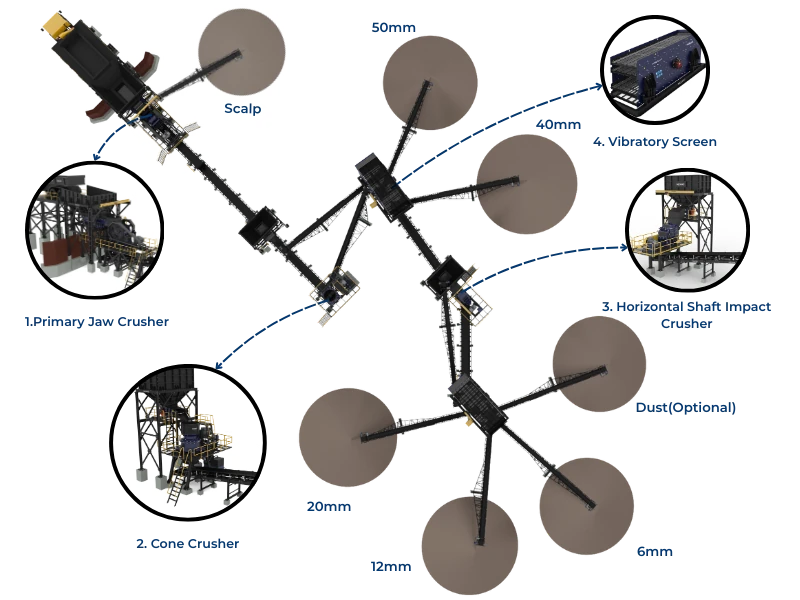
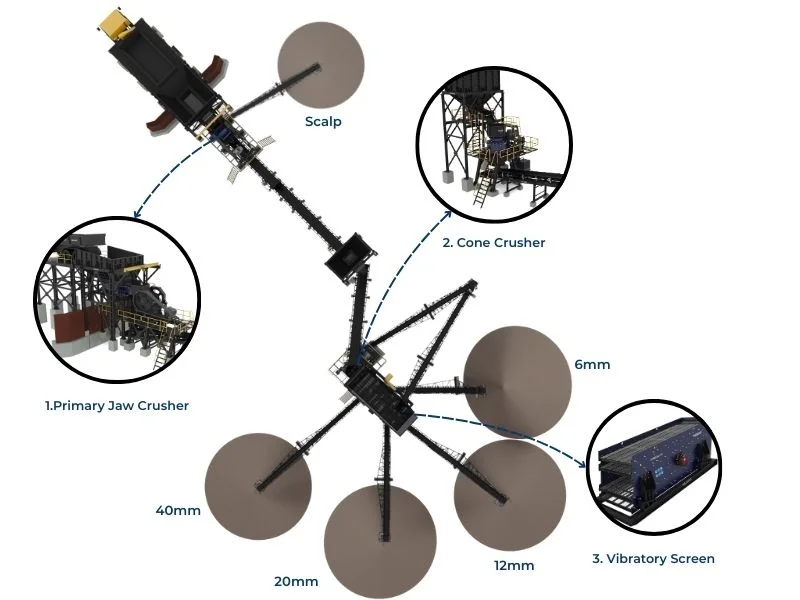
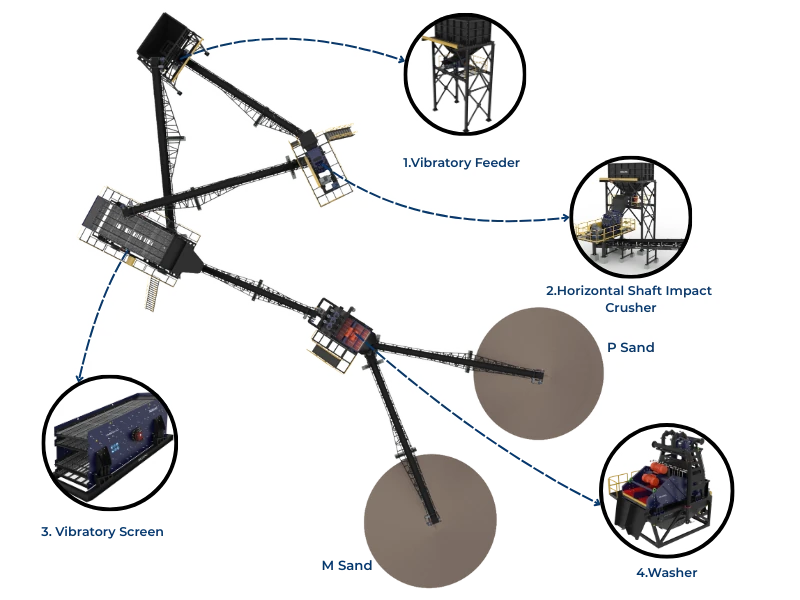
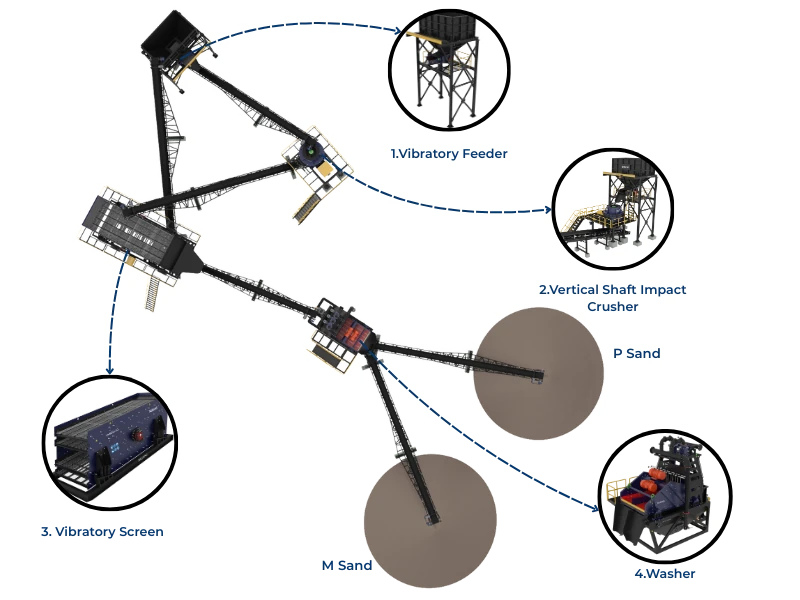
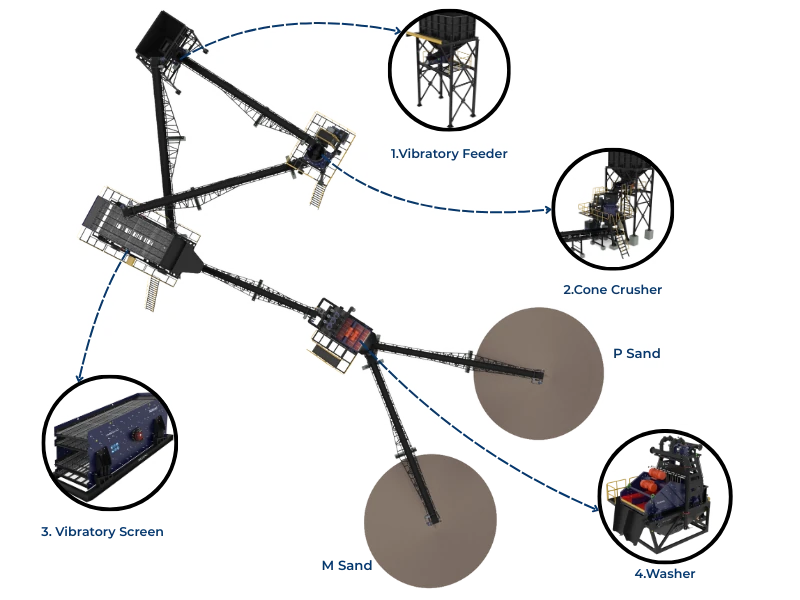
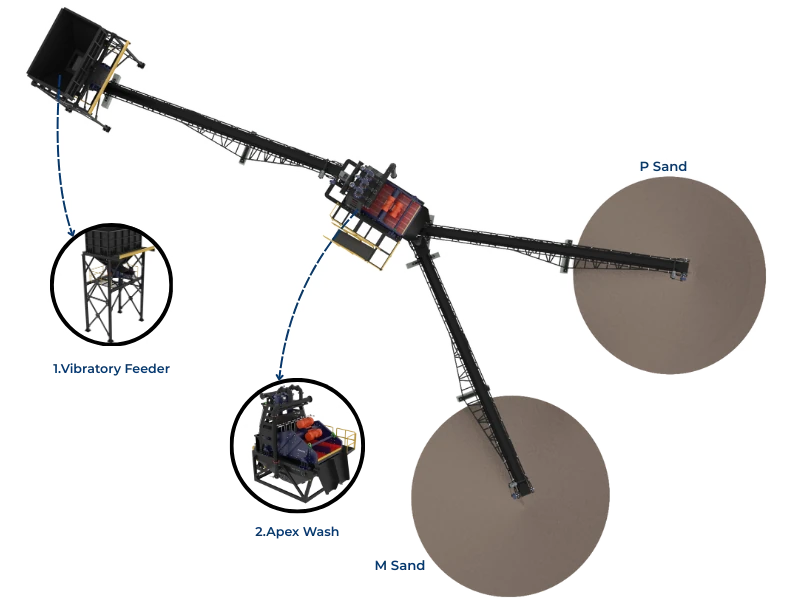
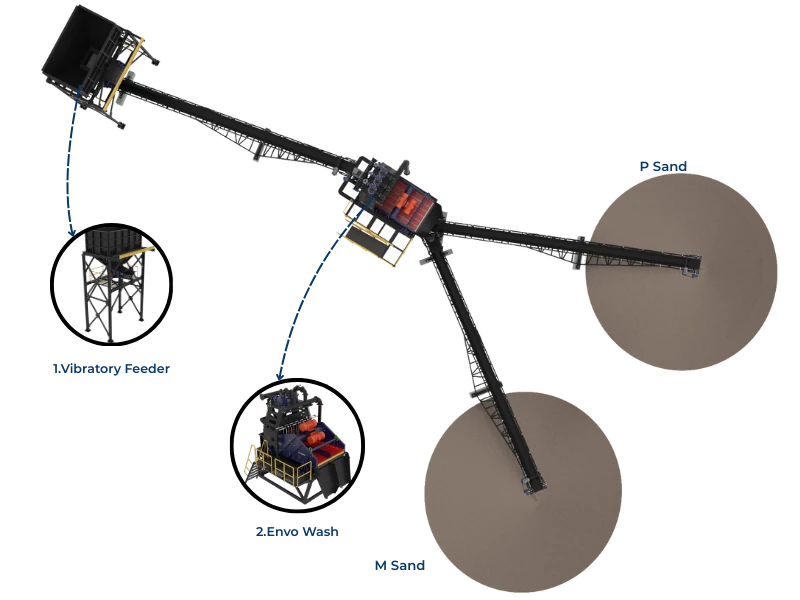





Two crushing plants can use the same crusher at the same setting and ship very different products. The difference is the flowsheet: whether the crusher discharge goes straight to product (open circuit) or is screened, with the oversize returned for another pass (closed circuit). That one loop decides how tightly you control the top size.
This article contrasts open and closed circuits, shows what each does to the product size distribution, and weighs the cost of the closing screen and recycle against the value of a guaranteed top size.
Open versus closed
In an open circuit, whatever the crusher produces is the product. Because no crusher reduces every particle below its setting in one pass, the product carries a tail of oversize — fine for a sub-base, fatal for a spec-bound concrete stone. In a closed circuit, a screen after the crusher passes the on-size product and returns the oversize. The recycled stream is the circulating load, and it guarantees the top size.
Worked example 1 — the oversize a screen removes
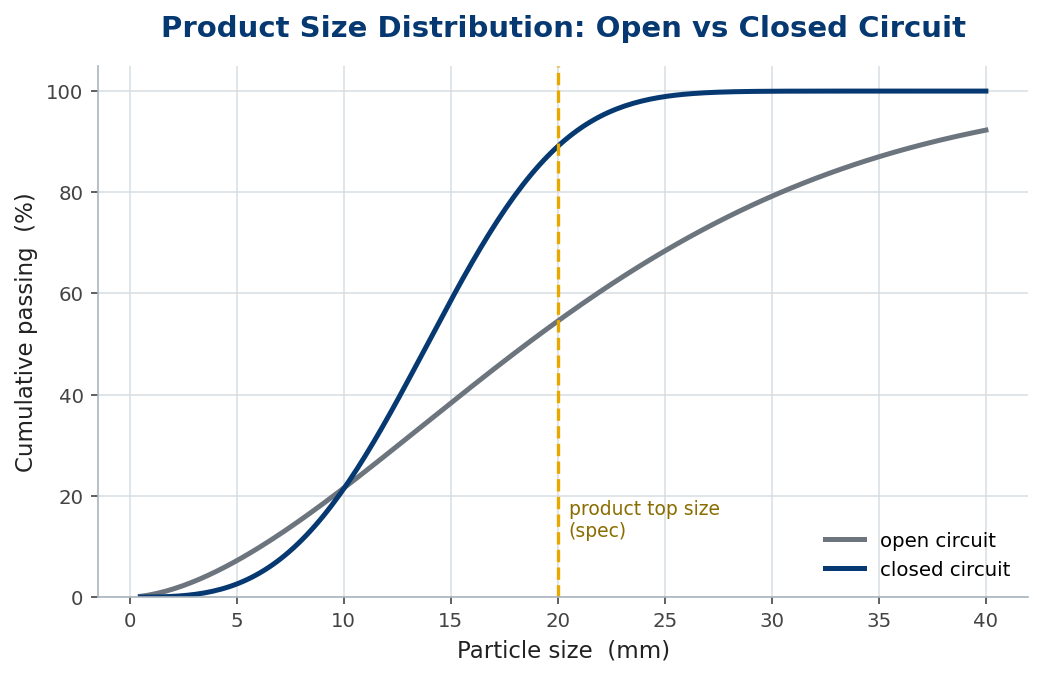
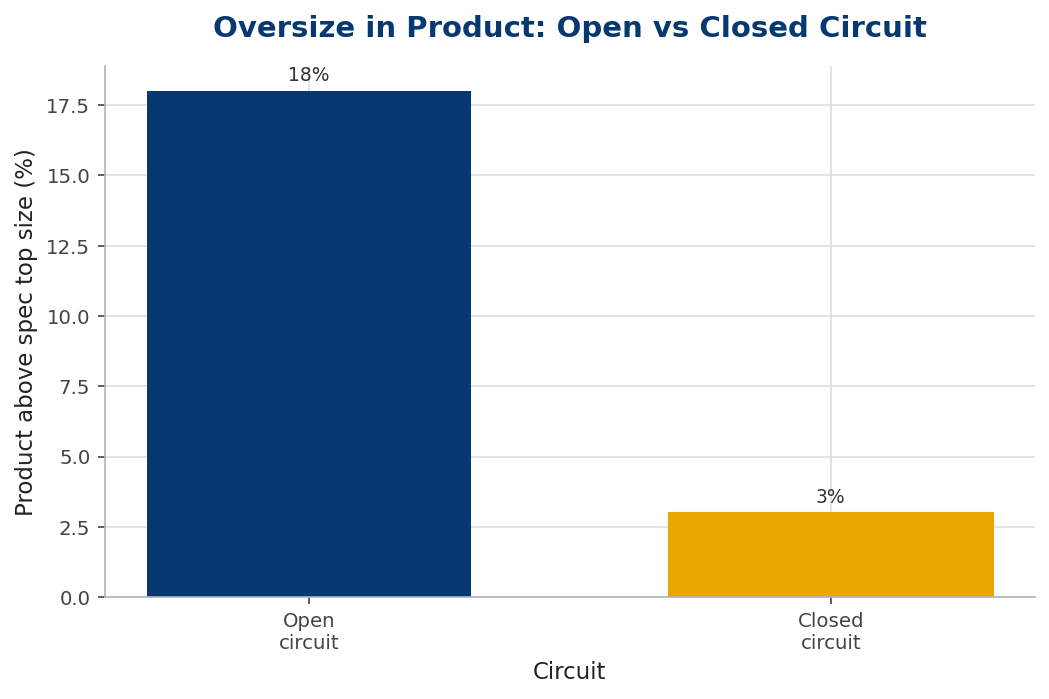
Suppose an open-circuit cone at a 20 mm setting yields a product with about 18% retained above the 20 mm spec sieve — the natural tail of single-pass crushing. Close the circuit with a 20 mm screen and that oversize is screened out and recrushed, dropping the product oversize to a few percent. The same crusher, the same setting, a different flowsheet — and a product that now meets spec.
The price of closing the circuit
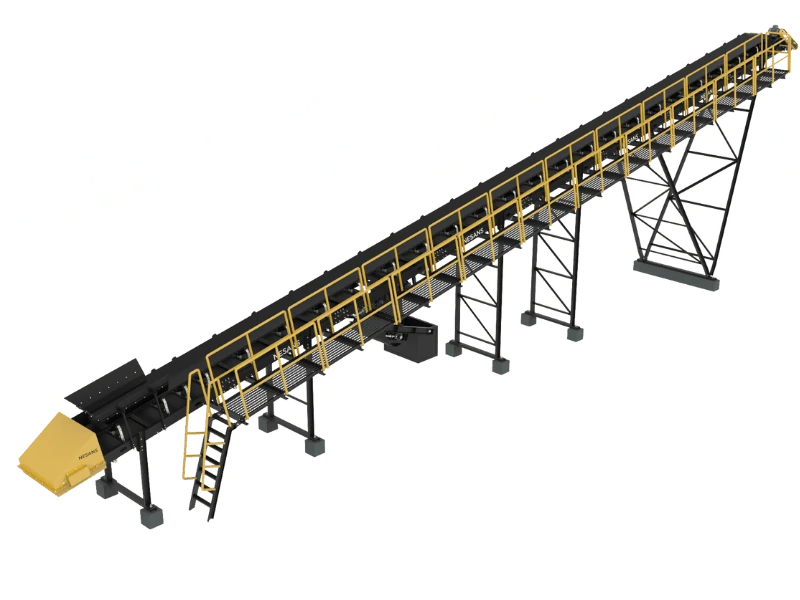
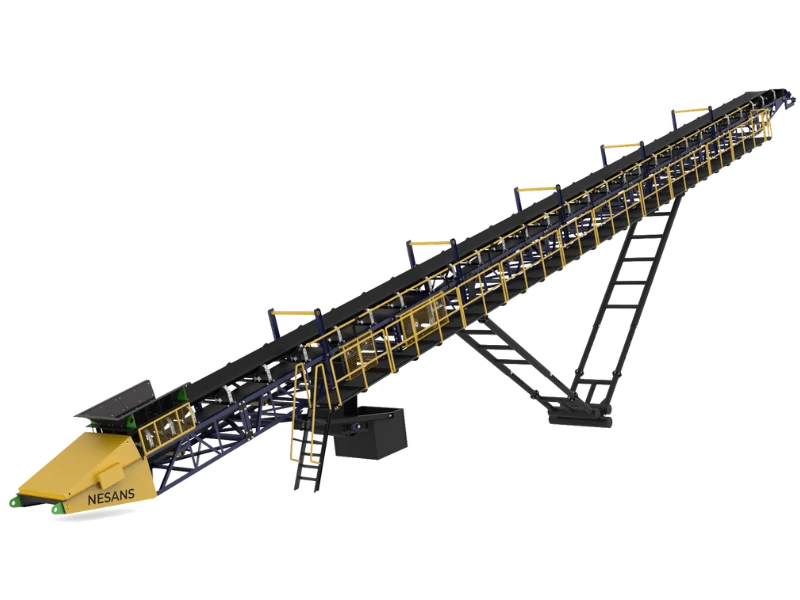
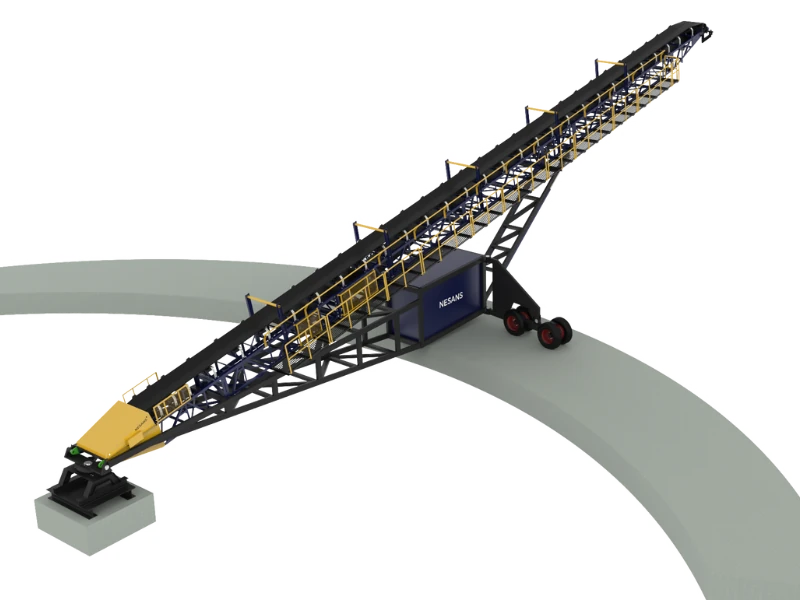
The control is not free. The closing screen, the return conveyor and the extra crushing of the recycled stream all cost capital and energy, and the circulating load means the crusher and screen are sized for more than the fresh feed. A circulating load of 25% means the crusher handles 1.25 tonnes for every tonne shipped. The question is always whether the product specification justifies that overhead.
| Aspect | Open circuit | Closed circuit |
|---|---|---|
| Top-size control | loose (oversize tail) | tight (guaranteed) |
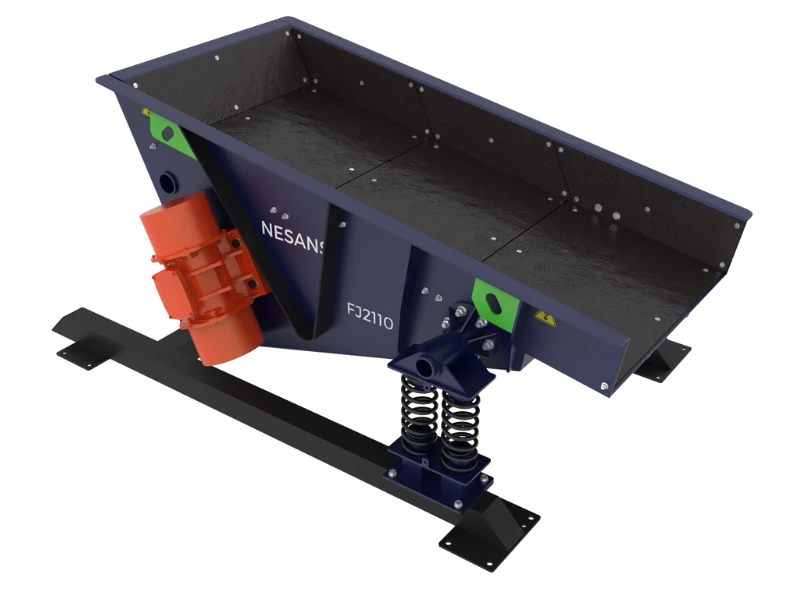
| Equipment | crusher only | crusher + screen + return |
| Energy / capacity | lower | higher (recirculation) |
| Product shape & fines | as-crushed | improved by re-crushing |
| Best for | sub-base, surge stages | spec aggregate, final product |
Worked example 2 — where each belongs
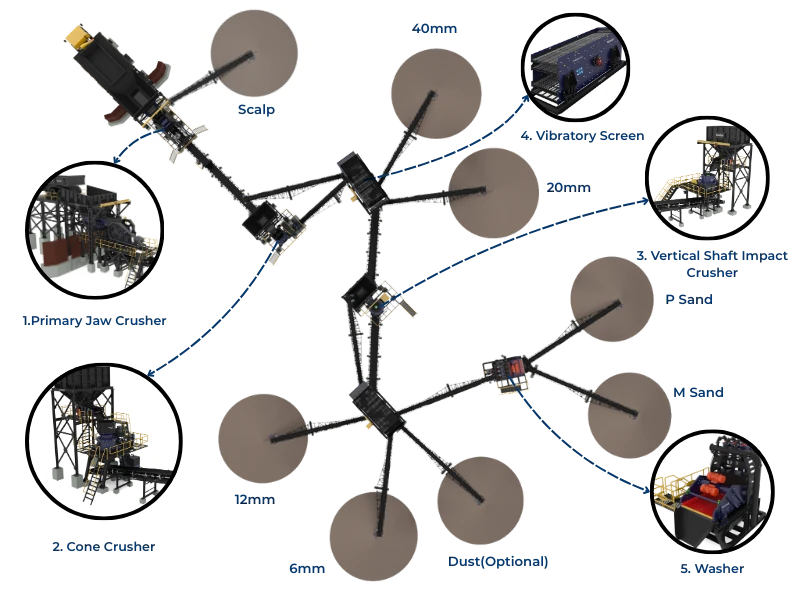
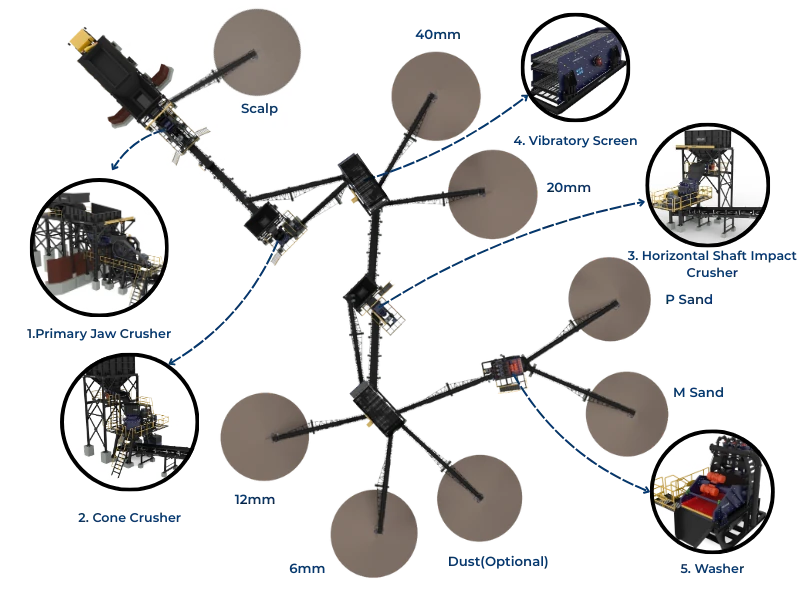
A three-stage plant uses both. The primary and secondary run open — their job is reduction, not final sizing, so a tail of oversize simply feeds the next stage. The tertiary, which makes the saleable product, runs closed: a screen guarantees the 20 mm and 10 mm top sizes the customer pays for, recycling the rest. Matching the circuit to the stage’s purpose — reduction open, final sizing closed — is how a flowsheet earns its capital.
In practice
Close the circuit where the top size is sold and leave it open where the stage only reduces. Size the closed-circuit crusher and screen for the circulating load, not the fresh feed, or the loop will choke the moment the product tightens. Watch the circulating load as a process signal: a rising load means the crusher is making less on-size per pass — usually worn liners or a drifting setting — long before the product sheet shows it.
Common mistakes
- Open circuit on a final product. The oversize tail breaches spec; close the last stage.
- Sizing on fresh feed. A closed circuit must carry the circulating load too, or it chokes.
- Ignoring circulating-load trend. A climbing load is an early warning of worn liners or a wide setting.
How the closing screen and circulating load interact
Closing the circuit couples the crusher and the screen into one system, and the circulating load is the variable that links them. The load is set by how much oversize the crusher leaves and how efficiently the screen removes it: a tighter crusher setting and a sharper screen both shrink the recycle, while worn liners or a blinded screen swell it. Because the crusher and screen must each carry the fresh feed plus the recycle, the circulating load sizes both machines.
A worked feel for the numbers helps. If the crusher produces 75% on-size product per pass and the screen is 90% efficient, the steady-state circulating load settles at a few tens of percent of fresh feed; let the screen efficiency fall to 75% and that recycle climbs steeply, because every tonne of misplaced on-size that the screen sends back to the crusher must be handled again. The circulating load is thus exquisitely sensitive to screen health — a small drop in efficiency produces a large rise in recirculating tonnage.
That sensitivity is exactly why circulating load makes such a good early-warning signal. Meter or estimate it, and a climbing trend tells you the crusher is making less on-size per pass (worn liners, a widening setting) or the screen is letting on-size ride over (blinding, worn media, wrong stroke) — well before the product sheet shows a problem. Many plants run blind to this and discover a worn circuit only when the product goes out of spec.
The design lesson follows directly: size the closed-circuit crusher and screen for the expected circulating load with margin, not for the fresh feed, and instrument the recycle so it can be watched. A closed circuit sized on fresh feed alone will choke the day the screen efficiency dips — the very day the load was always going to rise.
The bottom line
Open circuit ships what the crusher makes, oversize tail and all; closed circuit screens and recycles to guarantee the top size, at the cost of a screen, a return and a circulating load. Reduction stages run open; final-sizing stages run closed.
Match the circuit to the stage’s job, size the closed loop for the recirculation, and trend the circulating load as a health signal — and the flowsheet delivers spec product without crushing a gram more than it must.
Frequently asked questions
What is the difference between open and closed circuit crushing?
Open circuit ships the crusher discharge as-is; closed circuit screens it and returns the oversize for recrushing, guaranteeing the product top size.
Why does closed circuit cost more?
It adds a screen, a return conveyor and the energy to recrush the circulating load, and the crusher and screen must be sized for feed plus recycle.
Which stages should be closed?
The stage that makes the saleable, spec-bound product. Earlier reduction stages usually run open and feed the next stage.
Key takeaways
- Open circuit leaves an oversize tail; closed circuit screens and recycles to guarantee top size.
- Closing the circuit adds a screen, a return and a circulating load — cost and energy.
- Run reduction stages open, final-sizing stages closed.
- Size the closed loop for the circulating load and trend it as a wear signal.
