


















IS 383:2016 is the Indian standard for aggregates in concrete, and it is the document a manufactured-sand producer must answer to. The 2016 revision explicitly recognises crushed-stone (manufactured) sand — but recognition comes with grading and fineness requirements you have to demonstrate, batch after batch. This article shows how to read the Zone II envelope, compute fineness modulus, prove a compliant sample, diagnose a failing one, and fix it.
Grading zones
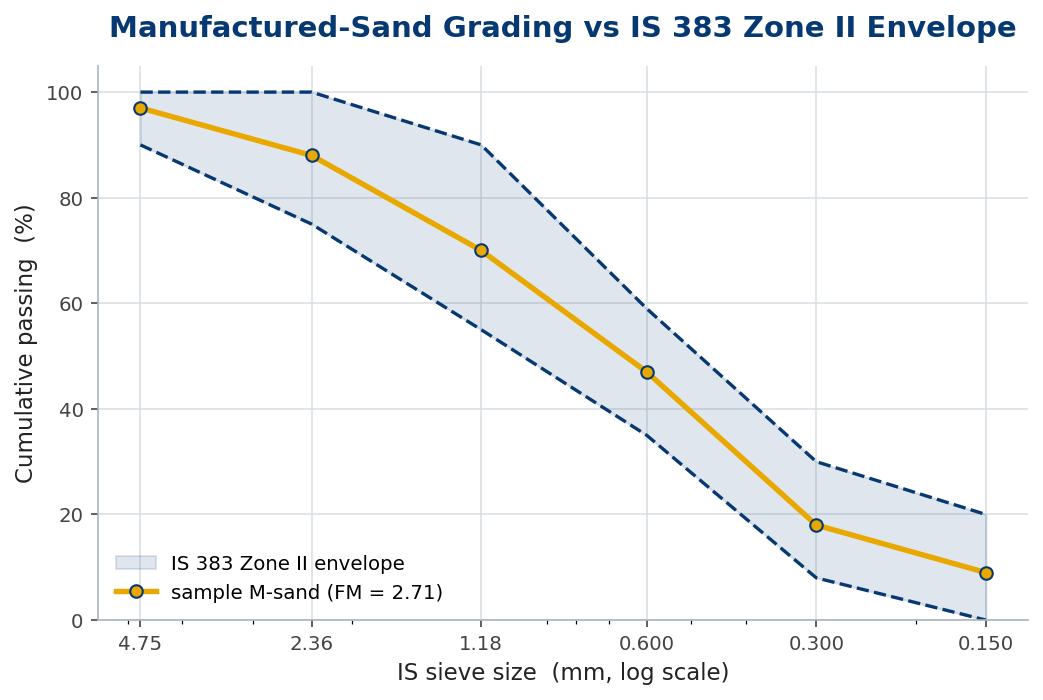
IS 383 places fine aggregate into four grading zones, I (coarsest) through IV (finest), defined by the percentage passing each IS sieve. Zone II is the workhorse for structural concrete sand — coarse enough for strength and low water demand, fine enough for cohesion and finish. Its limits are:
| IS sieve | Zone II — cumulative passing (%) |
|---|---|
| 10 mm | 100 |
| 4.75 mm | 90 – 100 |
| 2.36 mm | 75 – 100 |
| 1.18 mm | 55 – 90 |
| 600 µm | 35 – 59 |
| 300 µm | 8 – 30 |
| 150 µm | 0 – 10 (up to 20 for crushed sand) |
Fineness modulus
Fineness modulus (FM) is a one-number summary of coarseness: the sum of the cumulative percentages retained on the standard sieves, divided by 100.

Physically, a higher FM means a coarser sand (lower water demand, but harsher, less cohesive mixes); a lower FM means a finer sand (more cohesive, but thirstier for water and cement paste). For Zone II sand, FM normally lands between about 2.6 and 2.9.
Worked example 1 — a compliant sample
A sieve analysis of an M-sand sample gives the passing percentages below. Cumulative % retained is simply  :
:
| IS sieve | Passing (%) | Cumulative retained (%) | Within Zone II? |
|---|---|---|---|
| 4.75 mm | 97 | 3 | ✓ (90–100) |
| 2.36 mm | 88 | 12 | ✓ (75–100) |
| 1.18 mm | 70 | 30 | ✓ (55–90) |
| 600 µm | 47 | 53 | ✓ (35–59) |
| 300 µm | 18 | 82 | ✓ (8–30) |
| 150 µm | 9 | 91 | ✓ (0–20) |
| Sum | 271 |
The cumulative retained values sum to 271, so  . Every sieve falls inside the Zone II band and FM = 2.71 sits in the ideal range — the sample is compliant Zone II manufactured sand.
Reading the distribution itself
The cumulative curve proves compliance, but the individual percentage retained on each sieve tells you where the sand’s mass actually sits and how to control it. Figure 2 plots the same sample as a particle-size histogram:
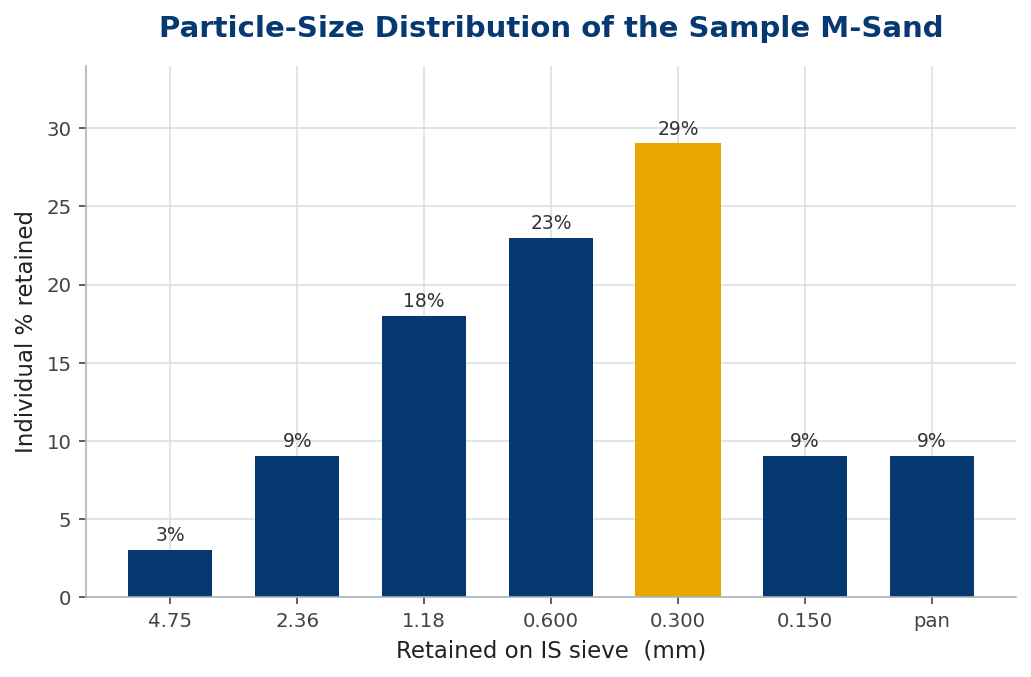
A healthy M-sand shows a broad, single-peaked distribution like this. Two warning shapes are common: a spike in the 150 µm/pan fractions (a VSI running too hard, over-producing fines) or a hollow in the 300–600 µm mid-range (a gap grading that hurts workability).
Worked example 2 — a failing sample, and the fix
Now take a finer, dustier product: passing 4.75 mm = 99, 2.36 mm = 92, 1.18 mm = 78, 600 µm = 58, 300 µm = 33, 150 µm = 26. Checking the limits: 300 µm at 33% exceeds the 8–30 band, and 150 µm at 26% exceeds even the relaxed 20% M-sand allowance — two failures, both from excess fines. The cumulative retained values (1, 8, 22, 42, 67, 74) sum to 214, giving

well below the Zone II comfort range — confirming an over-fine sand. The fix is to remove the excess minus-300 µm material: an air classifier or a fines-recovery wash trims the tail, lifts every cumulative-retained value, and pushes both the 300 µm and 150 µm fractions back inside the band while raising FM toward 2.6–2.8. The same crusher, a different classification cut, turns a reject into a compliant product.
Common mistakes
- Testing only at type approval. Grading and FM drift with feed rock and crusher wear; report them per batch, not once a year.
- Confusing the 150 µm and 75 µm limits. 150 µm is a grading sieve; 75 µm governs clay-size dust and carries its own (methylene-blue-gated) allowance.
- Chasing FM alone. FM is a control number; the zone grading limits are the actual pass/fail. A sand can hit a ‘good’ FM and still breach a sieve band.
Frequently asked questions
Which zone should concrete sand be?
Zone II is the preferred target for most structural concrete. Zone I (coarser) and Zone III (finer) are usable with mix-design adjustments to water and paste content; Zone IV is generally too fine for structural use.
My FM is out of range — do I reject the sand?
Not automatically. FM is a process control, not the legal limit; the grading envelope is. Out-of-range FM signals you should blend products or adjust classification before the grading itself drifts out.
What is the difference between the 150 µm and 75 µm clauses?
The 150 µm limit is part of the grading envelope (relaxed to 20% for crushed sand). The 75 µm limit caps clay-size dust; crushed sand may carry more of it if the fines are proven non-plastic by methylene blue.
Key takeaways
- Zone II is the target band for structural concrete sand; know its seven passing limits.
- IS 383:2016 relaxes the 150 µm limit to 20% for crushed-stone sand, and allows more non-plastic 75 µm dust — use both.
- FM is the sum of cumulative % retained ÷ 100; aim for ~2.6–2.9 in Zone II.
- Over-fine sand fails at 300/150 µm and runs a low FM; classification trims the tail and recovers compliance.
- Plot every batch against the envelope and report FM continuously — compliance is a process, not a one-off test.
