














Two of the quietest numbers on an aggregate test sheet — specific gravity and water absorption — quietly govern concrete mix design, batching accuracy and long-term durability. IS 2386 (Part 3) defines how to measure them, and a producer who ignores them ships sand and stone that throw a mix off its water-cement ratio batch after batch.
This article shows what each property is, how the test arithmetic works, the limits that matter, and why a high absorption is often an early warning of a durability problem you cannot see.
Definitions and the equations
Specific gravity compares the mass of the aggregate to the mass of an equal volume of water. Water absorption is the mass of water a dry aggregate takes up to reach the saturated-surface-dry (SSD) state, as a percentage of the dry mass:

| Symbol | Meaning | Units |
|---|---|---|
| A | Oven-dry mass | g |
| B | Saturated-surface-dry (SSD) mass | g |
| C | Apparent mass in water | g |
| Gbulk | Bulk specific gravity | – |
Worked example 1
A coarse aggregate sample: oven-dry  , SSD
, SSD  , mass in water
  .
.

A specific gravity of 2.60 and 1.5% absorption are typical of sound aggregate.
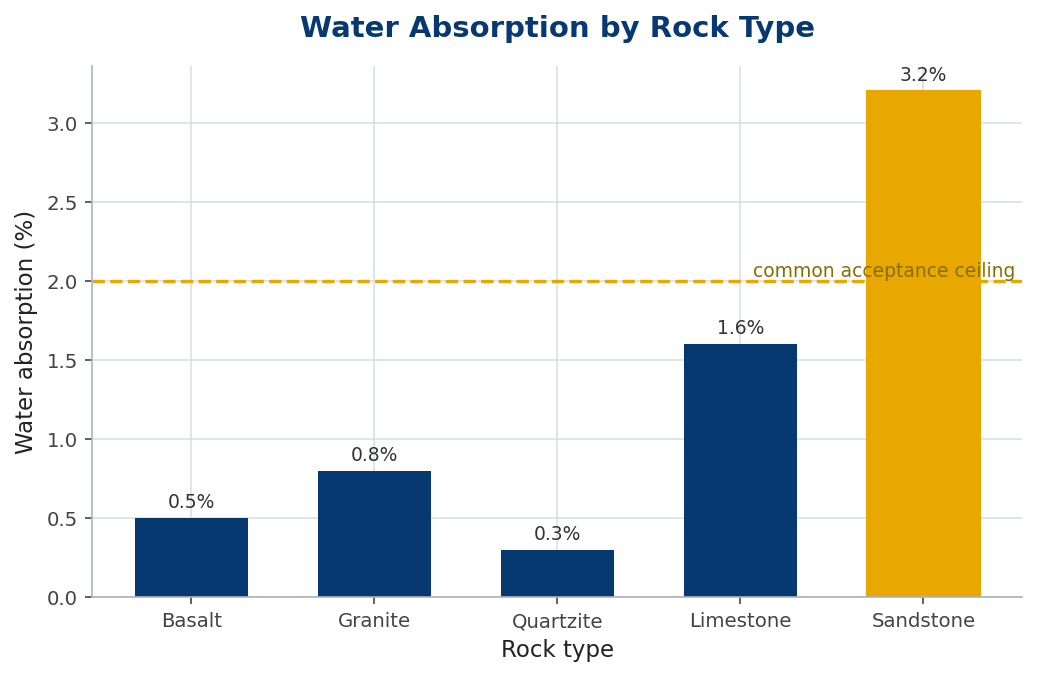
Absorption by rock — and the limit
Dense igneous rocks absorb a fraction of a percent; porous sedimentary rocks absorb several percent. Most specifications expect coarse aggregate below about 2% absorption for durable concrete.
Why absorption predicts durability
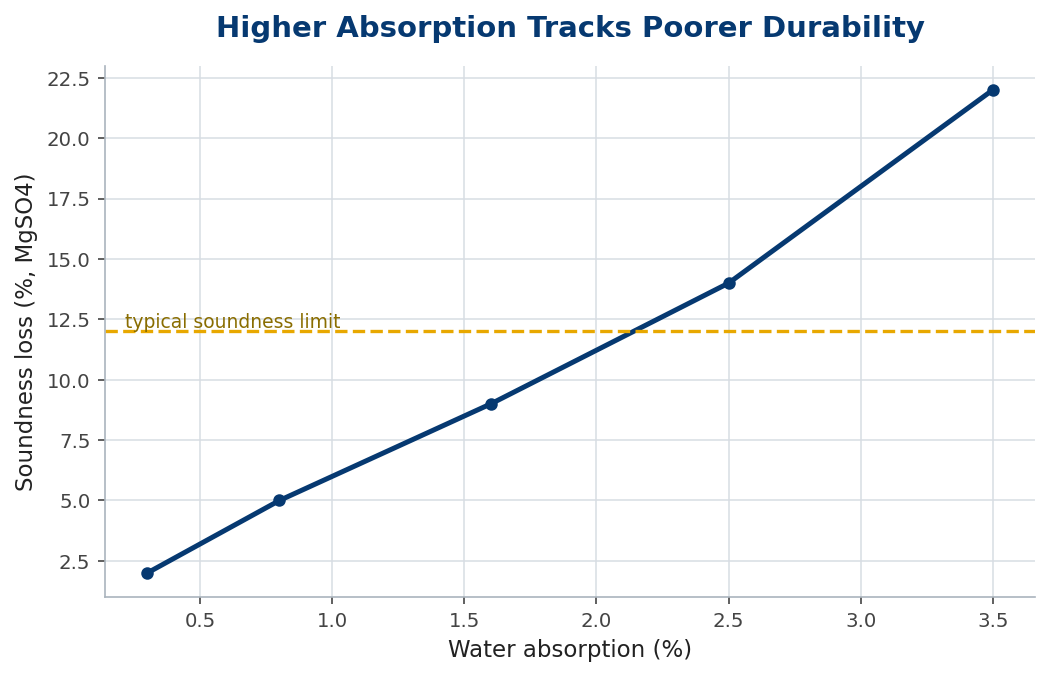
Absorption is a proxy for porosity, and porosity is the doorway for the weathering that destroys aggregate — freeze-thaw, salt crystallisation and sulfate attack all work through the pores. So a rising absorption tracks a rising soundness loss, as Figure 2 shows. A low-absorption aggregate is usually a durable one; a high-absorption aggregate deserves a soundness test before you trust it.
Worked example 2 — the batching correction
Suppose 1000 kg of the 1.5%-absorption aggregate is batched from a stockpile at 0.5% surface moisture. The aggregate still needs  of water to reach SSD — that is 10 kg of mixing water it will absorb rather than leaving free for hydration. Miss that correction across a full mix and the water-cement ratio drifts up enough to cost real strength. SG and absorption are not academic; they are batching inputs.
In practice
Run SG and absorption on each new face and whenever the rock looks different, and keep them on the same control chart as grading. Manufactured sand often absorbs more than natural sand because crushing opens micro-cracks, so its correction matters even more. And treat a step change in absorption as a geological signal: the quarry has moved into more porous or weathered rock, and a soundness and strength check should follow before the material reaches a customer.
Common mistakes
- Batching without the SSD correction. A thirsty aggregate raises the effective water-cement ratio and cuts strength.
- Reading absorption in isolation. Pair a high value with a soundness test — it is a porosity warning.
- Assuming M-sand behaves like river sand. Crushed sand usually absorbs more; measure it.
Which specific gravity? SSD, apparent and oven-dry
‘Specific gravity’ is not a single number, and using the wrong basis quietly corrupts a mix design. The same aggregate has three specific gravities depending on how its pores are counted. Apparent specific gravity counts only the solid, sealed volume; bulk (oven-dry) counts the solid plus the permeable pores as if empty; and bulk SSD (saturated surface-dry) counts them as if water-filled. The three differ by exactly the water absorption.
Concrete mix design works in the SSD condition for a reason: an SSD aggregate neither absorbs mixing water nor adds free water to the mix, so the water-cement ratio you design is the one you get. Design on the oven-dry basis and the dry aggregate drinks mixing water on contact, stiffening the mix and starving the hydration; design assuming wet aggregate when it is dry and the same error runs the other way. The SSD basis is the neutral reference that makes the batch predictable.
The measurement underpins it. A pycnometer (or the wire-basket method for coarse aggregate) weighs the sample saturated, surface-dry and oven-dry, and from those three masses every specific gravity and the water absorption fall out together. Getting the surface-dry condition right — damp but not glistening — is the operator skill the whole result hinges on, and the commonest source of scatter between labs.
So state the basis whenever you state a specific gravity, and carry the SSD value and the absorption into the mix design and the batching moisture correction together. A specific gravity quoted without its basis is ambiguous, and an absorption ignored at the batch plant is the difference between the slump you designed and the slump you pour.
The bottom line
Specific gravity and absorption look like box-ticking until a mix comes up weak. They set the volume the aggregate occupies and the water it steals, and absorption doubles as a cheap durability screen. Measure them per face, correct your batching to SSD, and watch absorption as a porosity alarm.
The producers who treat these two numbers as live process data ship concrete that hits its strength first time; the ones who file them away chase mysterious low breaks for months.
Frequently asked questions
What absorption is acceptable?
Commonly below ~2% for coarse aggregate in durable concrete, though the governing specification and exposure class set the actual limit.
Which specific gravity does mix design use?
The SSD (saturated-surface-dry) basis, so batching neither adds nor removes water from the aggregate at the reference condition.
Why does M-sand absorb more than river sand?
Crushing opens micro-cracks and creates fresh angular surfaces with more pore access, so manufactured sand typically shows higher absorption.
Key takeaways
 ; Absorption
  , with SSD as the reference.
- Batch to SSD — uncorrected absorption raises the effective water-cement ratio.
- Absorption is a porosity proxy: high values flag weak durability, so pair them with a soundness test.
- Measure per face and treat a step change as a geological warning — especially for M-sand.
