




A conveyor that is too narrow spills and chokes; one that is too wide and fast wastes capital and power. Sizing it correctly comes down to one tidy equation that links belt width, speed and the material’s bulk density — and to respecting two limits the equation does not show: lump size and the angle the load will stand at.
This article derives the capacity relation, sizes a belt two ways, and lays out the width-versus-speed trade-off that decides whether a conveyor runs quietly for twenty years or wears itself out chasing tonnage.
The capacity equation
Capacity is the cross-sectional area of material on the belt, carried past a point at the belt speed, times the bulk density:

with  in t/h, the load cross-section
  in m
in m , belt speed
  in m/s and bulk density
  in t/m
 . The cross-section grows with belt width and with the trough and surcharge angles — the angle the material naturally heaps at.
| Symbol | Meaning | Units |
|---|---|---|
| Q | Capacity | t/h |
| A | Load cross-sectional area | m2 |
| v | Belt speed | m/s |
| ρ | Bulk density | t/m3 |
Worked example 1
An 800 mm troughed belt carries crushed stone ( ) with a load cross-section
  at
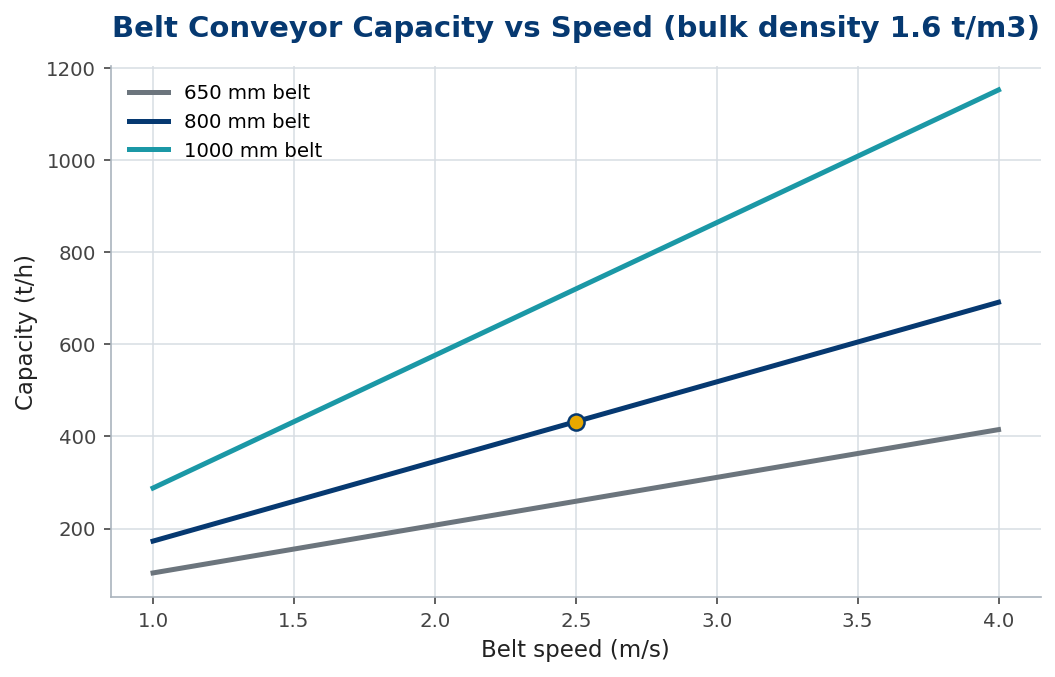
at  :
:

Figure 1 shows how capacity scales with speed for three belt widths.
Width or speed?
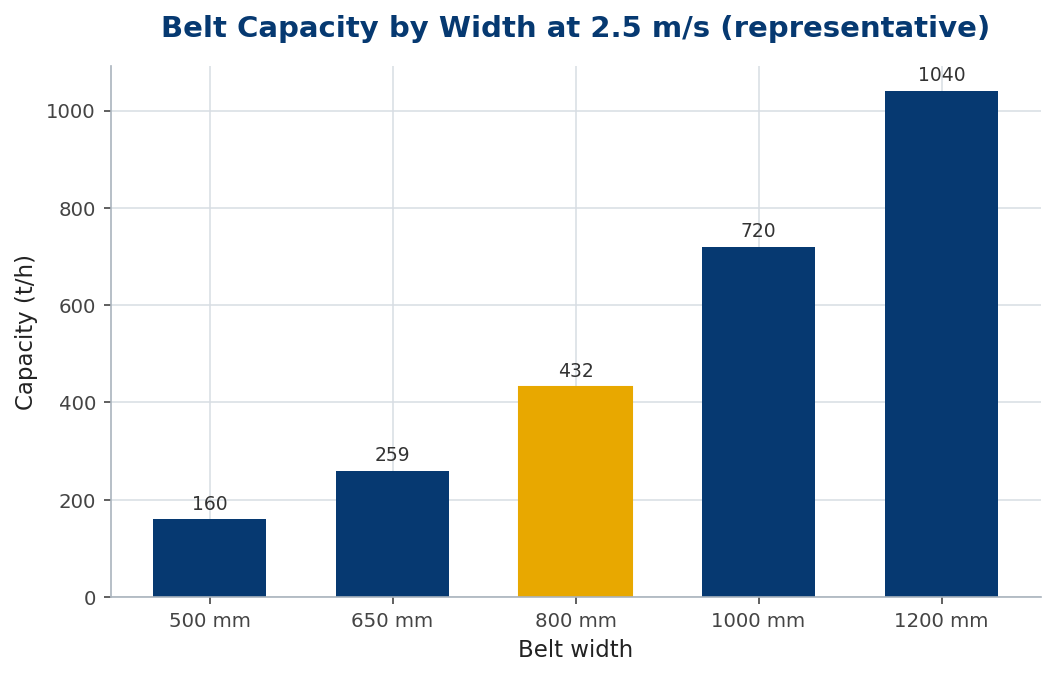
The equation offers two routes to capacity — a wider belt or a faster one — and they are not equivalent. Cross-section grows roughly with the square of belt width, so widening is a powerful and gentle way to add capacity. Speeding the belt adds capacity linearly but raises wear, noise, degradation of the rock and the risk of spillage and belt mistracking. As a rule, reach for width first and keep speed in a sober band (often 2–3.5 m/s for crushed aggregate).
The two limits the equation hides
Capacity is necessary but not sufficient. Two physical limits must also pass. First, lump size: the belt must be wide enough to carry the largest lumps without bridging the skirts — a common rule is a belt width of at least 2–3 times the top size for unsized rock. Second, the surcharge angle: free-flowing rounded material stands at a low angle and fills less cross-section than the equation’s ideal, while sticky or angular material stands higher. Both adjust the real away from the textbook value.
| Check | Rule of thumb | If it fails |
|---|---|---|
| Lump size | belt width ≥ 2–3 × top size | widen the belt |
| Surcharge angle | use the material's real angle, not 20° ideal | re-rate A |
| Speed | ~2–3.5 m/s for crushed stone | widen rather than speed up |
Worked example 2 — sizing for a duty
A circuit needs to move 500 t/h of 0–40 mm crushed stone. At and , the required cross-section is  — an 800 mm belt run a touch fuller, or a 1000 mm belt with comfortable freeboard. With 40 mm top size the lump-size rule (belt ≥ ~120 mm) is trivially met, so width is set by capacity and freeboard, and a 1000 mm belt at 2.5 m/s is the kinder, longer-lived choice.
In practice
Run belts a little below their theoretical capacity — aim to fill the cross-section to about 70–75%, leaving freeboard for surges and off-centre loading. Load in the direction of travel and centrally to protect tracking and the belt edges. And remember the capacity equation says nothing about power: that comes from belt length, lift and friction, and is a separate calculation — a short, level belt and a long, inclined one of the same capacity draw very different motors.
Common mistakes
- Running belts brim-full. Leave freeboard for surges; design to ~70–75% of the theoretical cross-section.
- Speeding up instead of widening. Width adds capacity with the square and far less wear; speed adds it linearly with more.
- Using the ideal surcharge angle. Free-flowing rock stands lower than 20°; rate on the real material.
Power and tension: the other half of conveyor design
Capacity sizes the belt to carry the tonnes; power and tension size the drive to move them. The two are independent: a conveyor can have ample cross-section yet stall or tear its belt if the drive and tension are wrong. The effective tension the drive must develop is the sum of the forces resisting the belt — the friction of carrying the load and belt along the idlers, plus the force to lift the material through any rise:

where  is the drive power in kilowatts,
  the effective tension in newtons and the belt speed in m/s. The lift term is the one that surprises: raising material is expensive, so a long, steep conveyor can demand far more power than its tonnage alone would suggest, while a long horizontal one is dominated by rolling friction.
Tension also has a floor set by the drive geometry, not just the load. The belt must grip the drive pulley without slipping, which requires a minimum tension on the slack side — provided by gravity take-up or a screw take-up — and it must not sag so far between idlers that material spills. Too little tension slips and spills; too much overloads the belt, pulleys and bearings, exactly the window the designer must hit.
So design a conveyor in two passes: cross-section and speed for the capacity, then tension and drive power for the resistances — friction plus lift — with adequate take-up to grip the pulley. A belt sized only for capacity, on an under-powered or under-tensioned drive, is a conveyor that carries the tonnes on paper and slips, sags or stalls in the yard.
The bottom line
Belt capacity is  , and the craft is in the cross-section: it grows with the square of width, so widening is the gentle way to add tonnes. Keep speed sober, leave freeboard, and clear the lump-size and surcharge checks the equation hides.
Size for the duty with margin and load the belt centrally, and a conveyor becomes the most reliable machine in the plant — which is exactly what it should be.
Frequently asked questions
Should I widen the belt or speed it up?
Widen first. Cross-section grows with the square of width, adding capacity gently; higher speed adds it linearly but raises wear, noise and spillage risk.
How wide must the belt be for my lump size?
A common rule is a belt width of at least 2–3 times the top size for unsized rock, so the largest lumps clear the skirts.
Does the capacity equation give the motor size?
No. Power depends on belt length, lift and friction — a separate calculation. Two belts of equal capacity can need very different motors.
Key takeaways
 — area in m2, speed in m/s, density in t/m3.
- Cross-section grows with the square of belt width, so widen before you speed up.
- Clear the hidden checks: lump size (belt ≥ 2–3 × top size) and the real surcharge angle.
- Leave freeboard (~70–75% fill); size power separately from capacity.
