





Three simple tests decide whether your stone is strong enough for the job: the Aggregate Crushing Value (ACV), the Aggregate Impact Value (AIV) and the Los Angeles Abrasion (LAA). All three reduce a rock’s resistance to load, shock and wear to a single percentage — and each has acceptance limits that change with the application.
Knowing what each test does, how the arithmetic works and where the acceptance limits sit lets you qualify a deposit before you sell a tonne — and spot the day the quarry drifts out of spec. We work an ACV and an LAA example, map the limits across concrete, bituminous and sub-base uses, and finish with the sampling discipline that makes any of it trustworthy.
What each test measures
All three are mass-loss ratios. ACV and AIV report the fines generated under a standard load or impact; LAA reports the loss after tumbling with steel balls:

where  is the test mass and
  is, for ACV/AIV, the mass passing the 2.36 mm sieve afterwards (for LAA, is the mass retained on the 1.7 mm sieve). Lower is stronger.
| Test | Action applied | Fraction reported |
|---|---|---|
| ACV | Slow compressive load (400 kN) | % passing 2.36 mm |
| AIV | Repeated hammer impacts | % passing 2.36 mm |
| LAA | Abrasion with steel charge in a drum | % mass lost |
Worked example 1 — ACV
A granite sample of  yields
  passing 2.36 mm after the load:

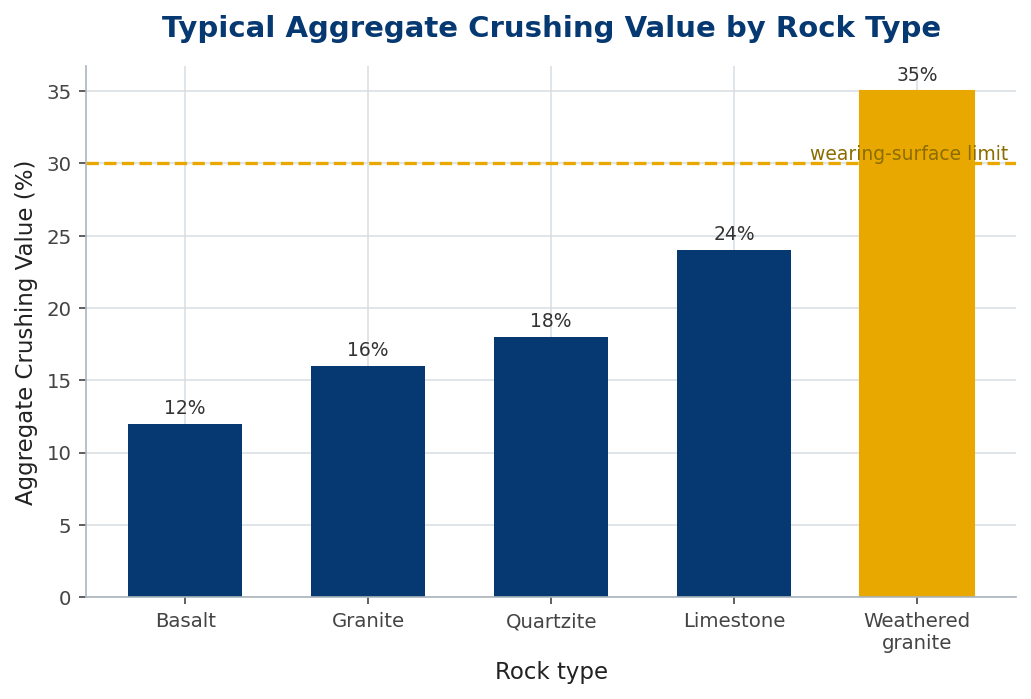
At 14%, this granite is comfortably inside every common limit — suitable even for concrete wearing surfaces.
Limits depend on the job
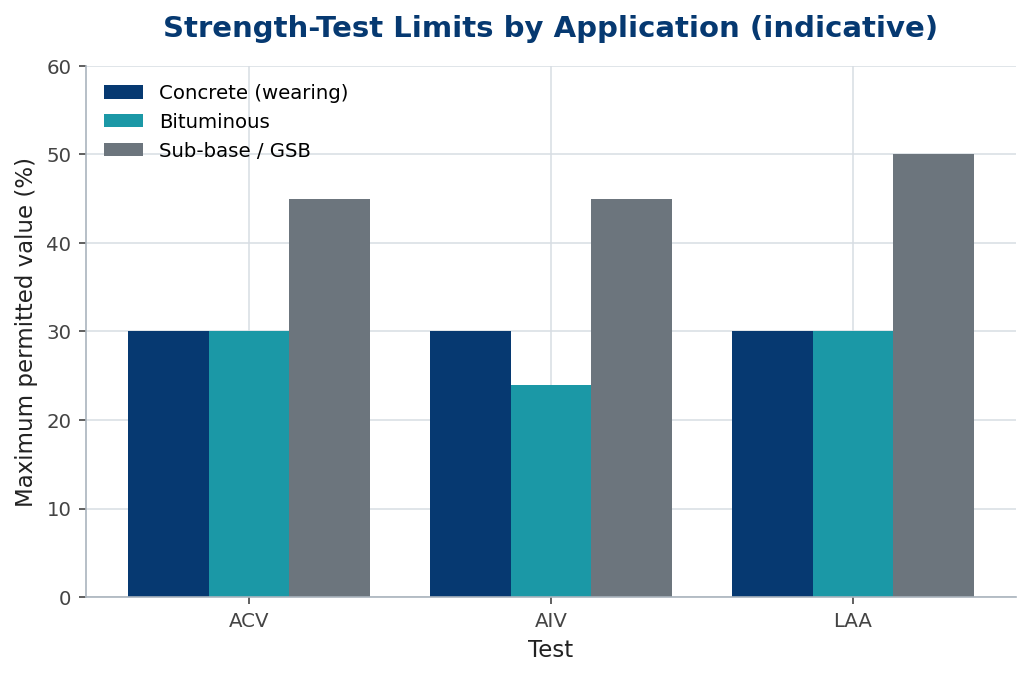
The same aggregate can pass for a sub-base yet fail for a concrete wearing course. Indicative maximum values:
Worked example 2 — LAA on the margin
A road-stone sample,  , retains 3500 g on the 1.7 mm sieve after abrasion, so the loss is 1500 g:

Exactly 30% — acceptable for many bituminous bases but on the limit for a wearing course. A material this close warrants extra samples to confirm it does not drift over.
Reading the tests together
No single test qualifies an aggregate. ACV and AIV gauge resistance to slow load and impact, LAA gauges surface abrasion, and they are read alongside water absorption and soundness, which flag porous or weatherable stone that may pass a strength test yet fail in service. A granite with a 14% ACV but high water absorption, for example, is mechanically strong but should be checked for the durability problems that porosity brings.
Which property governs depends on the duty. For railway ballast and road surfacing, abrasion (LAA) and impact (AIV) lead, because the stone is ground and hammered in service. For structural concrete, crushing strength (ACV) and particle shape matter more. Matching the test you emphasise to the way the aggregate will actually be loaded — not just collecting a full sheet of numbers — is the difference between a lab pass and a field success.
In practice
Strength tests are only as good as the sample. Take increments across the stockpile and the working face, not a single scoop, and reduce them by quartering so the tested fraction truly represents the lot. Because ACV and AIV move together, many producers run the quicker AIV for routine control and reserve the ACV (or LAA for road stone) for type approval and disputes. Above all, trend the numbers: a creeping ACV is an early sign that the quarry has worked into weathered or seamy rock — a warning you get weeks before the customer’s concrete or asphalt does.
Common mistakes
- Wrong sieve. ACV/AIV report passing 2.36 mm; LAA uses retained on 1.7 mm — mixing them corrupts the result.
- Application blind. A ‘pass’ is meaningless without naming the end use and its limit.
- Testing the wrong condition. Samples must be oven-dried and graded to the standard fraction before testing.
Frequently asked questions
Which test should I use?
ACV/AIV for crushing and impact strength (concrete, general use); LAA for abrasion resistance (road surfaces, ballast). The specification dictates which.
Are ACV and AIV the same?
Closely related — both report fines under mechanical action — but measured differently and not substitutable in a spec.
Does aggregate condition matter?
Yes. Tests run on a defined dry, graded fraction; moisture or wrong sizing shifts the value.
The ten per cent fines value: a finer ruler for strength
The aggregate crushing value has a blind spot: on strong, hard aggregates it saturates. Two excellent stones can both return a low ACV that fails to distinguish them, because the test crushes so little material that the result bunches up at the strong end. For exactly these aggregates, the ten per cent fines value (TFV) is the better ruler.
Instead of applying a fixed load and measuring the fines produced, the TFV test finds the load that produces a fixed 10% fines. A stronger aggregate needs a higher load to generate that 10%, so the TFV reports as a force in kilonewtons — the higher the better. Because it reads a load rather than a saturated percentage, it separates strong aggregates that ACV lumps together, and it can be run wet to expose moisture sensitivity.
The two tests are therefore complementary, and the choice follows the stone. For ordinary and weaker aggregates the ACV discriminates well and is quick; for strong, high-quality aggregates — and wherever a spec calls for it — the TFV gives the resolution ACV lacks. A producer qualifying a hard granite or basalt should reach for the TFV; one screening a soft limestone is well served by the ACV.
Read alongside impact (AIV) and abrasion (LAA), the TFV completes a strength picture that no single test gives. Strength is not one number but a small panel — crushing, impact, abrasion, and the ten per cent fines value where the stone is strong enough to need it — and matching the test to the aggregate’s strength range is part of testing it honestly.
The bottom line
ACV, AIV and LAA compress a rock’s mechanical fitness into three percentages, but the skill is in reading them in context: against the right limit for the job, alongside water absorption and soundness, and as a trend rather than a single result. A number without an application is meaningless; a number without a trend is a missed early warning.
Sample honestly, run the test the specification names, and watch the values move. The day your ACV starts creeping is the day to investigate the quarry — long before a customer’s structure does the investigating for you.
Key takeaways
- ACV/AIV and LAA are mass-loss percentages — lower means stronger.
 ; LAA reports the abrasion loss fraction.
- Acceptance limits tighten from sub-base to concrete wearing surfaces.
- Report the exact test the standard names; ACV and AIV are not interchangeable.
