






Dust is a cost and a compliance risk, and the instinct is to throw water at it. But plain water sprays and atomised fog cannons attack dust in fundamentally different ways, with very different water bills and very different effectiveness on the fine fraction that actually matters. Choosing between them is an engineering decision, not a hosepipe one.
This article explains the physics of wetting dust, compares sprays and fog cannons on cost and efficacy, and shows why matching droplet size to dust size is the key to both.
How water captures dust
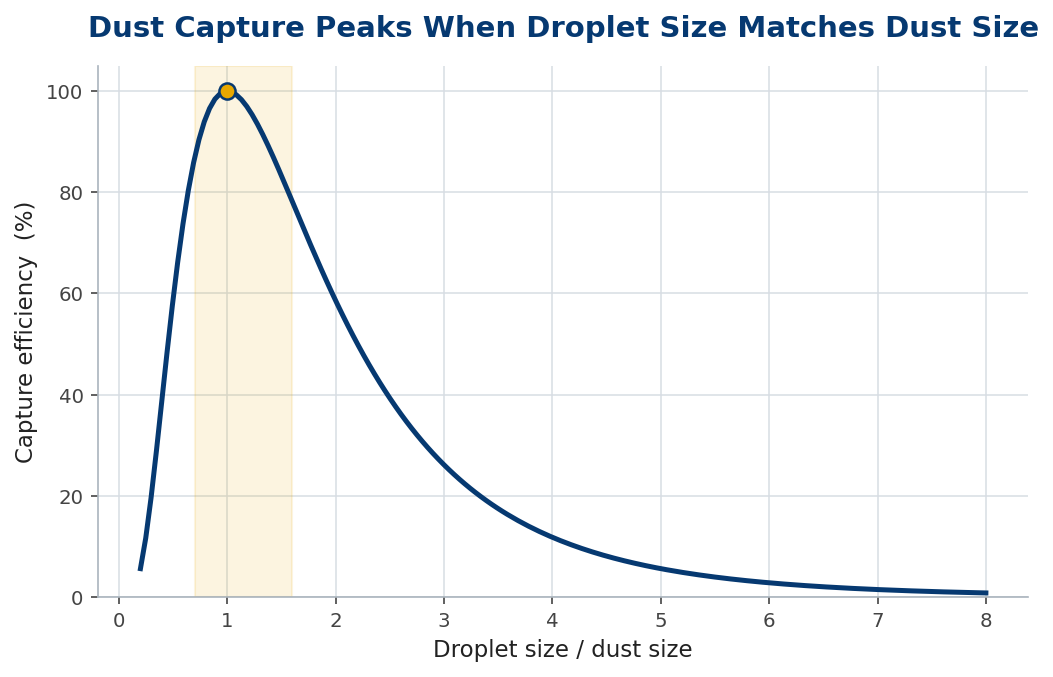
A water droplet captures a dust particle by collision and coalescence — and that works best when the droplet and the particle are of similar size. A large droplet sweeps past a fine particle in its bow wave without touching it; only a droplet close to the dust’s own size collides efficiently. Since respirable dust is a few microns, capturing it needs atomised droplets, which is the whole rationale for fog.
Worked example 1 — why sprays waste water on fine dust
A plain spray nozzle throws droplets of order 1–2 mm. Against a 5 µm respirable particle the size ratio is several hundred to one, far off the capture peak in Figure 1 — so most of the water falls straight to the ground having caught nothing fine. A fog cannon atomising to ~50 µm sits far closer to the dust size and captures the fine fraction with a fraction of the water. The spray wets the stockpile; the fog catches the dust.
Cost and water: the trade-off
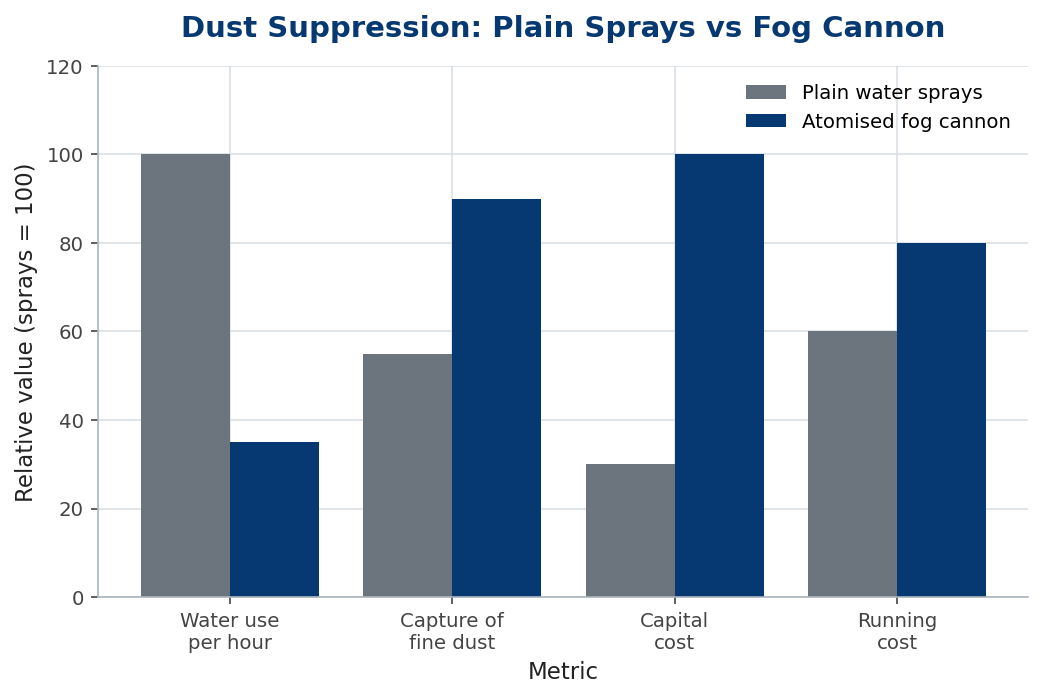
Each method has its place. Plain sprays are cheap to install and run, use a lot of water, and excel at preventing dust by wetting material at transfer points and on stockpiles and roads. Fog cannons cost more in capital and need filtered water and power, but use far less water and are far better at suppressing airborne fine dust over an open area.
Worked example 2 — matching method to the job
A plant has two dust problems: a conveyor transfer chute throwing visible dust, and a fine haze drifting off the screening building. The transfer is best fixed at source with a few cheap sprays wetting the material as it falls — prevention. The drifting haze, already airborne and fine, calls for a fog cannon that atomises to the dust’s size and knocks it down over the open area — suppression. Using the right tool for each, rather than one everywhere, gives the best result for the least water and cost.
| Need | Best tool | Why |
|---|---|---|
| Wet material at transfer | plain sprays | cheap prevention at source |
| Stockpile / road dust | plain sprays / bowsers | broad wetting |
| Airborne fine haze | fog cannon | droplet matches respirable dust |
| Water-scarce site | fog cannon | far lower water use |
In practice
Prevent at source before you suppress in the air — a few sprays wetting material at every transfer remove dust before it becomes a problem, and that is almost always the cheapest win. Reserve fog cannons for the airborne fine fraction and open areas where their droplet-matching pays. Mind the water: in dry regions a fog cannon’s low consumption is a decisive advantage, and adding a wetting agent (surfactant) lets droplets spread and capture more per litre. And do not over-wet the product — suppression water that ends up in the sand becomes a dewatering problem downstream.
Common mistakes
- Coarse sprays for fine dust. Big droplets miss respirable particles; match droplet to dust size with atomisation.
- Fog cannons for everything. Source wetting with cheap sprays prevents dust more economically than suppressing it in the air.
- Ignoring the water balance. Over-wetting adds moisture the product must later lose, and wastes scarce water.
Surfactants, water cost and the balance that ties it together
Plain water has a hidden inefficiency: its surface tension makes it bead up and roll off dusty surfaces and fine particles rather than wetting them. A small dose of surfactant (a wetting agent) breaks that tension, letting each droplet spread and capture far more dust per litre. On a fine, dry, hydrophobic dust the difference is large — surfactant-dosed water can capture what plain water simply slides past, which is why dust-suppression systems increasingly meter a wetting agent into the supply.
The economics of the wetting agent are usually compelling because water itself is rarely free. In a water-scarce region the cost is the tariff or the haulage of every tanker; everywhere, suppression water that ends up in the product becomes moisture the dewatering circuit must later remove. A surfactant that halves the water needed for the same dust capture therefore pays twice — less water bought, and less moisture to drive back out downstream.
That second cost is the one operators forget: the dust-suppression water balance is part of the plant water balance. Over-spray a transfer point and you have not just wasted water, you have added moisture to the sand that the dewatering screen or the dryer must then handle, at an energy cost. The right amount of water, dosed with a wetting agent and aimed precisely, controls the dust with the least water in and the least moisture out.
So design suppression as a metered system, not an open hose: aim sprays at the dust-generating point, dose a wetting agent to multiply each litre’s reach, and account for the water you add in the plant’s overall moisture budget. The cheapest, cleanest dust control is the one that uses the least water to do the job — which is exactly the one that does not come back to haunt the dewatering circuit.
The bottom line
Water captures dust best when droplet and particle are similar in size, so coarse sprays prevent dust by wetting material while atomised fog suppresses the airborne fine fraction. Sprays are cheap and water-hungry; fog cannons cost more and sip water.
Prevent at source with sprays, suppress airborne fines with fog, add a wetting agent, and watch the water balance — the right tool for each dust source controls the plant for the least water and cost.
Frequently asked questions
Why don't water sprays catch fine dust well?
Their droplets (1–2 mm) are hundreds of times larger than respirable dust, so they sweep past fine particles without colliding. Capture needs droplets near the dust size.
When is a fog cannon worth it?
For airborne fine dust over open areas, and on water-scarce sites — it atomises to the dust size and uses far less water than sprays.
Should I prevent or suppress dust?
Prevent first: wet material at transfer points with cheap sprays. Use fog cannons to suppress the fine haze that still escapes.
Key takeaways
- Dust capture peaks when droplet size matches dust size — fine dust needs atomised fog.
- Plain sprays: cheap, water-hungry, good for source wetting and prevention.
- Fog cannons: higher capital, low water, best for airborne fine suppression.
- Prevent at source first, suppress airborne fines second, and watch the water balance.
