





V-belt drives are everywhere on a plant — on crushers, screens, pumps and fans — and they fail more often from how they are tensioned than from any defect in the belt. Too loose and they slip, burn and waste power; too tight and they wreck bearings and themselves. The service life of a V-belt is decided at installation, by a number most plants never measure.
This article explains why belt tension sits in a narrow window, what slip costs in power and life, and the few disciplines — tension, alignment, sheave condition — that make a V-belt drive last.
Why tension lives in a window
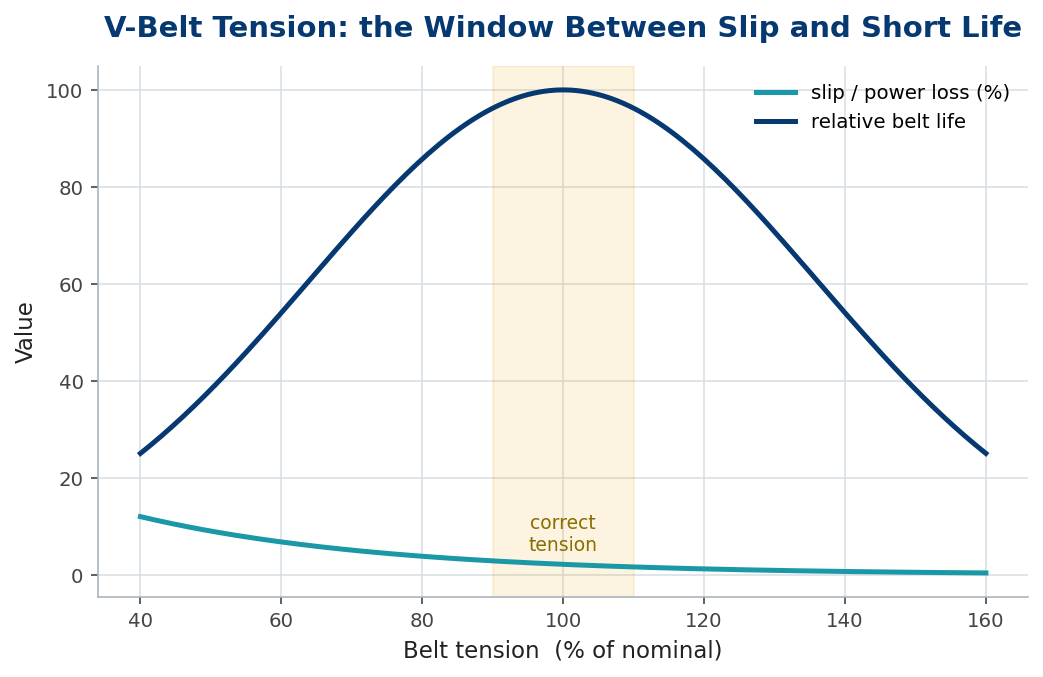
A V-belt transmits power by friction in the sheave grooves, and that needs grip. Too little tension and the belt slips: it cannot carry the load, it overheats, and it glazes and burns. Too much tension and the belt, the shafts and the bearings all carry needless load — the belt fatigues and the bearings fail early. Correct tension is the narrow band that grips without overloading.
Worked example 1 — the cost of slip
A slipping belt is not just a reliability problem; it wastes power and tonnage every hour. A 5% slip on a 75 kW crusher drive means roughly 5% of the input — about 3.75 kW — is lost as heat in the belt rather than crushing rock, and the driven speed (and so the throughput) drops with it. Over a year that lost energy alone is  , before the cost of the belt it burns out and the production it quietly steals. A five-minute tension check pays for itself many times over.
It is not just tension
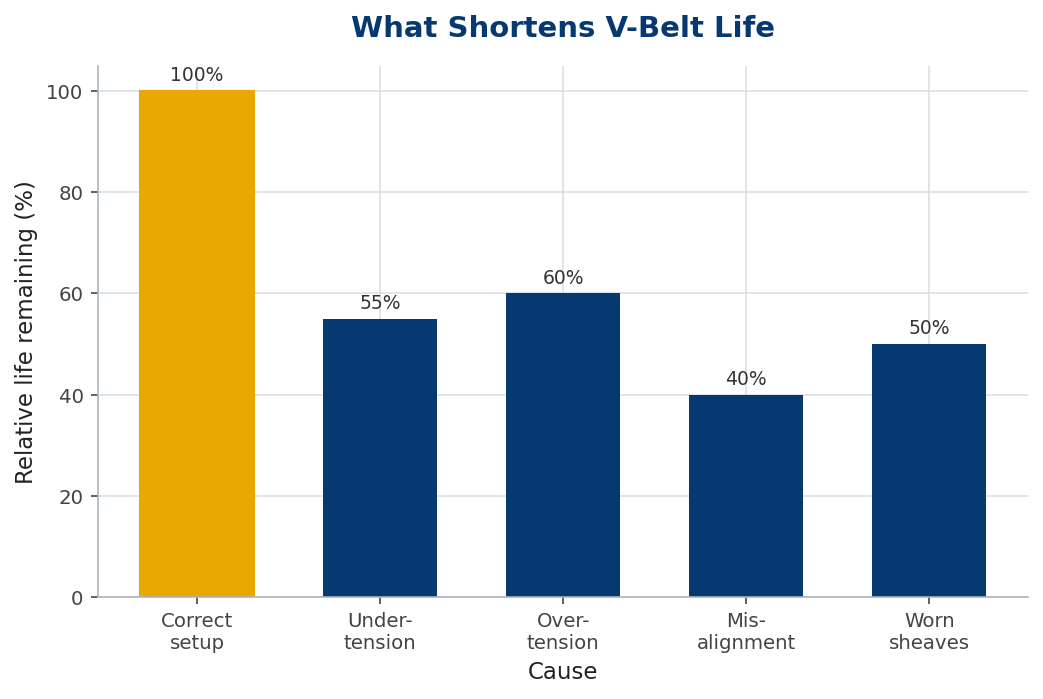
Tension is the headline, but three companions decide belt life with it. Alignment: misaligned sheaves drag the belt sideways in the groove, wearing it fast and unevenly. Sheave condition: worn grooves let the belt ride low and slip, so a belt on worn sheaves never grips however tight. And matched sets: on a multi-belt drive, mixing old and new (or different) belts means the tight ones carry the load and fail in turn.
Worked example 2 — why worn sheaves defeat tension
An operator keeps re-tensioning a drive that still slips, and keeps burning belts. The cause is not the tension but the sheaves: their grooves are worn so the belt bottoms out and rides on the base of the groove instead of wedging on the side walls, where the grip comes from. No tension fixes that — the belt simply cannot generate friction. A groove gauge would have shown the wear in seconds; the fix is new sheaves, after which normal tension grips perfectly. Chasing tension on worn sheaves is a classic, expensive loop.
| Fault | Symptom | Fix |
|---|---|---|
| Under-tension | slip, squeal, glazing, heat | tension to spec |
| Over-tension | bearing failure, belt fatigue | tension to spec |
| Misalignment | uneven side wear, flip-over | align sheaves |
| Worn sheaves | slip despite tension | replace sheaves, gauge grooves |
| Mixed belt set | uneven load, serial failure | fit a matched set |
In practice
Tension to the manufacturer’s spec with a proper tension gauge — not by thumb — and re-check after the run-in hours, when new belts seat and relax. Align the sheaves with a straightedge or laser so the belt runs straight in the groove. Gauge the sheave grooves periodically and replace worn sheaves rather than fighting slip with ever-more tension. Always fit a matched belt set, and keep the belts clean and dry — oil and dust destroy the friction the whole drive depends on.
Common mistakes
- Tensioning by feel. Use a tension gauge to the spec, and re-check after run-in — thumb pressure is guesswork.
- Chasing slip with tension on worn sheaves. Gauge the grooves; worn sheaves never grip, however tight.
- Mixing belts. Replace the whole set matched; mismatched belts share load unevenly and fail in series.
Belt construction, energy efficiency and the static hazard
Not all V-belts are equal, and the construction matters more than most buyers realise. A plain wrapped belt flexes against the sheave with internal friction that is quietly wasted as heat; a cogged (notched) raw-edge belt flexes more freely, runs cooler and transmits power a few percent more efficiently, while a wedge profile grips harder for its width. On a continuously running plant drive, a few percent efficiency across thousands of hours is real money in electricity.
That energy angle is the underrated case for belt upgrades. Replacing tired wrapped belts with cogged raw-edge or synchronous types, on the same sheaves, can shave measurable kilowatts off a large drive simply by wasting less in belt flex and slip — an upgrade that pays back in energy alone, before counting the longer life. Where a fixed-speed drive runs partly loaded, this efficiency gap widens further.
One safety property is easy to overlook: V-belts must be electrically conductive (anti-static) on any drive where dust is present, which is to say everywhere in a crushing plant. A non-conductive belt can accumulate a static charge and discharge as a spark — an ignition source in a dusty, and potentially explosive, atmosphere. Reputable industrial belts are made anti-static for exactly this reason; fitting a cheap non-conductive belt to save a little is a false economy with a genuine hazard attached.
So choose the belt as deliberately as you tension it: a cogged or wedge construction for efficiency and cool running on a hard-worked drive, an anti-static rating as non-negotiable in a dusty plant, and always a matched set. The right belt, correctly tensioned on true sheaves, is cheaper to run as well as longer-lived — the construction decision compounds with the maintenance discipline.
The bottom line
A V-belt’s life is set at installation: tension into the narrow window that grips without overloading, align the sheaves, keep the grooves true, and fit a matched set. Slip wastes power and tonnage; over-tension wrecks bearings.
Tension to spec with a gauge, re-check after run-in, gauge the sheaves, and keep the belts clean — and a humble V-belt drive runs for its full life instead of being a recurring, power-wasting headache.
Frequently asked questions
What happens if a V-belt is too loose?
It slips, wasting power as heat, dropping driven speed and throughput, and glazing and burning the belt. A few percent slip costs real energy and production.
Can over-tensioning damage the drive?
Yes — excess tension overloads the shafts and bearings, causing early bearing failure and belt fatigue. Tension to the spec, not tighter.
Why does my belt slip even when tight?
Usually worn sheave grooves: the belt bottoms out instead of wedging on the side walls. Gauge the grooves and replace worn sheaves.
Key takeaways
- Belt life is set at installation — tension to spec with a gauge, not by feel.
- Slip wastes power and throughput; over-tension destroys bearings.
- Worn sheaves never grip however tight — gauge the grooves and replace them.
- Align the sheaves and fit a matched belt set; keep belts clean and dry.
