
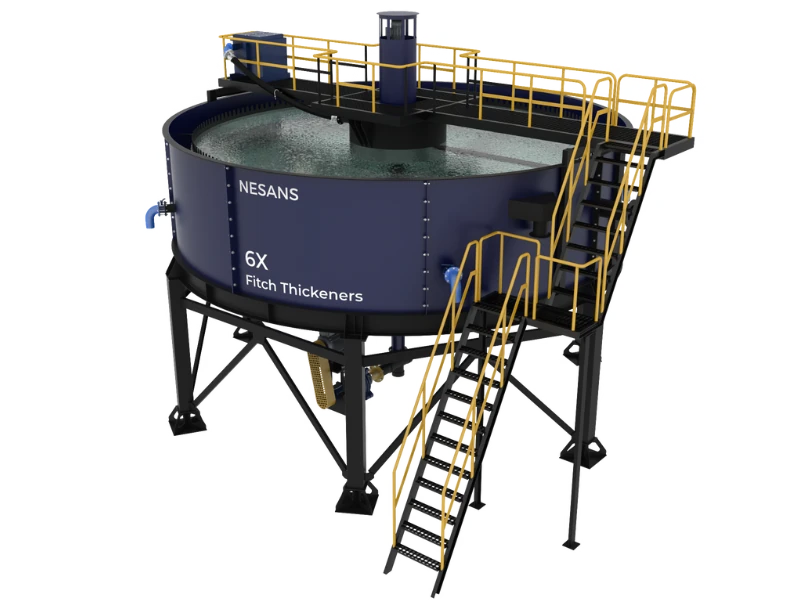






A washing plant’s water bill and its compliance both rest on one quiet machine: the thickener that settles the silt out of the dirty water so it can be reused. Size it too small and the overflow runs cloudy and the plant is starved of clean water; size it too large and you have buried capital in a tank. The right size comes not from a rule of thumb but from a settling test.
This article explains the settling-flux principle behind thickener sizing, shows how a simple jar test feeds it, and works through sizing the thickener area from the limiting flux.
The settling-flux idea
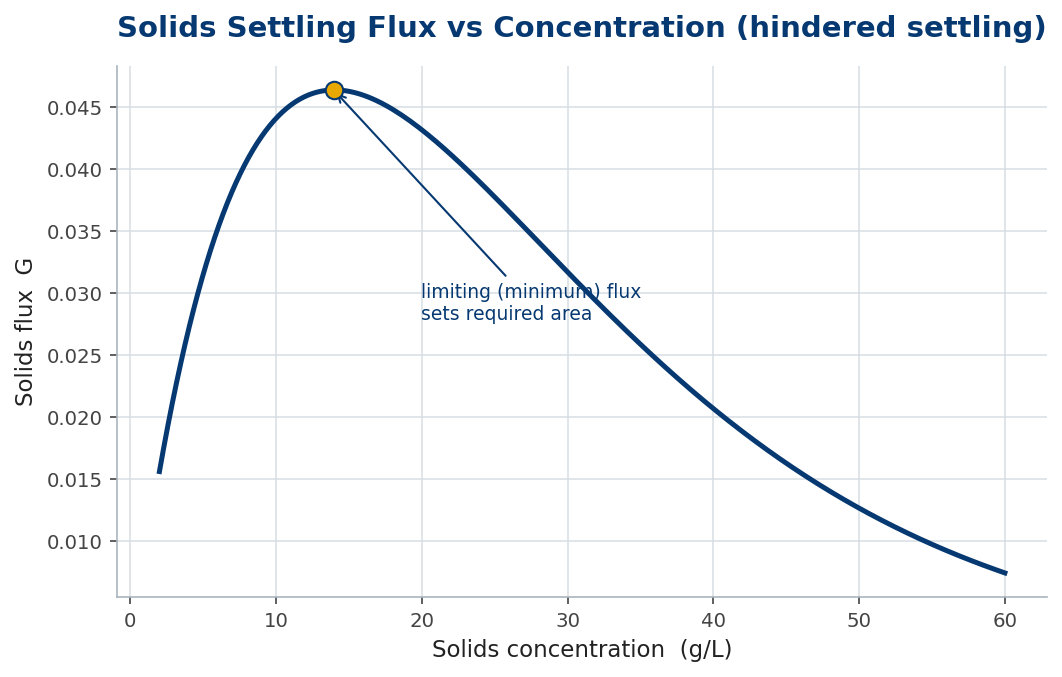
A thickener must pass solids downward (to the underflow) at least as fast as they arrive. The rate at which solids settle through a unit area — the solids flux — is the concentration times the settling velocity at that concentration:

Here is the catch: as the slurry thickens, the particles hinder each other and the settling velocity  falls. So the flux rises with concentration at first, then falls — and the minimum (limiting) flux somewhere in between is the bottleneck that sets the required area.
The jar test that feeds it
The data come from a cheap, classic experiment: pour the slurry into a measuring cylinder and time the interface as it settles. The slope of the interface-height curve gives the settling velocity at each concentration, and repeating at a few dilutions traces out the flux curve. This jar test — a cylinder, a stopwatch and a ruler — is the foundation of a sound thickener design, and skipping it is why so many thickeners are guessed wrong.
Worked example 1 — area from the limiting flux
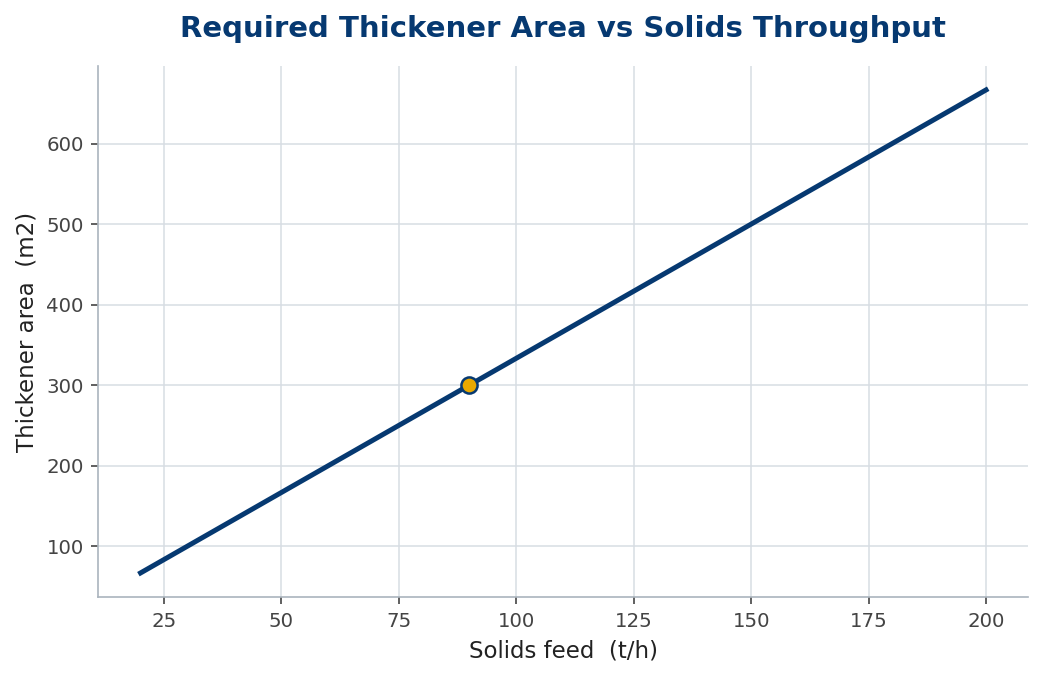
A wash plant must settle 90 t/h of dry solids, and the jar test gives a limiting unit flux of 0.30 t/m²·h. The required settling area is

That sets the thickener diameter at  . Add a design margin and round to the next standard size. The whole sizing flows from one limiting number that only a settling test can give.
Worked example 2 — the flocculant that shrinks the tank
That 300 m² assumes raw settling. Adding a flocculant — a polymer that bridges fine particles into fast-settling flocs — can multiply the settling velocity several-fold, raising the limiting flux to, say, 0.9 t/m²·h and cutting the required area to  . A third of the tank, for the cost of a dosing pump and polymer. This is why modern high-rate thickeners are small: chemistry does what area used to. The settling test must therefore be run with the intended flocculant to size the real machine.
| Lever | Effect on sizing | Note |
|---|---|---|
| Limiting flux (from test) | sets the area | the governing number |
| Solids load | area scales linearly | recover fines upstream to cut it |
| Flocculant | raises flux, shrinks tank | test with it, not without |
| Underflow density | sets rake / pump duty | deeper bed = denser underflow |
In practice
Always size from a settling test on the actual slurry, run with the flocculant you intend to use — a thickener sized from a textbook flux or without polymer will be wrong, usually badly. Reduce the solids load before you size the tank: every tonne of fines recovered upstream (in a cyclone) is area you do not have to build. And design the underflow end as carefully as the overflow — the rake torque and underflow pump must move the thickened mud the test predicts, or the thickener silts up and fails however large its area.
Common mistakes
- Sizing without a settling test. The limiting flux is material-specific; a rule of thumb gets it wrong.
- Testing without flocculant. Polymer multiplies the flux; size with the chemistry you will actually run.
- Forgetting the underflow. Rake and pump must move the thickened mud, or the tank silts up regardless of area.
The underflow end: rake torque, rheology and high-rate designs
Settling area gets a thickener the clear water; the underflow end gets it the thickened mud, and it is the half that more often fails. The raking mechanism must drag the settled solids inward to the central discharge against the resistance of an increasingly stiff, sometimes thixotropic, bed. As the bed thickens for a denser underflow, that resistance — and the rake torque required — rises steeply, and an under-torqued rake will stall and bury itself, taking the thickener out of service.
The mud’s rheology is therefore as important as the settling flux. A denser underflow is desirable — less water to pump, less to clarify — but past a point the bed becomes too viscous to rake or to pump, and the underflow ‘sets’. The design has to balance underflow density against rake torque and pump capability, which means characterising the thickened slurry’s yield stress, not just its settling velocity. A settling test sizes the area; a rheology test sizes the rake and the pump.
High-rate and paste thickeners push this balance with engineering. By dosing flocculant into a feedwell that grows large, fast-settling flocs, they achieve high fluxes in a far smaller footprint, and by managing the bed and rake for high torque they pull a much denser underflow — up to a paste that can be stacked or backfilled with minimal water. The small tank is bought with sophisticated flocculation, feedwell design and a heavy-duty rake drive.
So size a thickener as a whole machine: the settling test for the area, the flocculant for the flux, and the rheology for the rake torque and underflow pump. A thickener correctly sized for area but under-built at the underflow end will clarify beautifully right up until the day its rake stalls in mud it was never designed to move.
The bottom line
A thickener is sized on its limiting solids flux,  , and that flux comes from a settling test — run with the intended flocculant. Area scales with solids load, so recovering fines upstream and dosing polymer both shrink the tank.
Do the jar test on the real slurry with real chemistry, cut the solids load first, and design the underflow to move the mud — and the thickener delivers clean recycle water at the smallest honest size.
Frequently asked questions
How do I size a thickener?
Divide the solids throughput by the limiting (minimum) solids flux from a settling test: area = solids load / limiting flux. The flux must come from a test on the real slurry.
What is the limiting flux?
The minimum of the solids-flux-versus-concentration curve — the bottleneck concentration where settling is slowest relative to load. It governs the required area.
Why test with flocculant?
Flocculant multiplies the settling velocity and limiting flux, shrinking the tank several-fold. Sizing without it overstates the area massively.
Key takeaways
- Thickener area = solids load / limiting flux: .
- The limiting flux comes from a jar settling test on the actual slurry.
- Flocculant multiplies the flux and shrinks the tank — test with it.
- Cut solids load upstream and design the underflow to move the thickened mud.
