








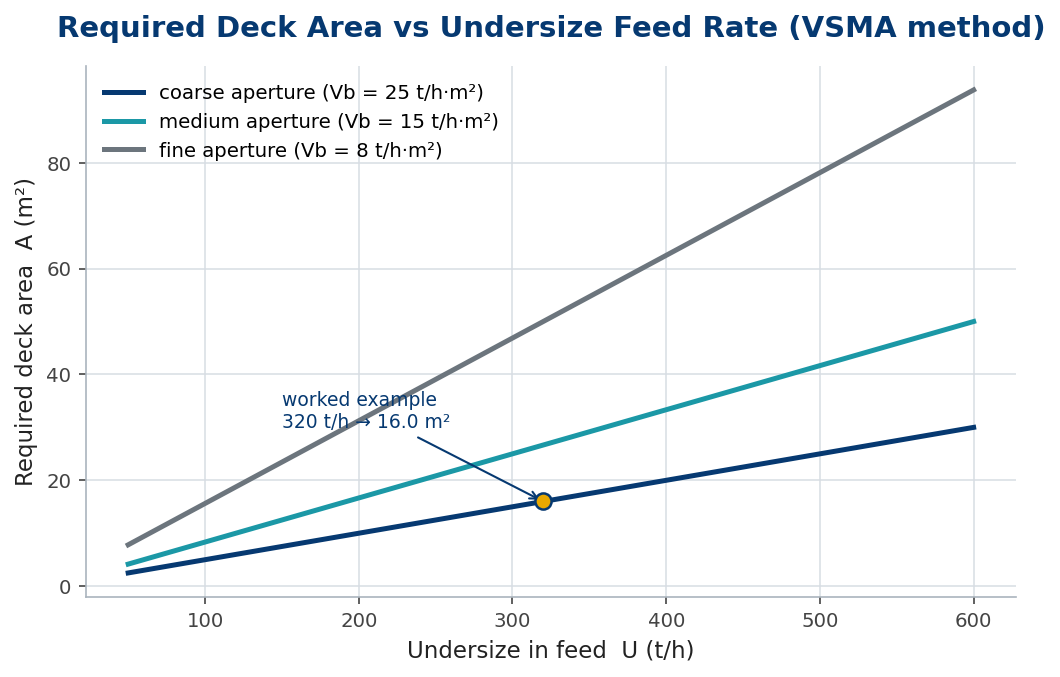
Specify a vibrating screen too small and you lose product to carryover and overload the deck; too large and you waste capital and starve the bed of the depth it needs to stratify. The VSMA (Vibrating Screen Manufacturers Association) area method sizes a deck to its actual duty instead of to a catalogue guess. This article walks the method end to end, works two examples (a dry top deck and a wet fine deck), and shows with two charts how sharply the answer moves with operating conditions.
The core relationship
The required deck area is the undersize you must pass divided by how much each square metre can handle under your specific conditions:

| Symbol | Meaning | Units |
|---|---|---|
 | Required deck area | m |
 | Undersize in the feed that must pass this deck | t/h |
 | Basic capacity for the aperture (from the VSMA/OEM chart) | t/h·m |
 | Product of correction factors (see below) | – |
The whole craft of screen sizing lives in two numbers: the basic capacity and the combined correction factor . Get those right and the arithmetic is trivial; get them wrong and no amount of vibration will save the deck.
Basic capacity
Basic capacity is the throughput one square metre of deck can pass at the aperture in question under reference conditions (free-flowing, dry, ~1.6 t/m , top deck, moderate near-size). It rises with aperture. Representative values — always confirm against your VSMA or manufacturer chart:
| Square aperture | Representative Vb (t/h·m²) |
|---|---|
| 5 mm | 9 |
| 10 mm | 16 |
| 20 mm | 25 |
| 40 mm | 38 |
Correction factors
Reference conditions rarely match reality, so is corrected by a chain of multipliers,  Each factor pulls the capacity up or down:
| Factor | Accounts for | Typical range | Direction |
|---|---|---|---|
 | % oversize in feed | 0.8 – 1.2 | >1 if little oversize |
 | % smaller than half the aperture | 0.7 – 1.8 | >1 with many fines |
 | Deck position (top / 2nd / 3rd) | 0.8 – 1.0 | <1 on lower decks |
 | Wet screening / spray bars | 1.0 – 1.4 | >1 when washing |
 | Bulk density vs 1.6 t/m | scales | ∝ density |
, a combined  increases the required area. Fines, lower decks and difficult material all cost you deck; washing and abundant half-size material can buy some back.
Worked example 1 — a dry top deck
A secondary screen receives 500 t/h onto a 20 mm top deck. A sieve check shows 64% of the feed is finer than 20 mm, so the undersize the deck must pass is

From the table,  for a 20 mm aperture. The feed is dry, on the top deck, density near 1.6 t/m, with a moderate fines content — the factors net to
  . Then

A deck of roughly 2.4 m × 7.0 m (16.8 m) satisfies the duty with a little margin.
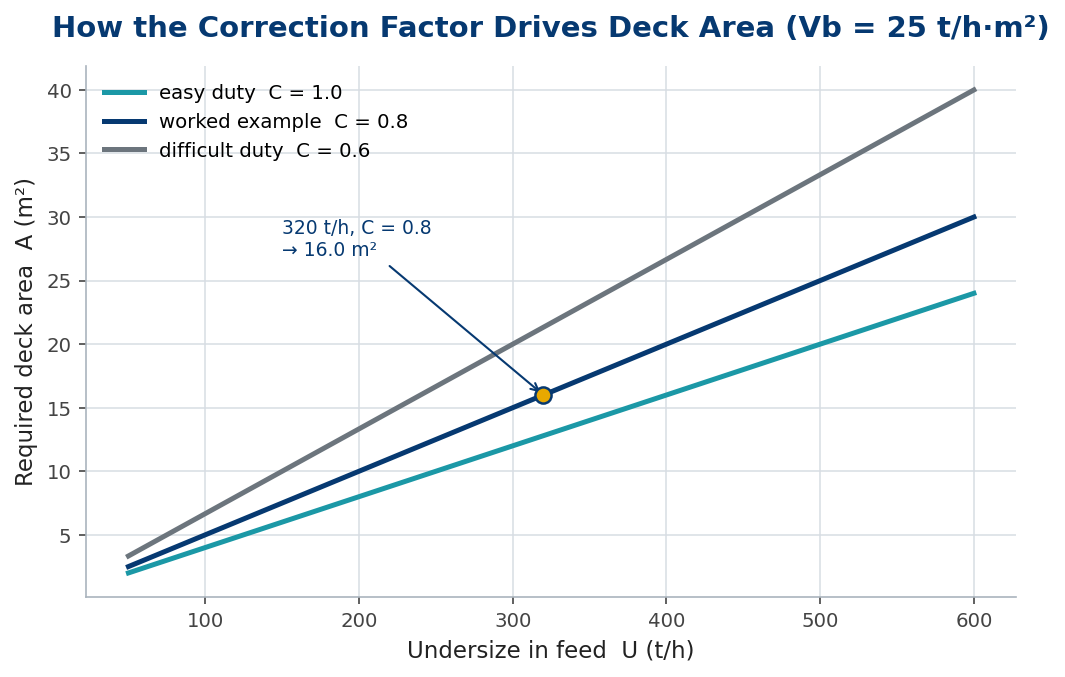
Why the correction factor matters as much as the aperture
Operators often treat as a fudge factor. It is not — it can move the required area by 70% at a fixed aperture and feed rate. Figure 2 holds  and varies only : the same 320 t/h needs 12.8 m on an easy duty (
 ) but 21.3 m on a difficult one (
 ).
).
Worked example 2 — a wet fine deck
Now size a 5 mm bottom wash deck passing 150 t/h of undersize, with spray bars. Basic capacity  . The factors: bottom deck
  , wet screening
  , abundant half-size material
  , density near reference
  . Combined
  :
:

Here the wet factor (washing helps fine material pass) more than offsets the lower-deck penalty — a deck you might have over-sized had you ignored  .
.
Always finish with a bed-depth check
Area sizing assumes the bed can stratify. If the discharge-end bed is too deep, near-size particles never reach the cloth and efficiency collapses no matter how generous the area — which, as the companion article on circulating load shows, then balloons the recycle. As a field rule, keep the discharge-end bed depth below about four times the aperture for dry crushed stone (and nearer 2.5–3× for fine or dewatering decks). If it is deeper, widen the screen to add capacity and thin the bed; lengthen it to add residence time and efficiency.
The factors behind the correction factor
The single combined correction factor is really a product of several individual factors, each capturing one way the real duty departs from the ideal laboratory basis. Multiplying them together is what turns a textbook basic capacity into a number you can size a deck on — and reading them individually is what lets you diagnose why a particular deck needs so much area.
The main factors are these. The oversize factor rises as the feed carries more material coarser than the aperture, because oversize merely conveys across and does not screen. The half-size factor rewards a feed rich in particles below half the aperture — those fall through almost instantly, so a feed full of them screens easily. The deck-location factor credits lower decks, which receive feed already relieved of its coarse fraction by the decks above.
Three more capture the physical screen and the conditions. The wet-screening factor boosts capacity where water sprays wash near-size particles through on a fine cut. The open-area factor adjusts for the actual open area, set by the aperture relative to the wire (or panel) thickness — a heavier wire steals open area and capacity. And factors for deck slope and bulk density correct for inclination and for how heavy the material is. A deck can be penalised on several at once: little half-size, much near-size and a heavy wire compound into a large required area.
The practical discipline is to compute each factor explicitly rather than reaching for a single guessed number. Writing them out shows which condition is driving the size — often the half-size and near-size content rather than the tonnage — and where a change (washing the cut, choosing a thinner wire, re-ordering the decks) would recover capacity. The combined factor is an answer; the individual factors are the explanation, and the explanation is what lets you improve the duty instead of merely sizing for it.
Frequently asked questions
Do I size on total feed or undersize?
Always on the undersize that must pass the deck, . The oversize influences the correction factor but is not the tonnage being screened through.
More width or more length?
Width adds capacity and thins the bed (fixes overload); length adds residence time and efficiency (fixes carryover). Diagnose which problem you have before choosing.
How much margin should I add?
Typically 10–20% on area, plus headroom on selection. Circuits with variable feed or sticky fines warrant the upper end.
Key takeaways
- Size the deck to the undersize it must pass:
 .
. - Basic capacity comes from the aperture; the correction factor captures everything reality throws at it.
- Because factors multiply , alone can swing the required deck area by 70% — never treat it as a fudge.
- Washing (
 ) can offset lower-deck penalties on fine decks.
 - Area is necessary but not sufficient — always validate with a discharge-end bed-depth check.
