






The cloth on a screen deck decides everything the screen does: how much it passes, how cleanly it cuts, how often it blinds and how long it lasts. Choosing media is a set of trade-offs — open area against wear life, capacity against blinding resistance — and the arithmetic of open area makes those trade-offs concrete.
This article computes open area from aperture and wire, weighs the main media families against blinding and wear, and shows how near-size material drives the blinding that media choice must defend against.
Open area — the capacity number
Open area is the fraction of the deck that is actually a hole, and it sets how much a screen can pass. For square woven wire it follows directly from the aperture and the wire diameter:

where  is the aperture and
  the wire diameter. The thicker the wire — for wear life — the less open area, and the less the deck passes.
| Symbol | Meaning | Units |
|---|---|---|
| a | Aperture (clear opening) | mm |
| d | Wire diameter | mm |
| OA | Open area | % |
Worked example 1
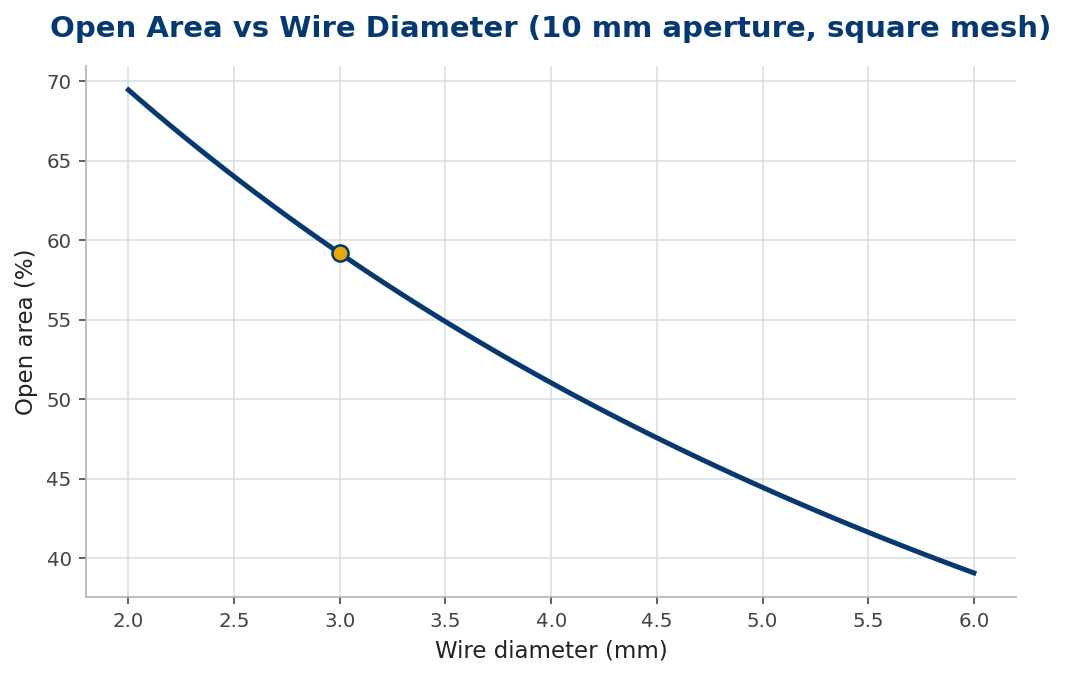
A 10 mm square aperture in 3 mm wire:

Step up to 4 mm wire for a longer wear life and open area falls to  — an eight-point loss of capacity bought with wire. Figure 1 shows the full trade-off.
The media families
Beyond wire, the choice of material trades open area for life and for blinding resistance. Woven wire gives the most open area; polyurethane and rubber last far longer and resist blinding through flex, at the cost of open area; self-cleaning (piano-wire or wave) decks fight blinding mechanically.
| Media | Open area | Wear life | Blinding resistance |
|---|---|---|---|
| Woven wire | highest | lowest | low |
| Polyurethane | lower | high | high (flexes) |
| Rubber | lower | high | high (flexes) |
| Self-cleaning wire | high | medium | high (mechanical) |
Blinding and near-size material
Blinding — near-size particles lodging in the apertures — is the enemy that media choice defends against, and its driver is the amount of near-size material in the feed. The more particles close to the aperture size, the worse the blinding, and the stronger the case for flexible or self-cleaning media over plain wire.
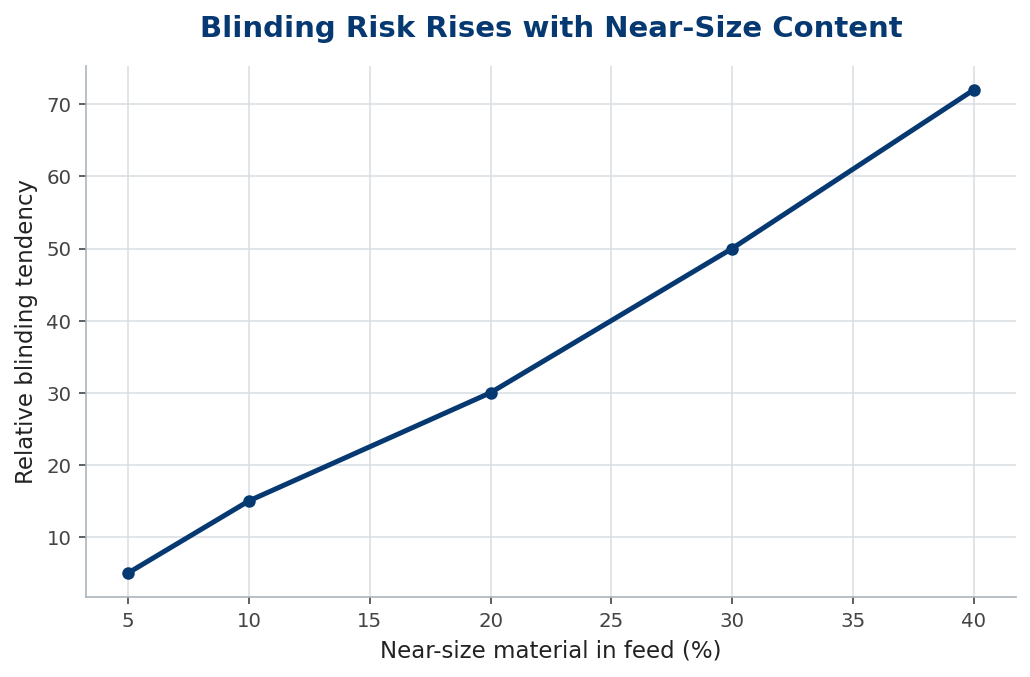
Worked example 2 — choosing for a sticky fine cut
A 4 mm cut on damp, near-size sand blinds woven wire within hours. Polyurethane panels at the same 4 mm aperture give perhaps two-thirds the open area — so you may need slightly more deck area — but they flex enough to shed the blinding and last many times longer. The right comparison is not open area alone but effective throughput over a media campaign: a wire deck at 59% open area that blinds to 30% effective is worse than a PU deck at 40% open area that stays open.
In practice
Match the media to the cut and the feed, not to habit. Coarse, dry, abrasive scalping rewards rubber or thick wire for wear; fine, damp or near-size cuts reward polyurethane or self-cleaning decks for blinding resistance; clean, easy sizing can use open woven wire for maximum capacity. Tension woven wire correctly — a loose cloth blinds and fails fast — and check aperture shape: slotted and rectangular openings pass more and blind less than square ones for many duties. Track effective throughput, not just hours, to know when a media change is really paying.
Common mistakes
- Choosing on open area alone. A high-open-area cloth that blinds beats nothing; compare effective throughput over a campaign.
- Plain wire on near-size, damp cuts. It blinds fast; use flexible or self-cleaning media.
- Loose tensioning. Under-tensioned woven wire blinds and fatigues early.
Aperture shape and how the media is mounted
Open area and media family set the broad behaviour, but two finer choices — the shape of the aperture and how the panel is mounted — decide capacity and blinding resistance at the cut. The aperture shape changes the effective opening a particle sees: square apertures give a precise, predictable cut; slotted (elongated) apertures pass far more near-size and flaky material per unit area, lifting capacity and resisting blinding, at the cost of a less precise cut and some elongated particles slipping through end-on.
Round apertures sit at the other extreme — the most precise and blind-resistant for a given size but the lowest open area, reserved for duties where a sharp cut matters more than tonnage. So the aperture shape is itself a lever: slotted for capacity and anti-blinding on near-size feed, square for a balanced cut, round for precision. Matching the shape to the feed and the required sharpness is a real design decision, not a default.
Mounting matters just as much. Tensioned media — woven wire or thin panels hooked and tensioned across the deck — offers the highest open area and is cheap to replace, but tension must be maintained or the panel flaps, wears and blinds. Modular media — polyurethane or rubber panels bolted or clipped to a sub-frame — gives up some open area for far longer life, easy part-panel replacement, and the aperture-flex that sheds near-size particles.
So specify the media as shape and mounting and material together: a slotted polyurethane modular panel for a sticky, near-size, abrasive fine cut; tensioned wire with square apertures for a clean, high-open-area coarse cut. The blinding problem is solved less by any single property than by matching all three to the material the screen actually has to handle.
The bottom line
Open area,  , sets a screen’s capacity, and every media choice trades it against wear life and blinding resistance. Near-size, damp feeds drive blinding and push you from plain wire toward polyurethane or self-cleaning decks.
Choose for the cut and the feed, compare on effective throughput over a media campaign rather than catalogue open area, and tension the cloth properly — and the deck delivers both capacity and a sensible life.
Frequently asked questions
How do I calculate open area?
For square woven wire,  , with the aperture and the wire diameter. Thicker wire lowers it.
When should I move off woven wire?
When the feed is near-size and damp (blinding) or when wire life is uneconomically short. Polyurethane and self-cleaning decks then win on effective throughput.
Why does aperture shape matter?
Slotted and rectangular openings generally pass more and blind less than square ones, useful for elongated or near-size material.
Key takeaways
- sets screen capacity; thicker wire lowers it.
- Media choice trades open area against wear life and blinding resistance.
- Near-size, damp feeds drive blinding — use polyurethane or self-cleaning media.
- Compare media on effective throughput over a campaign, not catalogue open area.
