






Manufactured sand carries far more fines than natural sand, and that worries concrete engineers — but the fear is misplaced. The problem is not the quantity of fines; it is whether those fines are inert stone dust or active clay. The methylene blue value (MBV) is the quick, cheap test that tells the two apart, and it has quietly become one of the most important quality checks for M-sand.
This article explains what MBV measures, why active clay — not stone dust — is the enemy, and how to read the test to accept good M-sand that a crude fines limit would wrongly reject.
Fines are not all the same
The minus-75 µm fraction in M-sand can be two very different things. Stone dust — the rock ground fine — is inert; in moderation it fills voids and improves the mix. Active clay — swelling clay minerals like montmorillonite — is harmful: it coats particles, absorbs water and admixture, and weakens the concrete. A simple percentage-passing limit cannot tell them apart; MBV can.
How the test works
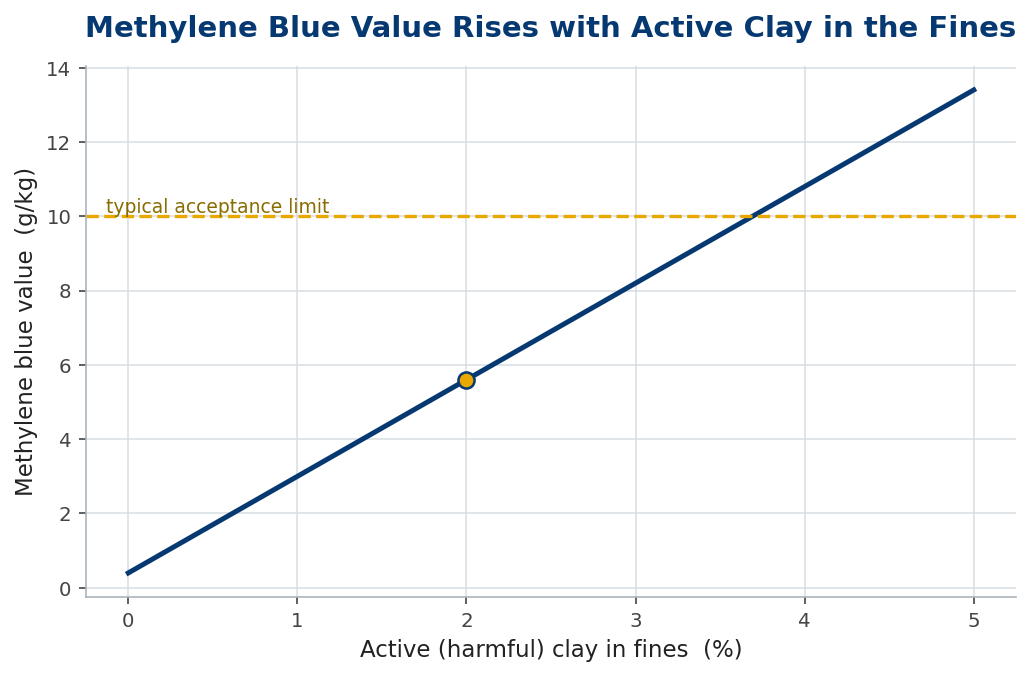
Methylene blue dye is adsorbed onto the surface of active clay minerals, which have a huge, charged surface area; inert stone dust adsorbs almost none. Titrating a slurry of the fines with dye until the clay is saturated gives the MBV in grams of dye per kilogram of fines. A high MBV means a lot of active clay surface; a low MBV means the fines are mostly harmless dust.
Worked example 1 — same fines, different verdict
Two M-sands both carry 12% passing 75 µm — identical on a crude fines limit. Sand A returns MBV 3 g/kg; Sand B returns MBV 16 g/kg. Sand A’s fines are inert stone dust and the sand is excellent; Sand B’s fines are active clay and the sand will rob water and strength. A fines-percentage limit would pass or fail both together; MBV correctly accepts A and rejects B. This is why the test matters.
Why active clay hurts concrete
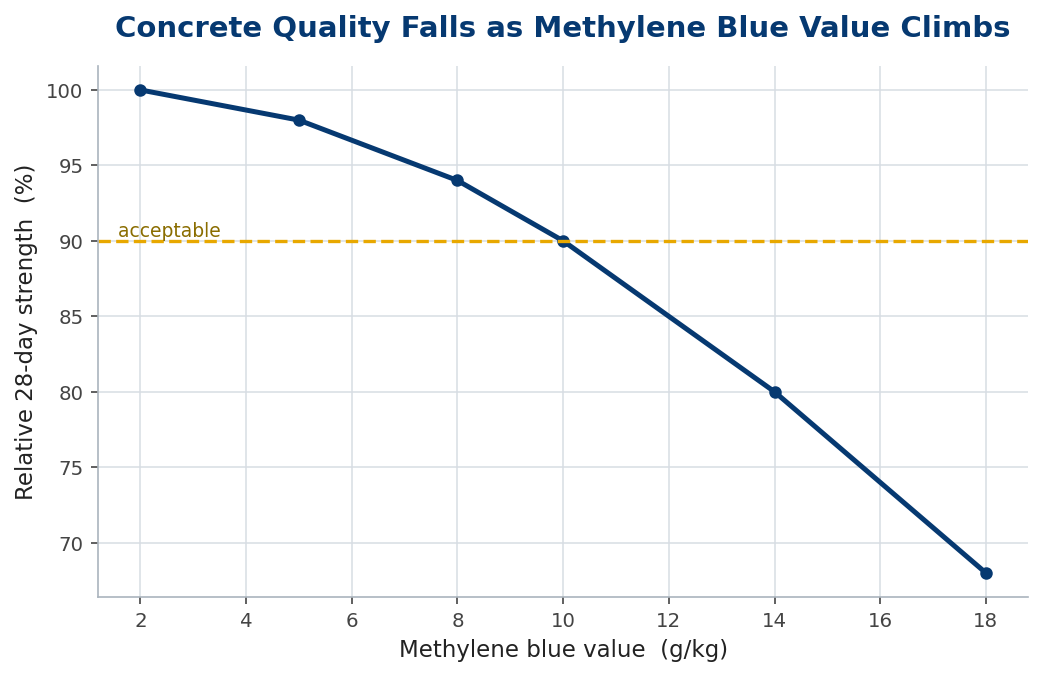
Active clay’s enormous surface adsorbs mixing water and chemical admixture, so the concrete needs more of both for the same workability — raising the water-cement ratio and cutting strength and durability. It also makes the mix sticky and slump loss rapid. The damage scales with MBV, which is why specifications cap it rather than capping total fines.
Worked example 2 — fixing a high MBV
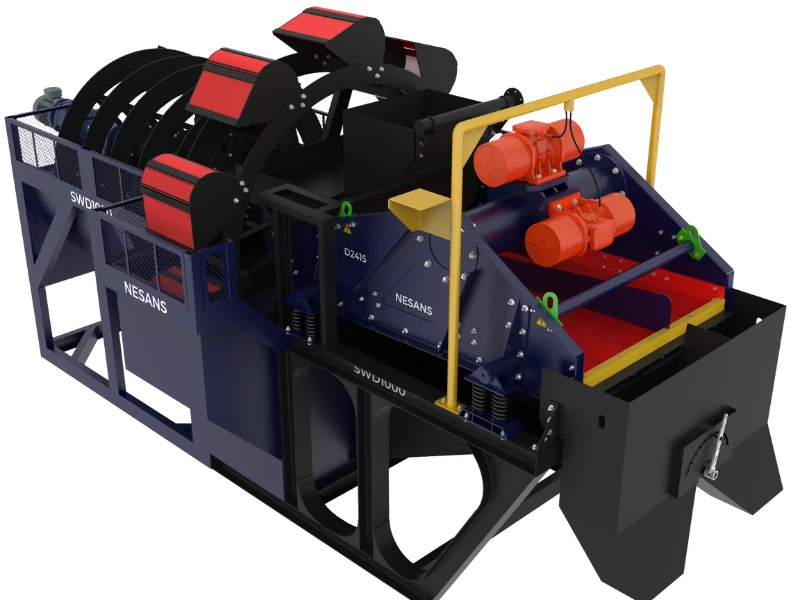
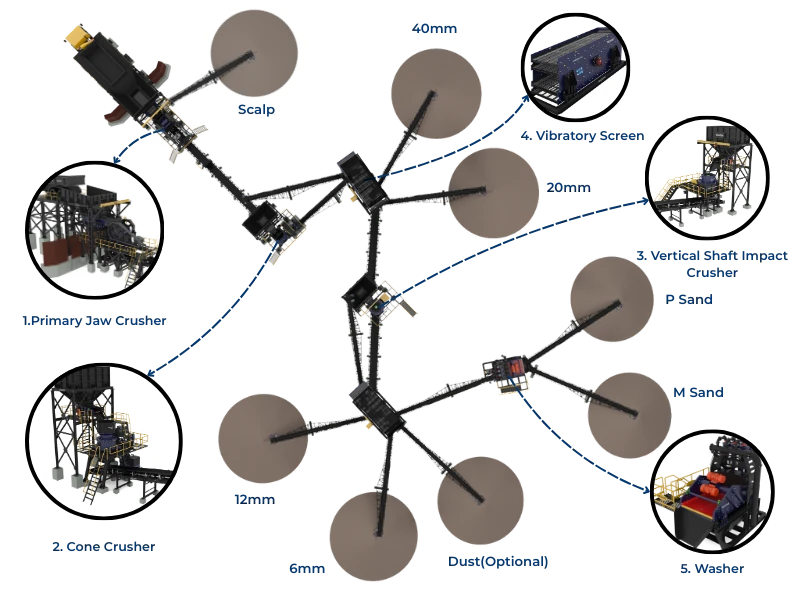
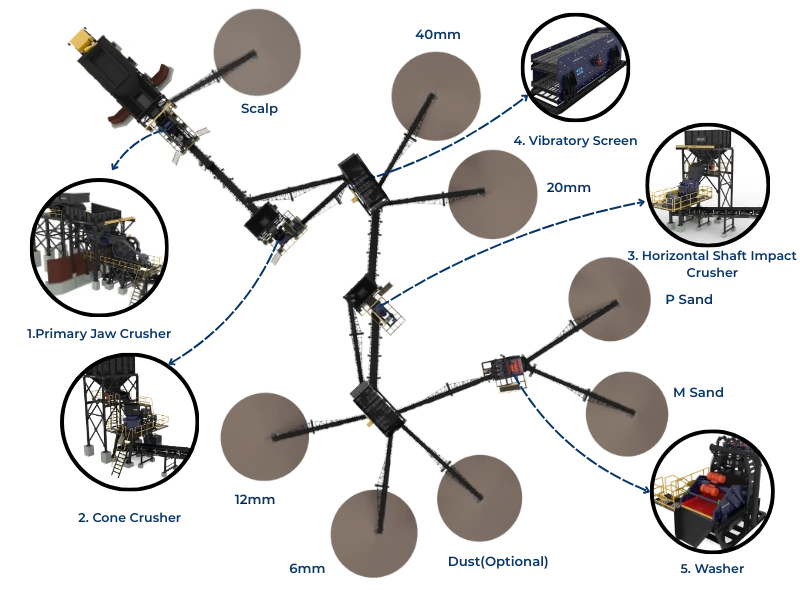
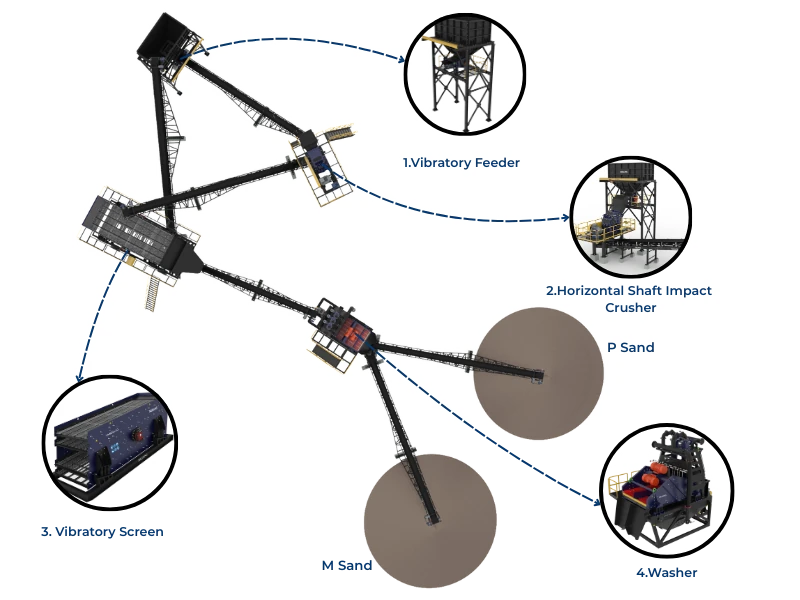
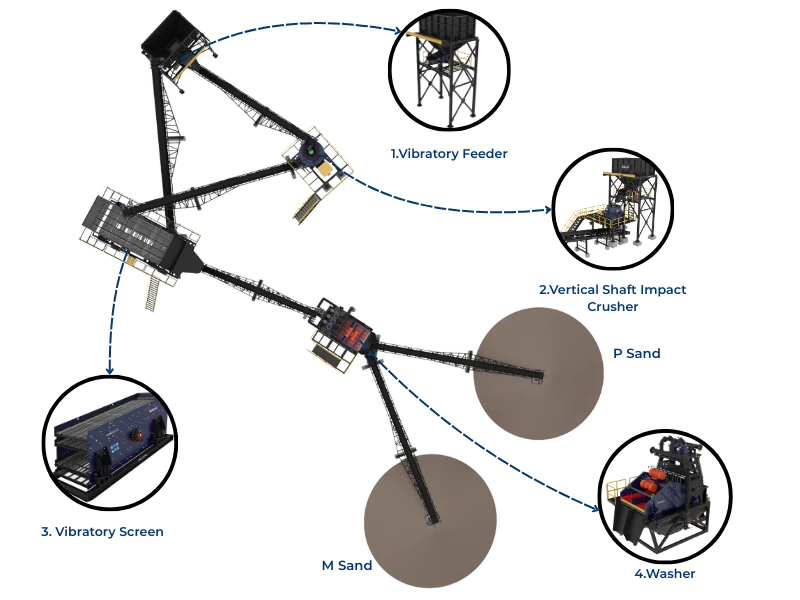
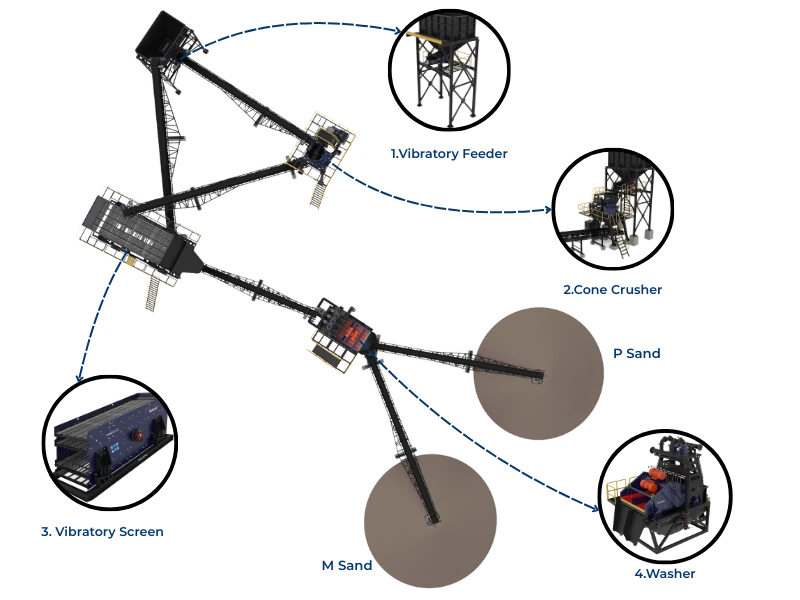
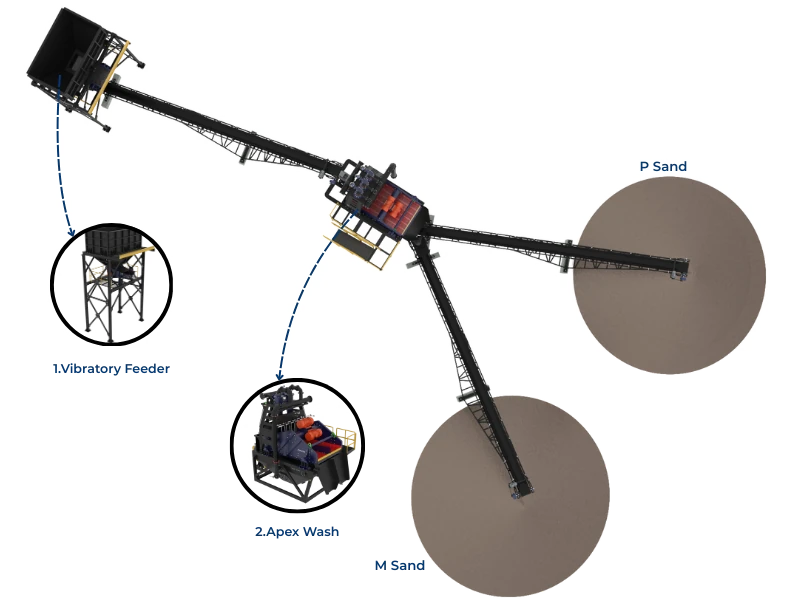
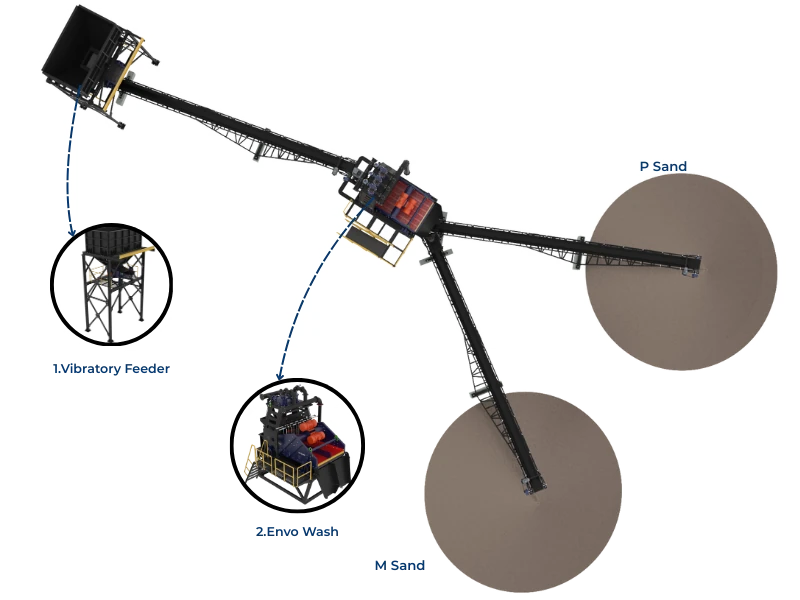
An M-sand fails at MBV 14 against a limit of 10. The clay is coming in with the feed — weathered seams or overburden in the quarry. Two fixes work: at the quarry, selective mining to avoid the clay-bearing zones drops the MBV at source; at the plant, washing the sand strips the active clay off the particles, often halving the MBV. The test does double duty: it qualifies the product and, trended, it points to where the clay enters so you can stop it. A clean wash circuit usually turns a failing MBV into a comfortable pass.
| Fines type | MBV | Effect on concrete |
|---|---|---|
| Inert stone dust | low | fills voids, can help |
| Some active clay | moderate | raises water/admixture demand |
| High active clay | high (>limit) | weak, sticky, durability loss |
In practice
Test MBV, not just the fines percentage — the percentage tells you how much dust, MBV tells you whether it matters. Use it to defend good high-fines M-sand that a blunt percentage limit would reject, and to catch clay-contaminated sand that a low fines count would let through. Trend it as a quarry-control tool: a rising MBV warns of clay seams or overburden entering the feed before the concrete results do. And remember the fix is usually washing or selective mining, not scrapping the deposit.
Common mistakes
- Limiting fines by percentage alone. It cannot tell inert dust from harmful clay — use MBV.
- Rejecting all high-fines M-sand. Low-MBV fines are benign or beneficial; the test lets you keep good sand.
- Ignoring a rising trend. Climbing MBV signals clay entering the feed — act at the quarry or wash plant.
Companion tests: sand equivalent and reading them together
Methylene blue value is powerful but narrow — it quantifies active clay specifically. A useful companion is the sand equivalent test, which gives a broader, quicker read on the overall proportion of clay-like and dust fines relative to sand. A sample is agitated in a flocculating solution in a graduated cylinder and left to settle; the ratio of the settled sand column to the total (sand plus suspended fines) column, as a percentage, is the sand equivalent. A high value means clean sand; a low one means a lot of fines, clay-like or not.
The two tests answer different questions and are strongest together. Sand equivalent asks ‘how much fine, clay-like material is there overall?’; methylene blue asks ‘how active — how harmful — is that fine fraction?’. A sand with a moderate sand-equivalent but a low MBV is carrying inert dust and is fine; the same sand-equivalent with a high MBV is carrying active clay and is not. Run together, they separate the merely dusty from the genuinely contaminated.
Layering in fineness modulus completes the picture for an M-sand. FM places the gradation (coarse or fine), sand equivalent gauges the bulk of fines, and MBV judges their harmfulness. A producer who trends all three has a compact dashboard: a drift in FM flags a crushing or screening change, a falling sand equivalent flags rising fines, and a rising MBV flags clay entering the feed — each pointing to a different cause and fix.
The discipline is to read the panel, not a single number. M-sand has been wrongly rejected on a high fines count that MBV would have absolved, and wrongly accepted on a clean-looking gradation that MBV would have condemned. Three cheap tests — FM, sand equivalent, MBV — together certify an M-sand with a confidence none of them gives alone.
The bottom line
Methylene blue value distinguishes harmful active clay from harmless stone dust, which a fines percentage cannot. It is the right way to judge M-sand fines: low MBV fines are benign, high MBV fines rob water, admixture and strength.
Test MBV to qualify the sand, trend it to find clay at source, and wash or selectively mine to fix a high value — and high-quality M-sand is accepted on merit rather than rejected on a crude fines count.
Frequently asked questions
What does the methylene blue value measure?
The amount of active clay in the fines, via dye adsorbed onto the clay's large surface. Inert stone dust adsorbs almost none, so MBV isolates the harmful fraction.
Why not just limit the percentage of fines?
Because it cannot distinguish harmless stone dust from harmful clay. Two sands with equal fines can behave completely differently — MBV tells them apart.
How do I lower a high MBV?
Wash the sand to strip active clay off the particles, or selectively mine to avoid clay-bearing zones in the quarry.
Key takeaways
- MBV measures active clay, not total fines — the clay is what harms concrete.
- Low MBV fines are inert stone dust (can help); high MBV fines rob water and strength.
- Use MBV to accept good high-fines M-sand and reject clay-contaminated sand.
- Fix a high MBV by washing or selective mining; trend it to find clay at source.
