







A hydrocyclone has no moving parts, yet it makes a remarkably precise size cut — which is why it deslimes sand, recovers fines and classifies slurries across the industry. Sizing one means hitting a target cut size, the  , and the Plitt model turns the cyclone’s geometry and duty into that number.
This article identifies the cut size, shows how it scales with cyclone diameter, lays out the variables the Plitt model uses, and reads the partition curve that describes how sharply the cut is made.
The cut size
The is the particle size that has an equal chance of reporting to the underflow (coarse) or the overflow (fine). It is the cyclone’s effective cut, and to first order it is governed by the cyclone diameter:
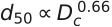
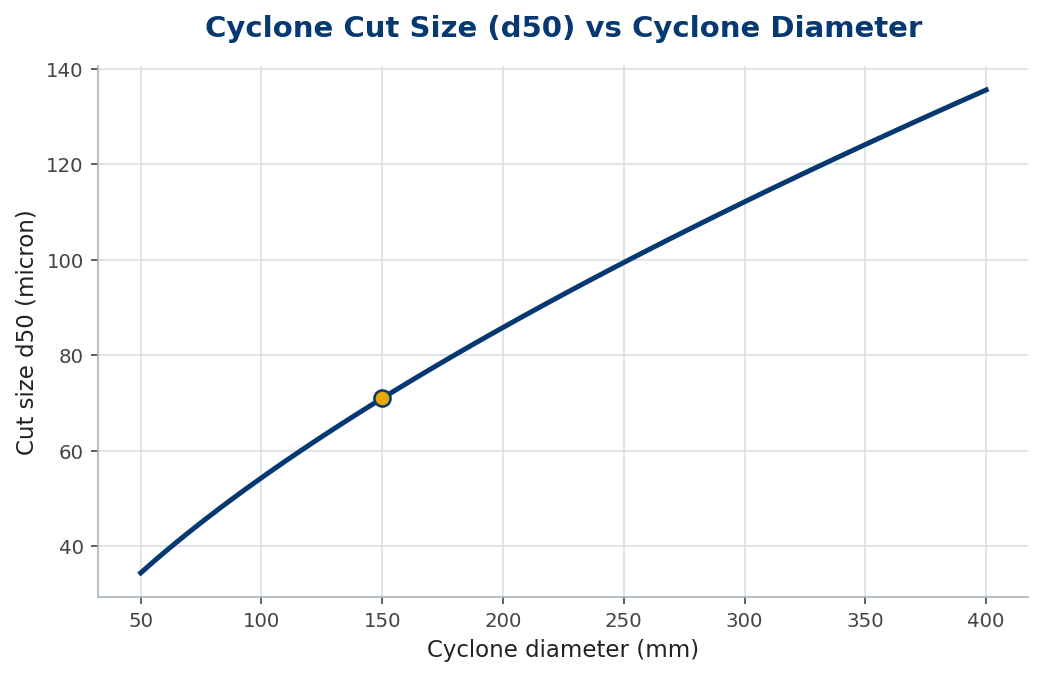
so a bigger cyclone makes a coarser cut. The full Plitt model refines this with the inlet, vortex-finder and apex diameters, the feed solids and the flow.
Worked example 1
A 150 mm cyclone, with the proportionality calibrated for a sand duty, cuts at about

That is a classic desliming cut — it sends the minus-75 µm silt to overflow and keeps the saleable sand in the underflow.
What the Plitt model adds
Diameter dominates, but the cut and the sharpness are tuned by the rest of the geometry and the duty. The Plitt correlation collects these into one equation; the variables that matter most are:
| Variable | Effect on cut | Lever |
|---|---|---|
| Cyclone diameter Dc | larger → coarser cut | select unit size |
| Vortex finder Do | larger → coarser cut | swap insert |
| Apex (spigot) Du | larger → finer cut, wetter underflow | swap insert |
| Feed solids Cv | higher → coarser cut | control density |
| Feed pressure / flow | higher → finer cut | pump setting |
The partition curve and sharpness
One cut size hides how cleanly the cyclone separates. The partition (Tromp) curve plots the chance a particle reports to underflow against its size; the is the 50% point, and the steeper the curve the sharper the cut. A real cyclone also sends a fraction of fines to underflow regardless of size — the bypass — which the corrected curve accounts for.
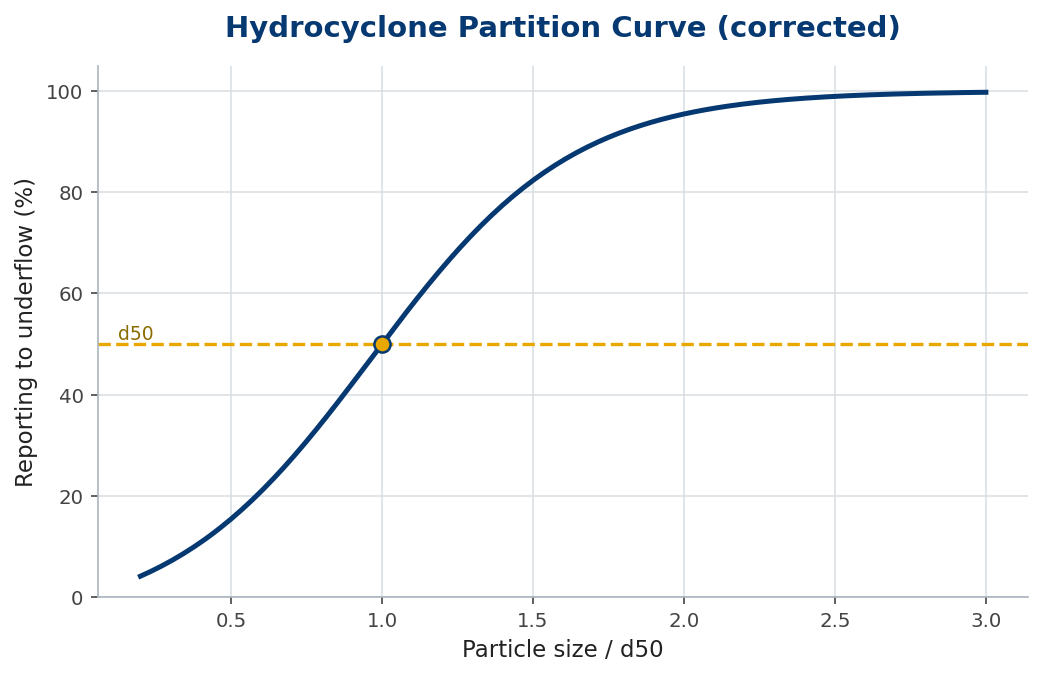 ; a steeper curve means a sharper separation and less misplaced material.
Worked example 2 — shifting the cut
Suppose the 71 µm cut is sending a little good sand to overflow. Rather than change cyclones, fit a smaller vortex finder or raise the feed density — both coarsen the cut, pushing more borderline sand to the underflow product. Conversely, a larger apex or higher pressure finer-cuts and deslimes harder. The inserts and the pump make a single cyclone tunable across a useful range without new hardware.
In practice
Watch the underflow discharge shape: a roping (rope-like) discharge means the apex is overloaded and the cut has gone coarse and erratic, while a wide spray means too much water is reporting to underflow. A 20–30° spray is the healthy target. Cluster small cyclones in parallel rather than using one large unit when you need a fine cut at high tonnage, and keep the feed pressure steady — the cut size chases the pressure, so a surging pump makes a wandering product.
Common mistakes
- One big cyclone for a fine cut. Fine cuts need small cyclones; cluster them in parallel for tonnage.
- Ignoring the apex discharge. Roping signals an overloaded spigot and a lost, coarse cut.
- Unstable feed pressure. The cut tracks pressure; a surging feed makes a wandering product.
Geometry ratios and reading the discharge
Beyond the diameter, a cyclone’s cut and sharpness are set by a handful of geometric ratios, and good cyclone practice is really about keeping those ratios in their healthy ranges. The vortex finder, the apex (spigot), the inlet and the cone angle are all scaled to the cyclone diameter, and standard design ratios — the vortex-finder and apex diameters as fractions of  — keep the cyclone classifying cleanly rather than roping or spraying.
The apex-to-vortex-finder ratio is the one operators watch most. Too small an apex relative to the vortex finder overloads the underflow and the cyclone ropes; too large and too much water reports to underflow, wetting the product and coarsening the cut. The healthy window discharges a 20–30° spray cone, which is why the discharge shape is read as a live gauge of whether the geometry and load are matched.
Tonnage is handled by number, not size. Because a fine cut needs a small cyclone but a small cyclone has little capacity, high-tonnage fine-classification duties use a cluster — many small cyclones manifolded in parallel on one feed — rather than one large unit. The cluster keeps every cyclone at the right size for the cut while the manifold provides the throughput, and individual cyclones can be valved out for maintenance without stopping the duty.
So size a cyclone by diameter for the cut, set the internal geometry by the standard ratios, and cluster small units for fine cuts at tonnage — then run it by watching the discharge. A steady 20–30° spray at both overflow and underflow, fed at constant pressure, is a cyclone classifying as designed; a rope or a flooded spray is the geometry or the load telling you it is not.
The bottom line
A cyclone is sized to a cut, the , which scales mainly with diameter ( ) and is refined by the Plitt variables — vortex finder, apex, feed solids and pressure. The partition curve shows how sharply it cuts.
Pick the diameter for the cut, tune with inserts and feed density, keep the apex spraying and the pressure steady — and a part with no moving pieces becomes one of the most precise classifiers on the plant.
Frequently asked questions
What is the d50?
The particle size with a 50:50 chance of reporting to underflow or overflow — the cyclone's effective cut size.
How do I make a finer cut?
Use a smaller cyclone diameter, a larger apex, or higher feed pressure; lower the feed solids. Cluster small cyclones in parallel for tonnage.
What does a roping underflow mean?
The apex is overloaded: instead of a 20–30° spray it discharges a rope, the cut goes coarse and erratic, and sand is lost to overflow.
Key takeaways
- Size a cyclone to its cut, the ; to first order .
- The Plitt model refines the cut with vortex finder, apex, feed solids and pressure.
- The partition curve shows the cut () and the sharpness of separation.
- Keep the apex spraying (not roping) and the feed pressure steady for a stable product.
