









Diesel or electric? It is one of the largest decisions in a plant’s life and one of the most often made on instinct. Diesel is cheap to buy and move; electric is dear to connect but cheap to run. The honest comparison is not the price tag but the total cost of ownership — capital plus a stream of running costs — and it usually crosses over within a couple of years of steady operation.
This article builds the TCO of each option, finds the crossover year, and shows why the cost of a kilowatt-hour is the variable that decides it.
The TCO model
Total cost of ownership is the capital cost plus the running cost accumulated over the years of operation:

Diesel has a low  but a high
  (fuel); electric has a high (grid connection, transformers) but a low . The lines cross at the year the cheaper-to-run option overtakes the cheaper-to-buy one.
The kilowatt-hour gap
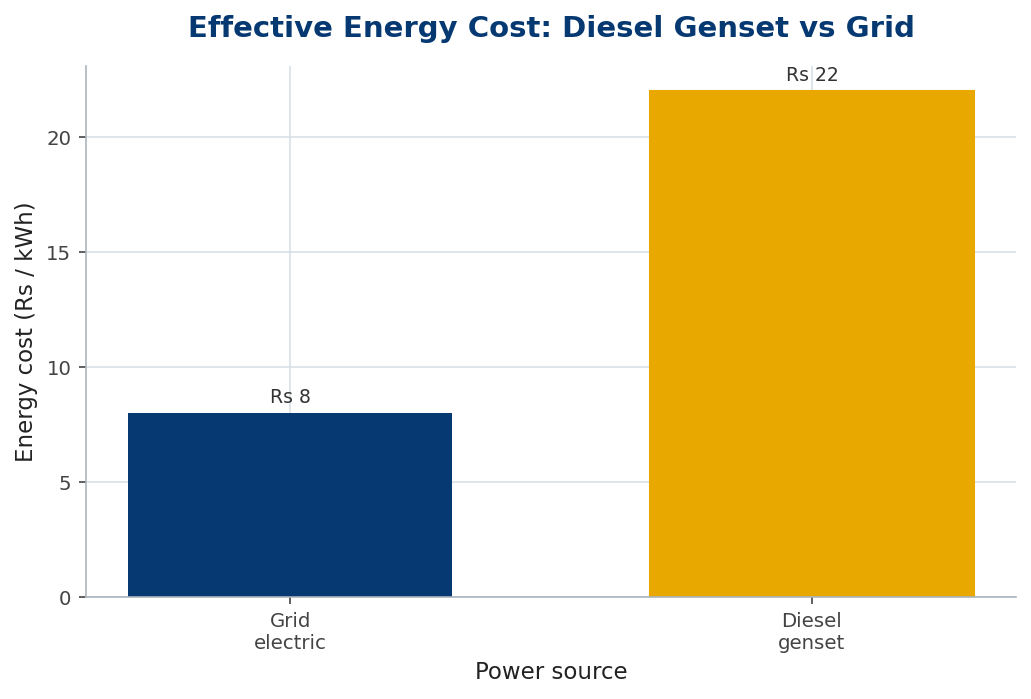
The whole comparison turns on energy price. A diesel genset turns roughly a quarter-litre of fuel into each kilowatt-hour, so at pump prices its effective energy cost is two to three times grid electricity.
Worked example 1 — the crossover
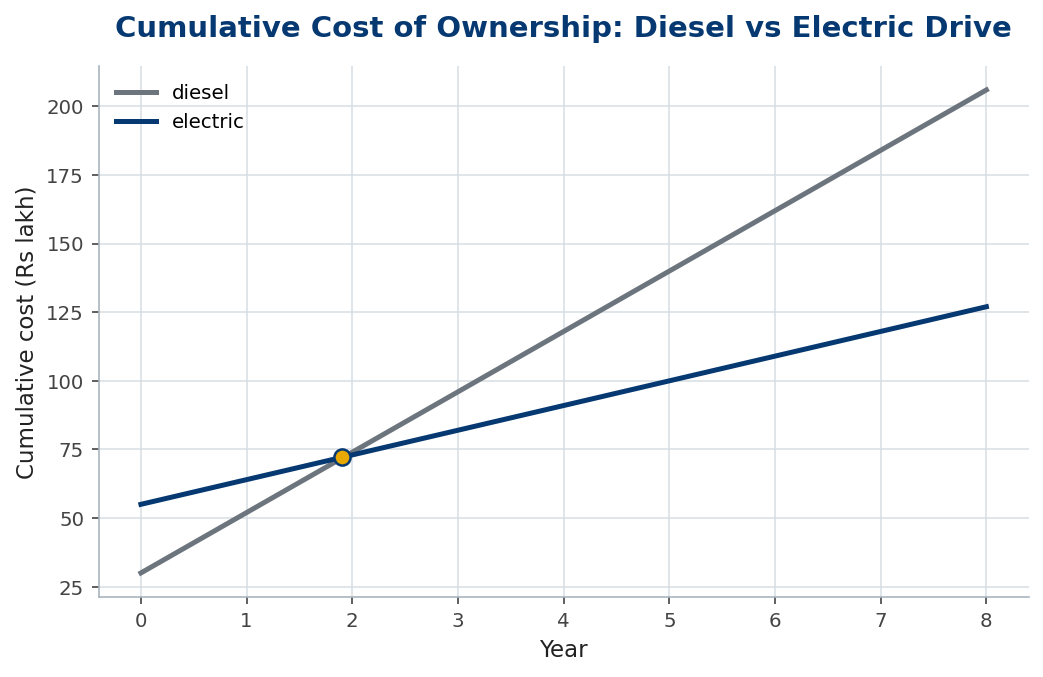
Say an electric installation costs Rs 55 lakh to connect but runs at Rs 9 lakh/yr; the diesel equivalent costs Rs 30 lakh but runs at Rs 22 lakh/yr. The crossover is

After about two years the electric plant is cheaper, and pulls further ahead every year thereafter.
When diesel still wins
The crossover assumes steady running and an available grid. Two situations flip the answer. A genuinely mobile or short-life operation — a contract crushing job, a remote pit — may never reach the crossover, so its lower capital and portability win. And where no grid exists, the electric option carries the full cost of bringing power to site, pushing its capex and its crossover far out. The model does not say ‘always electrify’; it says ‘know your crossover and your running hours’.
Worked example 2 — the hours that decide it
The same plant run only 1,500 hours a year instead of 4,000 burns far less diesel, so its annual running-cost penalty shrinks and the crossover stretches from under two years to perhaps four or five. Utilisation, once again, is decisive: a hard-run plant electrifies easily, a lightly used one may not. Always test the crossover at your real operating hours, not the nameplate.
In practice
Build the TCO with delivered energy prices, not list ones — include diesel logistics and genset maintenance on one side, demand charges and power-factor penalties on the other. Count the things the spreadsheet misses too: electric drives are quieter, cleaner and lower-maintenance, which matters for permits and labour, while diesel offers independence from grid reliability. A hybrid — grid for the base plant, a genset for peaks or outages — is often the real optimum, and the same model sizes it.
Common mistakes
- Comparing on capex. Diesel’s low purchase price hides a high running cost; compare TCO over real hours.
- Using list energy prices. Include diesel logistics, genset maintenance, and grid demand/power-factor charges.
- Ignoring utilisation. The crossover stretches sharply at low operating hours.
The costs beyond fuel: maintenance, emissions and environment
Fuel drives the crossover, but several other costs separate diesel from electric and they nearly all favour the electric side. A diesel engine is a maintenance burden in its own right — oil and filter changes, injectors, cooling, exhaust after-treatment, and a finite overhaul life — whereas an electric drive is comparatively maintenance-light, with no combustion to service. Over the years that maintenance gap adds quietly to diesel’s running cost beyond the fuel.
Emissions are increasingly a cost, not just a conscience. Diesel engines must meet tightening exhaust-emission stages, which add after-treatment hardware and its upkeep, and on-site diesel generates the local pollution and carbon that permits and carbon pricing increasingly penalise. An electric plant moves those emissions to the power station — and toward zero as the grid greens or the site adds solar — which is a compliance and reputational asset as well as a carbon one.
The operating environment counts too. Electric drives are quieter and cleaner at the working face, which eases noise permits, improves the workplace and can be decisive near communities; diesel offers independence from the grid and mobility in return. These are not line items in a simple fuel comparison, but they shift real decisions — a quarry near housing may electrify for the noise and dust alone.
So build the TCO on the full cost difference, not just the kilowatt-hour gap: fold in diesel’s heavier maintenance, its emissions hardware and exposure, and the environmental advantages of electric drive. Counted honestly, these usually pull the crossover in further toward electrification — the fuel arithmetic understates the case rather than overstating it.
The bottom line
Diesel versus electric is a crossover, not a verdict:  . With steady running and an available grid, electric usually overtakes diesel inside two years; with low hours or no grid, diesel can stay ahead.
Know your crossover and your running hours, price energy as delivered, and consider a hybrid — and the decision rests on arithmetic rather than instinct.
Frequently asked questions
Why is genset power so much dearer than grid?
A diesel genset converts roughly a quarter-litre of fuel into each kWh, so at pump prices its energy costs two to three times grid electricity, before engine maintenance.
When does diesel still make sense?
Short-life, mobile or remote operations that never reach the crossover, or sites with no grid where electrifying carries the full connection cost.
Is a hybrid worth it?
Often, yes — grid for the base load with a genset for peaks or outages captures most of the saving while keeping resilience.
Key takeaways
 ; the crossover is
  .
.- Diesel energy costs 2–3× grid electricity — the engine of the crossover.
- With steady running and a grid, electric usually wins inside two years.
- Low hours or no grid favour diesel; test the crossover at real utilisation.
