






Quarry blasting is the critical first step in aggregate production, and blast design decisions made in the quarry directly impact crusher performance, wear costs, and product quality in the processing plant. Many operations treat blasting and crushing as separate functions, missing the opportunity to optimize the complete system. Poor fragmentation from suboptimal blasting can reduce crusher throughput by 30-40% while dramatically increasing wear rates and energy consumption. Understanding the relationship between blast design and crusher requirements enables optimization that benefits the entire operation.
Understanding the Blasting-Crushing Connection
How Fragmentation Affects Crushing
Rock fragmentation from blasting determines the size distribution of material entering the primary crusher. This distribution directly affects:
- Crusher feed acceptance: Oversized material causes bridging and blockages
- Throughput rate: Finer fragmentation enables higher feed rates
- Crushing ratio required: Coarser feed requires more size reduction stages
- Wear rates: Larger pieces cause more impact wear
- Energy consumption: Crushing consumes 20-30× more energy than blasting
Economic Impact Quantification
Consider a 500 TPH quarry operation comparing optimal vs. poor fragmentation:
| Factor | Poor Fragmentation | Optimal Fragmentation | Difference |
|---|---|---|---|
| Effective throughput | 350 TPH (70%) | 475 TPH (95%) | +125 TPH |
| Crushing energy (kWh/t) | 3.2 | 2.4 | -25% |
| Liner life (hours) | 2,500 | 3,800 | +52% |
| Secondary breaking cost | ₹15/tonne | ₹3/tonne | -80% |
| Annual operating cost difference | ₹1.5-2.5 crore (for 1.5 million tonne/year operation) |
The "Mine to Mill" Concept
Mine to Mill optimization recognizes that increasing blast energy costs is often economically justified by larger savings in crushing and grinding. The key insight: energy applied in blasting is 20-30× more efficient at breaking rock than mechanical crushing.
Example economics:
- Blasting cost increase: ₹2-3/tonne for finer fragmentation
- Crushing cost reduction: ₹8-15/tonne from improved throughput and efficiency
- Net benefit: ₹6-12/tonne
Blast Design Parameters Affecting Crushing
Burden and Spacing
Burden (distance from blast hole to free face) and spacing (distance between holes) are the primary controls on fragmentation:
| Parameter | Effect of Increasing | Impact on Crushing |
|---|---|---|
| Burden | Coarser fragmentation, more boulders | Reduced throughput, more secondary breaking |
| Spacing | Coarser fragmentation in toe | More oversize, bridging problems |
| Burden/Spacing ratio | Affects uniformity of breakage | Variable feed sizing, inconsistent loading |
Optimal ratios for crusher feed:
- Burden: 25-35× hole diameter
- Spacing: 1.1-1.3× burden
- Target P80: 60-70% of primary crusher feed opening
Powder Factor
Powder factor (explosive quantity per unit rock volume) directly controls energy input and fragmentation fineness:
| Rock Type | Typical Powder Factor (kg/m³) | Effect on Fragmentation |
|---|---|---|
| Soft limestone | 0.25-0.35 | Fine, uniform breakage |
| Medium granite | 0.35-0.50 | Moderate, may need adjustment |
| Hard basalt | 0.45-0.65 | Requires higher energy input |
| Fractured/weathered | 0.20-0.35 | Over-breakage risk if too high |
Optimization approach:
- Measure actual fragmentation distribution (photo analysis or screening)
- Compare to crusher feed requirements
- Adjust powder factor to achieve target P80
- Balance cost increase against crushing benefits
Timing and Sequencing
Blast timing affects fragmentation uniformity and muckpile characteristics:
Short delays (15-25ms between rows):
- Tighter, more confined muckpile
- Finer, more uniform fragmentation
- Better for crusher feed consistency
Long delays (40-65ms between rows):
- Looser, more spread muckpile
- Coarser fragmentation, more oversize
- Easier digging but harder crushing
Hole Diameter Selection
Hole diameter affects both blast efficiency and fragmentation:
| Hole Diameter | Fragmentation Effect | Cost Impact |
|---|---|---|
| Small (75-100mm) | Finer, more uniform | Higher drilling cost, lower explosive cost |
| Medium (115-140mm) | Balanced performance | Moderate total cost |
| Large (165-200mm) | Coarser, more variable | Lower drilling cost, higher explosive cost |
Smaller holes with tighter patterns generally produce better fragmentation for crushing, but total drilling and blasting cost must be considered.
Measuring Fragmentation for Crusher Optimization
Photo Analysis Methods
Modern image analysis systems provide rapid, accurate fragmentation measurement:
Implementation:
- Capture images of muckpile or truck loads
- Software identifies and measures individual rocks
- Generates size distribution curve (P10, P50, P80, P100)
- Compares to target specifications
Key metrics for crusher feed:
- P80: 80% passing size—should be 60-70% of crusher feed opening
- P100: Maximum size—should not exceed crusher feed opening
- Uniformity coefficient: Measures distribution spread—lower is more uniform
Monitoring Crusher Response
Track crusher performance metrics to correlate with blast design:
| Metric | Indicator of Good Fragmentation | Indicator of Poor Fragmentation |
|---|---|---|
| Throughput rate | Consistent at rated capacity | Variable, frequently below target |
| Power draw | Steady at 80-90% of rated | Fluctuating, frequent spikes |
| Bridging frequency | Rare (once per shift or less) | Frequent (multiple per hour) |
| Secondary breaking need | Minimal (5% of material) | Frequent (>20% of material) |
Optimizing Blast Design for Crusher Feed
Target Fragmentation Sizing
Establish target fragmentation based on primary crusher specifications:
For jaw crushers:
- Target P80: 60-65% of feed opening width
- Maximum size (P100): 85-90% of feed opening width
- Allow for occasional oversize requiring breaking
For gyratory crushers:
- Target P80: 55-60% of feed opening
- More sensitive to oversize due to choke point
- Tighter fragmentation control required
Example: For a 1200×900mm jaw crusher (900mm feed opening width):
- Target P80: 540-585mm
- Maximum size: 765-810mm
- Anything larger requires secondary breaking
Rock Type Considerations
Different rock types respond differently to blasting and affect crusher behavior:
| Rock Type | Blast Response | Crusher Impact | Optimization Focus |
|---|---|---|---|
| Hard, massive granite | Breaks along blast fractures | High wear, blocky product | Higher powder factor, tighter patterns |
| Laminated limestone | Breaks along bedding planes | Slab production, bridging risk | Timing for cross-break, smaller holes |
| Weathered rock | Over-breaks easily | Excessive fines, may blind screens | Lower powder factor, controlled blast |
| Competent basalt | Requires high energy | Excellent product, high wear | Maximum powder factor practical |
Muckpile Configuration
Muckpile shape affects loading efficiency and crusher feed consistency:
Ideal muckpile characteristics:
- Uniform fragmentation throughout pile
- No segregation of fines and coarse
- Optimal throw for loading equipment access
- Minimal oversize on surface
Blast design for good muckpile:
- Front row timing creates initial throw
- Back row timing controls final pile shape
- Appropriate stemming prevents cratering
- Controlled throw prevents excessive spread
Handling Poor Fragmentation at the Crusher
Secondary Breaking Options
When blasting produces oversize material, secondary breaking is required:
| Method | Capacity | Cost per Tonne Broken | Best Application |
|---|---|---|---|
| Hydraulic rock breaker | 50-150 t/hr (of oversize) | ₹25-50 | Regular oversize handling |
| Drop ball | 30-80 t/hr | ₹15-30 | Large boulders, low tech |
| Secondary blasting | Variable | ₹10-20 | Massive boulders, unsafe for breaker |
| Grizzly scalping | Continuous | ₹5-10 (diversion cost) | Consistent oversize percentage |
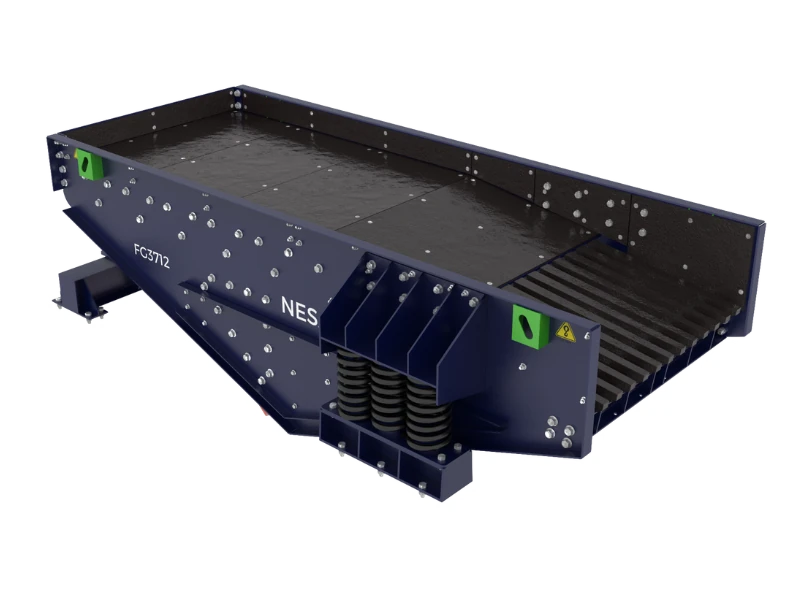
Grizzly Feeder Optimization
Grizzly feeders ahead of the crusher can manage variable fragmentation:
Bar spacing selection:
- Bars spaced at 60-70% of crusher CSS
- Removes fines that consume crusher energy
- Provides buffer for feed rate variation
Handling oversize:
- Reject chute directs oversize to breaker pad
- Reduces crusher blockages
- Maintains consistent feed to crusher
Communication and Feedback Systems
Blast-to-Crush Feedback Loop
Establish formal communication between blasting and crushing operations:
Data to share from crushing to blasting:
- Crusher throughput achieved vs. target
- Bridging and blockage frequency
- Secondary breaking tonnage required
- Wear rates and liner life
Data to share from blasting to crushing:
- Blast design parameters used
- Actual powder factor achieved
- Photo analysis fragmentation results
- Any anomalies or deviations
Optimization Meetings
Regular meetings between drilling/blasting and crushing teams:
- Weekly review of performance metrics
- Monthly analysis of cost impacts
- Quarterly optimization trials
- Annual strategic review and goal setting
Case Study: Fragmentation Optimization
A 400 TPH granite quarry optimized blast design for crusher performance:
Initial condition:
- Powder factor: 0.38 kg/m³
- Burden: 3.5m, Spacing: 4.0m
- P80 fragmentation: 520mm
- Crusher throughput: 320 TPH (80% of rated)
- Secondary breaking: 18% of material
Optimized design:
- Powder factor: 0.48 kg/m³ (+26%)
- Burden: 3.0m, Spacing: 3.5m (tighter pattern)
- P80 fragmentation: 380mm (-27%)
- Crusher throughput: 385 TPH (96% of rated)
- Secondary breaking: 4% of material
Economic result:
| Cost Category | Before | After | Change |
|---|---|---|---|
| Blasting cost/tonne | ₹18 | ₹24 | +₹6 |
| Secondary breaking/tonne | ₹9 | ₹2 | -₹7 |
| Crushing cost/tonne | ₹42 | ₹35 | -₹7 |
| Lost production value | ₹12 | ₹2 | -₹10 |
| Net savings/tonne | ₹18 | ||
| Annual savings (1.2M tonnes) | ₹2.16 crore |
Conclusion
Quarry blasting and crusher performance are inseparably linked. Optimizing blast design for crusher feed—rather than minimizing blast cost alone—typically reduces total production cost by ₹10-25 per tonne. The key is treating drilling, blasting, and crushing as an integrated system rather than separate operations. Establish fragmentation targets based on crusher requirements, measure actual fragmentation systematically, and maintain regular communication between blasting and crushing teams. The additional investment in blast optimization returns many times its cost through improved crusher throughput, reduced energy consumption, extended wear life, and minimized secondary breaking requirements. Make fragmentation measurement and blast-crush feedback loops standard practice in your operation.
