














Bearings fail on a schedule you can calculate. The same ISO equation that bearing makers use to rate their products lets a maintenance planner turn load and speed into an expected life in hours — and, just as usefully, shows how cruelly a little overload shortens it.
That second use — quantifying how overload shortens life — is what turns L10 from a procurement number into a maintenance tool. Read the load right and you can forecast a change-out to within weeks; read it wrong, or ignore lubrication and contamination, and the same bearing fails in a fraction of its calculated life. We work the life in hours, then the overload penalty, then the field factors that decide which of the two you actually get.
The L10 equation
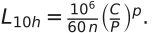
L10 is the life 90% of identical bearings will reach or exceed. In millions of revolutions,
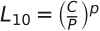
and converted to hours at a shaft speed  (rpm),
| Symbol | Meaning | Value |
|---|---|---|
| C | Basic dynamic load rating (from catalogue) | kN |
| P | Dynamic equivalent load on the bearing | kN |
| p | Life exponent | 3 (ball), 10/3 (roller) |
| n | Shaft speed | rpm |
 or
or  , halving the load multiplies life eight- to ten-fold — and a 20% overload nearly halves it.
Worked example 1
A roller bearing ( ) with
  carries
  at
at  . The load ratio is
  , so
, so

about 1.3 years of continuous running. Figure 1 shows how steeply that life depends on the load ratio.
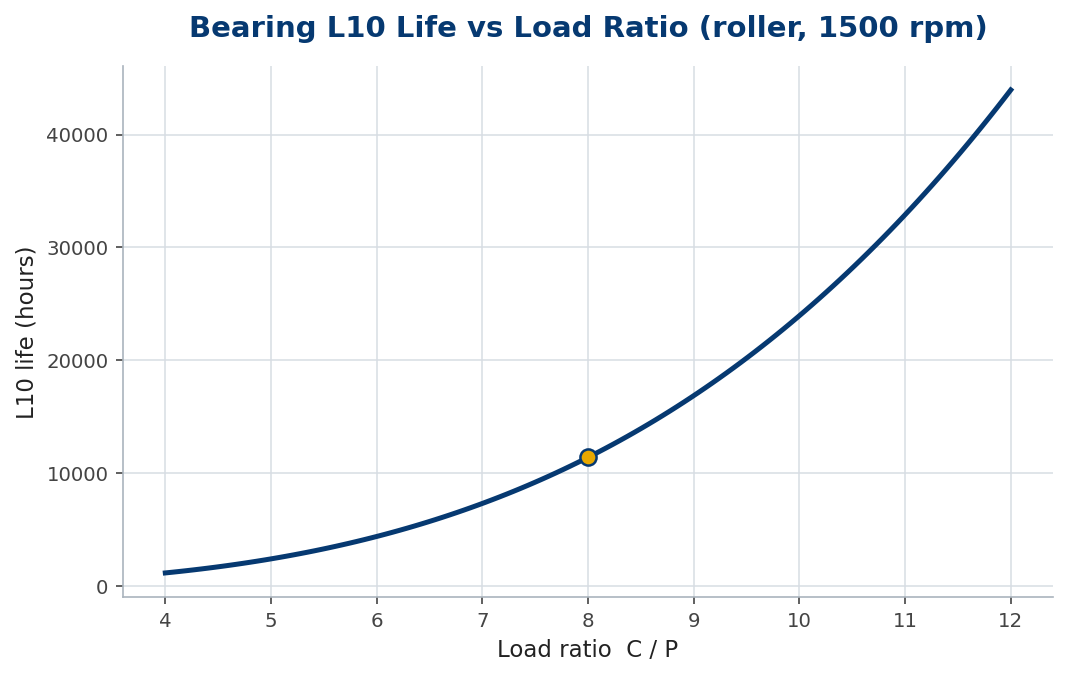
 (a lighter load or a larger bearing) buy disproportionate life.
What overload really costs
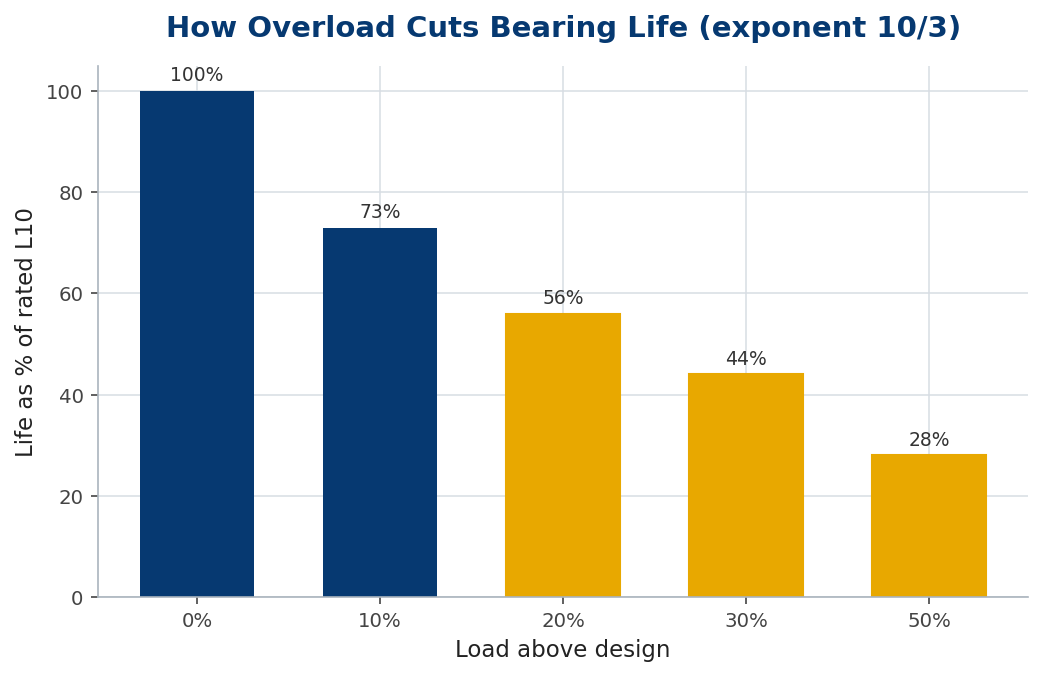
Run the same bearing above its design load and life collapses by the exponent. A 20% overload leaves only  of the rated life; a 50% overload, just 28%.
Worked example 2 — an overloaded screen bearing
A vibrating-screen bearing rated for 11,400 h is run 20% over its design load (heavier bed, larger stroke). Expected life falls to  — the change interval almost halves, and unplanned failures begin if the schedule is not updated.
 ; poor lubrication or contamination (low
  ) can cut the practical life well below the basic figure.
From L10 to a maintenance interval
A life in hours is only useful once it becomes a date on the planner. Convert it with the duty cycle: the example bearing’s 11,400 h, on a plant running 4,000 operating hours a year, is about 2.8 years — so a three-yearly change with interim condition checks is rational. Run the same plant 6,500 h a year and that bearing is due in under two years; the steel did not change, the duty did.
The reliability target shifts the number too. L10 means 10% are expected to fail before the interval, which is fine for an accessible, non-critical position but not for a buried main bearing. There you either plan on a fraction of L10 or specify a larger bearing so the practical reliability is higher. Pairing the calculated interval with vibration or temperature monitoring then lets you run confidently to the planned date and still catch the unlucky early failures before they cause secondary damage.
In practice
The equation gives a clean number, but field life is set by three things it assumes away: mounting, lubrication and contamination. A bearing fitted with the wrong internal clearance, or onto a shaft out of tolerance, can lose much of its calculated life before it ever sees full load. Lubricant viscosity at running temperature sets the factor — too thin a film and metal-to-metal contact erases the benefit of any load margin. And on a dusty crushing plant the seals matter as much as the bearing: ingress of fines is a leading cause of early failure. Calculate L10, then protect it with the right fit, clean grease and effective sealing.
Common mistakes
- Using radial load for
 . is the dynamic equivalent load combining radial and axial components.
 - Treating L10 as a guarantee. It is a 90%-reliability life; 10% fail sooner by definition.
- Ignoring lubrication. The factor often matters more than the load itself.
Frequently asked questions
What is the difference between L10 and L50?
L10 is the life 90% of bearings exceed; L50 (median) is roughly 5× L10. Plan on L10, not the median.
How much does doubling the load hurt?
Life drops to  — about 1/8 for ball, 1/10 for roller bearings.
Why include a lubrication factor?
The basic L10 assumes ideal films and cleanliness; corrects for real viscosity and contamination, which dominate many field failures.
The adjusted rating life: lubrication and cleanliness
The basic L10 captures load and speed, but two bearings under identical load can live very different lives depending on how clean and well-lubricated they are. Modern bearing standards account for this with an adjusted rating life that multiplies the basic L10 by life-modification factors:

where  adjusts for a required reliability above 90% and captures lubrication and contamination together. The striking thing is the range of : it can fall well below one for a dry, dirty bearing, or rise several-fold for a clean one running on a full lubricant film. Contamination and lubrication can matter as much as the load itself.
The lubrication side turns on the film: if the oil or grease film fully separates the rolling surfaces (a high viscosity ratio), fatigue is dramatically delayed; if the film is thin and the surfaces touch, life collapses. This is why the right grade and a healthy film — the same logic as gearbox lubrication — is a bearing-life decision, not just a friction one.
The contamination side is just as decisive: a single hard particle rolled into the raceway makes a dent that becomes a fatigue-crack initiator, so an effective seal and clean lubricant routinely outweigh a step up in bearing size. The practical message is that you buy bearing life as much through sealing and lubrication as through the catalogue load rating — and the adjusted life equation is how that trade is quantified rather than guessed.
The bottom line
The L10 equation turns load and speed into a defensible change-out interval, and its exponent is the warning: load discipline matters more than almost anything else you can do to a bearing. A position kept near its design load lasts for years; the same bearing chronically overloaded fails in a fraction of the time.
Calculate the life, convert it through the duty cycle into a date, then defend that date with clean lubrication, correct fitting and basic condition monitoring. The equation sets the target; the field factors decide whether you reach it.
Key takeaways
 , with
  ball, 10/3 roller.
- Life is highly non-linear in load: a 20% overload halves it.
- Use the dynamic equivalent load , not bare radial load.
- Correct the catalogue life for lubrication and contamination via .
