





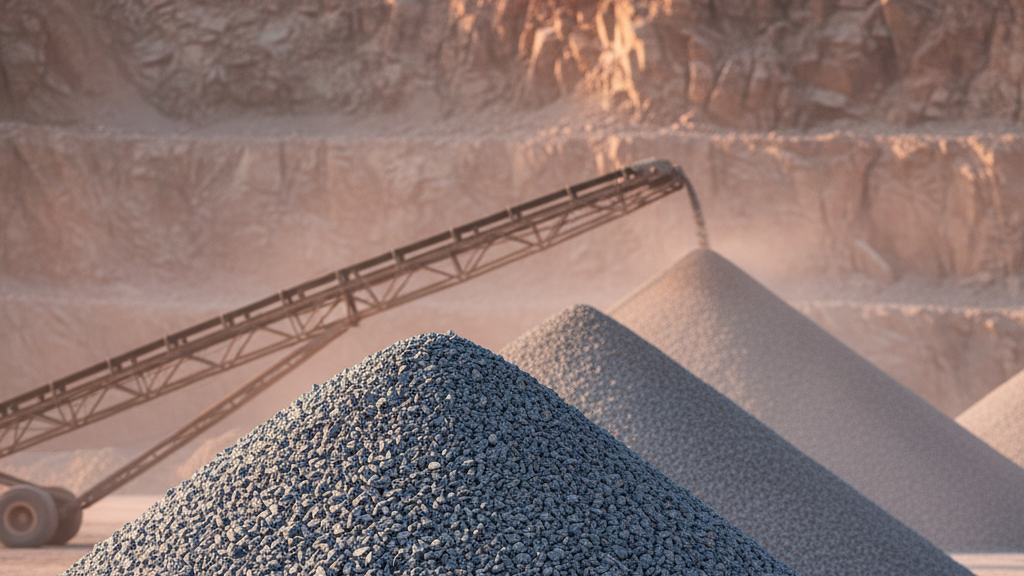
Aggregate stockpile segregation represents one of the most significant—yet frequently overlooked—causes of product quality problems in crushing operations. When material segregates in stockpiles, the resulting grade variation can cause batch-to-batch inconsistency that costs operations ₹2-5 lakh monthly in customer complaints, rejected loads, and price penalties. Understanding segregation mechanisms and implementing proper stockpile management can virtually eliminate this problem, ensuring consistent product quality that meets IS 383 specifications for every load.
Understanding Segregation Mechanisms
What Causes Segregation
Segregation occurs when particles of different sizes separate during stockpile formation and material handling. Three primary mechanisms drive this separation:
Trajectory Segregation: When material is discharged from a conveyor or dropped from height, larger particles travel further than smaller particles due to their greater momentum. This creates zones of different gradation across the stockpile face.
Percolation Segregation: Smaller particles filter down through the voids between larger particles as material flows down the stockpile face. This concentrates fines at the pile interior and base while coarse material accumulates at the surface and toe.
Fluidization Segregation: Fine particles become airborne during material discharge and settle in different locations than the bulk material, creating dust deposits with abnormal gradation.
Factors Affecting Segregation Severity
| Factor | Effect on Segregation | Mitigation Approach |
|---|---|---|
| Drop height | Higher drop = more segregation | Minimize freefall distance, use rock ladders |
| Particle size range | Wider range = more segregation | Narrow product specifications where possible |
| Moisture content | Dry material segregates more | Maintain optimal moisture (2-4%) |
| Particle shape | Rounded particles segregate more | Limited control; affects handling method choice |
| Stockpile height | Higher piles = more percolation | Limit pile height to 10-12m maximum |
| Wind conditions | Wind increases fines separation | Windbreaks, moisture control |
Measuring Segregation Impact
Gradation Variation Analysis
Quantify segregation by sampling from different stockpile locations and comparing gradations. A properly managed stockpile should show less than 5% variation on any sieve size between sampling locations.
Sampling protocol for segregation assessment:
- Sample from pile top (center and two edges)
- Sample from pile face at three heights (top, middle, bottom)
- Sample from pile toe (three locations around perimeter)
- Run complete gradation analysis on each sample
- Calculate standard deviation for each sieve size
Interpreting results:
| Standard Deviation | Segregation Level | Action Required |
|---|---|---|
| <2% | Minimal | Current practices adequate |
| 2-5% | Moderate | Implement improvements |
| 5-10% | Severe | Immediate action required |
| >10% | Critical | Stop operations until resolved |
Economic Impact Calculation
Calculate the cost of segregation-related quality problems:
Direct costs:
- Rejected loads requiring reprocessing: ₹150-300/tonne reblending cost
- Customer complaints and credits: ₹200-500/tonne price reduction
- Load-specific testing costs: ₹500-1,500 per test
Indirect costs:
- Customer relationship damage and lost sales
- Production delays for reprocessing
- Increased testing frequency requirements
Example calculation: Operation producing 300 TPH, 10-hour shifts, experiencing 5% rejection rate due to gradation variation:
- Daily rejection: 3,000 × 0.05 = 150 tonnes
- Reblending cost: 150 × ₹200 = ₹30,000/day
- Monthly impact: ₹30,000 × 25 = ₹7.5 lakh
Stockpile Design for Minimum Segregation
Optimal Stockpile Geometry
Stockpile design significantly affects segregation severity. Key design parameters:
Cone vs. Windrow: Conical stockpiles maximize segregation because material flows down all sides equally, creating concentric rings of different gradation. Windrow (linear) stockpiles allow reclaim from the cross-section, which naturally blends material from different zones.
Height limitations: Limit conical stockpile height to 10-12m maximum. Each additional meter of height increases percolation segregation. For critical applications requiring tight gradation control, limit height to 6-8m.
Angle of repose: Steeper angles (35-40°) create faster material flow down the face, increasing trajectory segregation. Manage material moisture and fines content to achieve flatter angles (30-35°) where possible.
Stacking Strategies
Layer building (chevron stacking): Build stockpiles in thin layers by moving the stacking point across the pile footprint. This distributes gradation variation throughout the pile rather than concentrating it radially.
Radial stacking: The most common but worst method for segregation. A fixed stacking point builds a cone with severe segregation. Use only when other methods are impractical.
Windrow stacking: Build linear piles by moving the stacking point along the pile length. Subsequent reclaim cuts through all deposited layers, providing natural blending.
| Stacking Method | Segregation Tendency | Blending Effectiveness | Application |
|---|---|---|---|
| Chevron (traveling tripper) | Low | Excellent | High-volume, quality-critical |
| Windrow | Moderate | Good | Medium-volume, general use |
| Cone and shell | Moderate-high | Fair | Space-limited operations |
| Radial (fixed point) | High | Poor | Avoid for graded products |
Reclaim Strategies for Consistent Gradation
Cross-Section Reclaim
The key to eliminating segregation impact is reclaiming across the full stockpile cross-section. This naturally blends material from all segregation zones:
Front-end loader technique:
- Attack the pile face perpendicular to the stockpile axis
- Take full-height cuts from base to top
- Rotate bucket to capture material from all heights
- Avoid partial-height cuts that sample only one zone
Reclaimer systems: Bucket wheel or scraper reclaimers automatically cut across the full stockpile section, providing consistent blending. These systems are most effective with chevron or windrow stacking methods.
Avoiding Single-Zone Reclaim
Never reclaim from a single location for extended periods. Common mistakes:
- Toe reclaim only: Yields coarse-biased product from percolation zone
- Top skimming: Yields coarse-biased product from trajectory zone
- Center tunneling: Yields fines-rich product from percolation core
- Edge mining: Yields variable product depending on deposition history
Real-Time Quality Management
Sampling Frequency
Establish sampling protocols that detect segregation-related variation before product ships:
| Product Type | Minimum Sampling | Critical Sieves |
|---|---|---|
| Concrete aggregate | Every 500 tonnes | 4.75mm, 10mm, 20mm |
| Asphalt aggregate | Every 300 tonnes | 2.36mm, 4.75mm, 10mm |
| Road base | Every 1,000 tonnes | 4.75mm, 20mm, 40mm |
| Manufactured sand | Every 250 tonnes | 150μm, 300μm, 600μm |
Control Charts
Implement statistical process control (SPC) to detect gradation drift before it causes specification failures:
Setting up control charts:
- Establish baseline from 20+ samples under normal operation
- Calculate mean and standard deviation for each critical sieve
- Set warning limits at ±2 standard deviations
- Set action limits at ±3 standard deviations
- Plot each sample result and monitor trends
Response to control chart signals:
- Single point outside warning: Increase sampling frequency
- Two consecutive points outside warning: Investigate reclaim method
- Point outside action limit: Stop shipping, investigate cause
- Trend toward limit: Proactive investigation before violation
Equipment and Systems for Segregation Control
Rock Ladders and Flow Control
Rock ladders reduce drop height and control material flow velocity, significantly reducing trajectory segregation:
Design considerations:
- Maximum freefall between shelves: 2-3m
- Shelf angle: 35-45° for controlled flow
- Shelf material: Wear-resistant steel or rubber lining
- Position: At conveyor discharge, bin outlets, transfer points
Telescopic chutes: Adjustable-length chutes maintain constant drop height as stockpile grows. More effective than rock ladders for new material placement.
Spreader Systems
Mechanical spreaders distribute material across a wider area, reducing point loading:
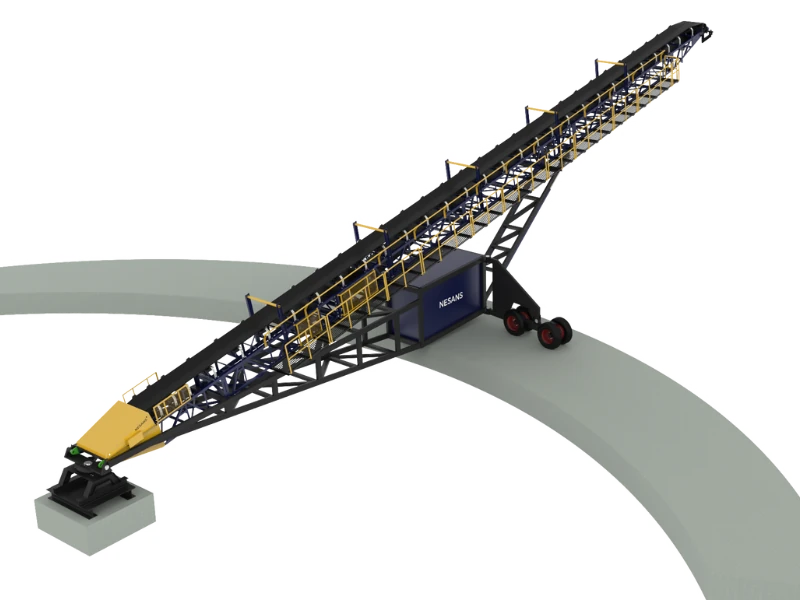
- Traveling trippers: Move stacking point along conveyor length
- Rotary distributors: Spread material in circular pattern
- Vibrating spreaders: Use vibration to distribute material laterally
Moisture Addition Systems
Controlled moisture addition reduces segregation by increasing particle cohesion:
Optimal moisture range: 2-4% for most aggregate products. Higher moisture increases cohesion but may cause handling problems and customer complaints.
Application points:
- At crusher discharge (combines with dust suppression)
- At screen discharge (product-specific application)
- At stockpile stacking point (final treatment)
Operational Best Practices
Loader Operator Training
Train loader operators in segregation-aware reclaim techniques:
| Practice | Why It Matters | Training Method |
|---|---|---|
| Full-face cuts | Blends all segregation zones | Visual demonstration, supervision |
| Consistent bucket filling | Maintains gradation consistency | Weigh test loads, feedback |
| Rotate reclaim points | Avoids single-zone mining | Marked reclaim zones, schedule |
| Recognize gradation changes | Early problem detection | Sample identification training |
Shift Communication
Establish communication protocols for gradation-related issues:
- Shift handover includes stockpile status and any gradation concerns
- Quality lab communicates sample results within 30 minutes
- Out-of-spec results trigger immediate notification to plant operator
- Daily production meeting reviews gradation trends
Documentation and Traceability
Maintain records that allow issue investigation:
- Stockpile deposition records (time, volume, source)
- Reclaim records (location, time, destination)
- Quality test results with sample location identification
- Customer delivery records linked to stockpile/reclaim records
Troubleshooting Segregation Problems
Problem: Consistent Coarse Bias
Likely causes:
- Reclaim focused on pile toe and edges
- Insufficient moisture allowing fines to percolate
- Excessive drop height at stacking point
Solutions:
- Implement full-face reclaim protocol
- Increase moisture to 3-4%
- Install rock ladder or reduce stacking height
Problem: Consistent Fine Bias
Likely causes:
- Reclaim tunneling into pile center
- Wind-blown fines contamination
- Upstream screening problems
Solutions:
- Expand reclaim to full cross-section
- Install windbreaks, clean affected areas
- Check screen efficiency and apertures
Problem: Erratic Gradation Variation
Likely causes:
- Multiple products commingled in stockpile
- Inconsistent reclaim practices between operators
- Source material gradation changes
Solutions:
- Dedicate stockpiles to single products
- Standardize and train reclaim procedures
- Monitor and control crusher settings
Case Study: Gradation Stabilization
A 250 TPH aggregate operation experienced 8% rejection rate due to gradation variation in their 20mm product. Investigation revealed:
Problems identified:
- 15m stockpile height with fixed radial stacking
- Loader operators reclaiming from convenient locations
- No moisture addition at stockpile
- Sampling only from loaded trucks
Solutions implemented:
- Limited pile height to 8m with windrow stacking
- Trained operators on full-face reclaim, marked zones
- Added moisture spray at stacking conveyor discharge
- Implemented stockpile sampling protocol
Results after 3 months:
- Rejection rate: 8% → 0.5%
- Gradation standard deviation: 7.2% → 2.1%
- Monthly cost savings: ₹4.2 lakh (reduced rejections, testing, complaints)
- Implementation cost: ₹1.8 lakh (training, equipment, moisture system)
- Payback period: 13 days
Conclusion
Aggregate stockpile segregation is a solvable problem that many operations overlook. The combination of proper stacking methods, appropriate stockpile geometry, full-face reclaim practices, and moisture management can reduce gradation variation from 10%+ to under 3%. The economic benefits of consistent product quality—including reduced rejections, fewer customer complaints, and premium pricing potential—typically return 5-10× the implementation investment within the first year. Start with the basics: limit pile height, train operators on proper reclaim technique, and implement systematic sampling. Build from there with engineering controls like rock ladders and moisture systems. Your customers will notice the difference in product consistency, and your bottom line will reflect the improvement.
