
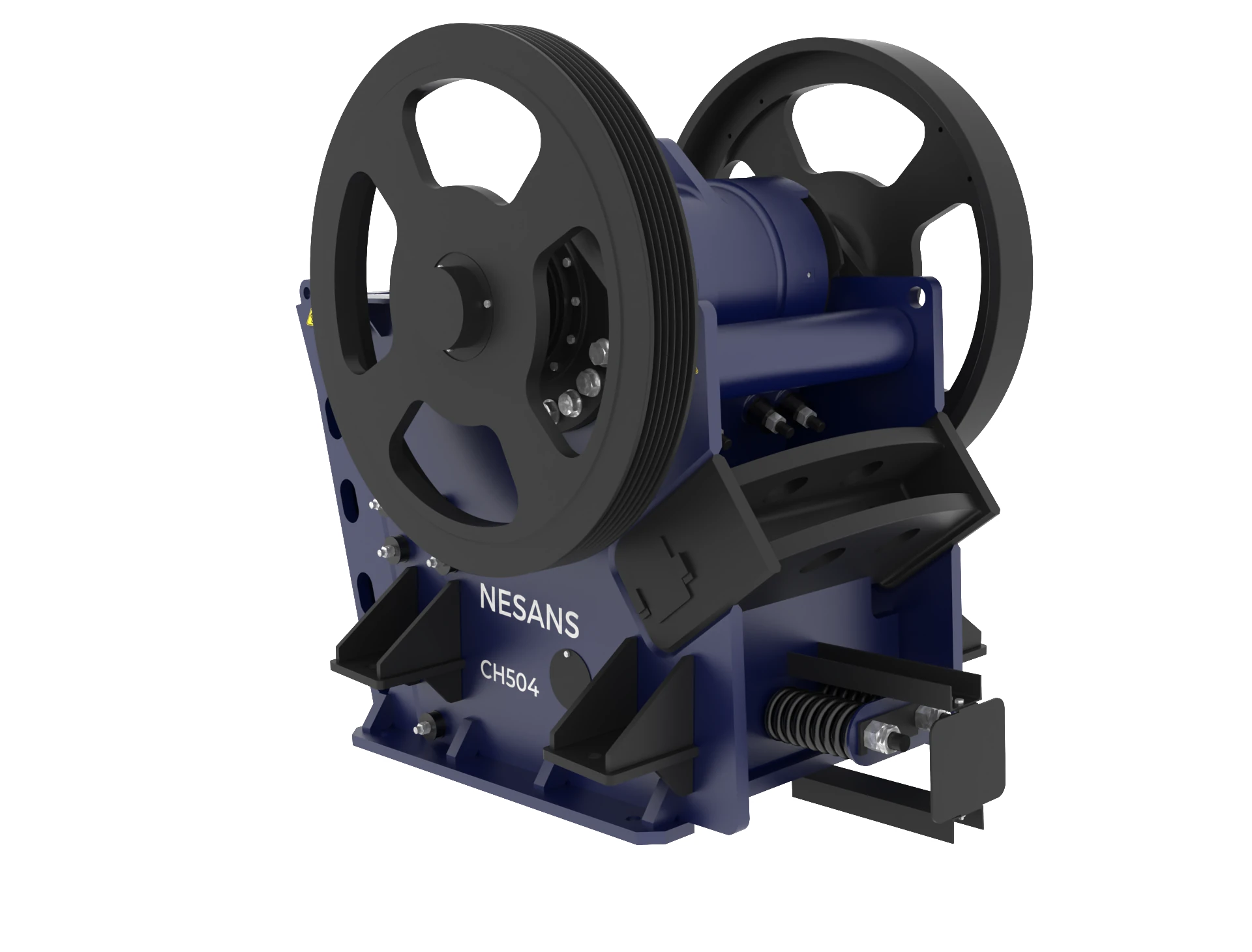
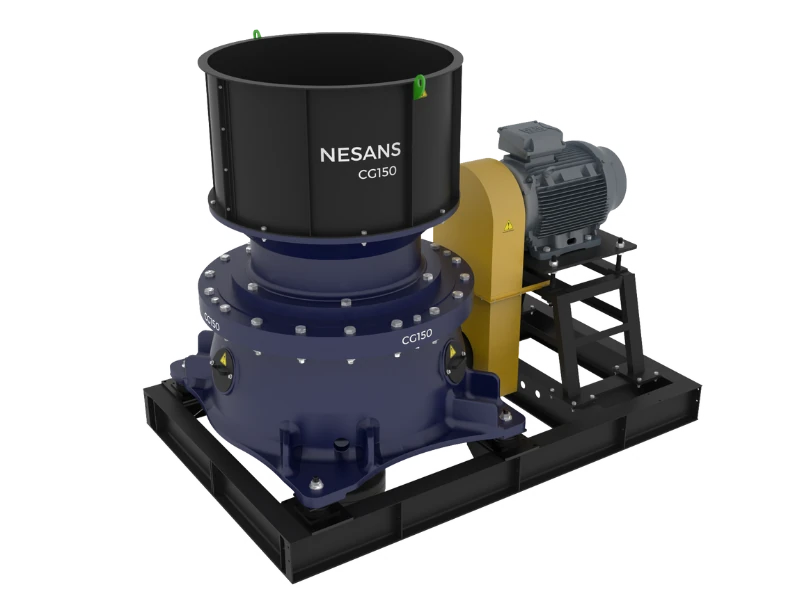
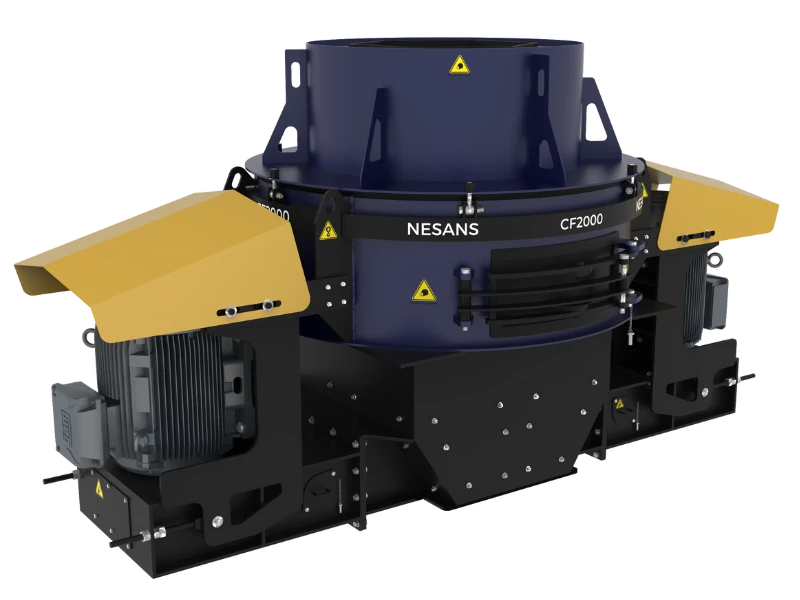
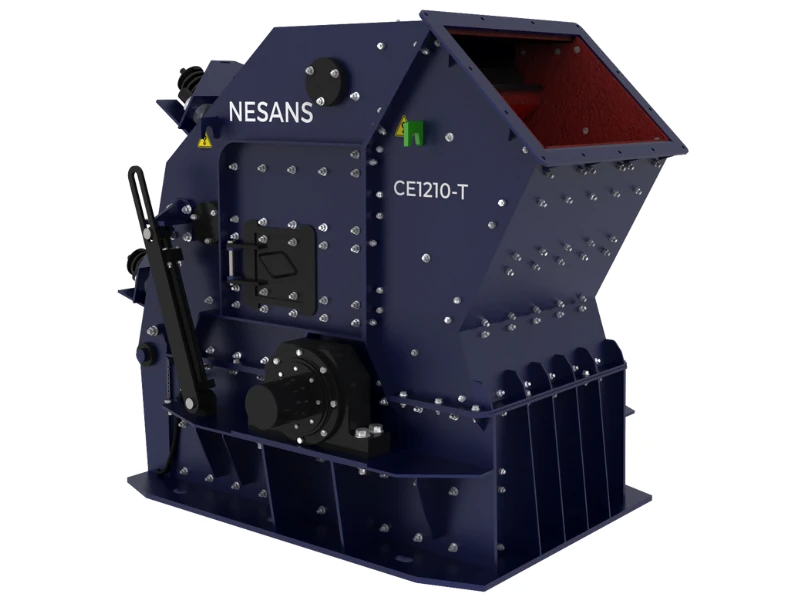
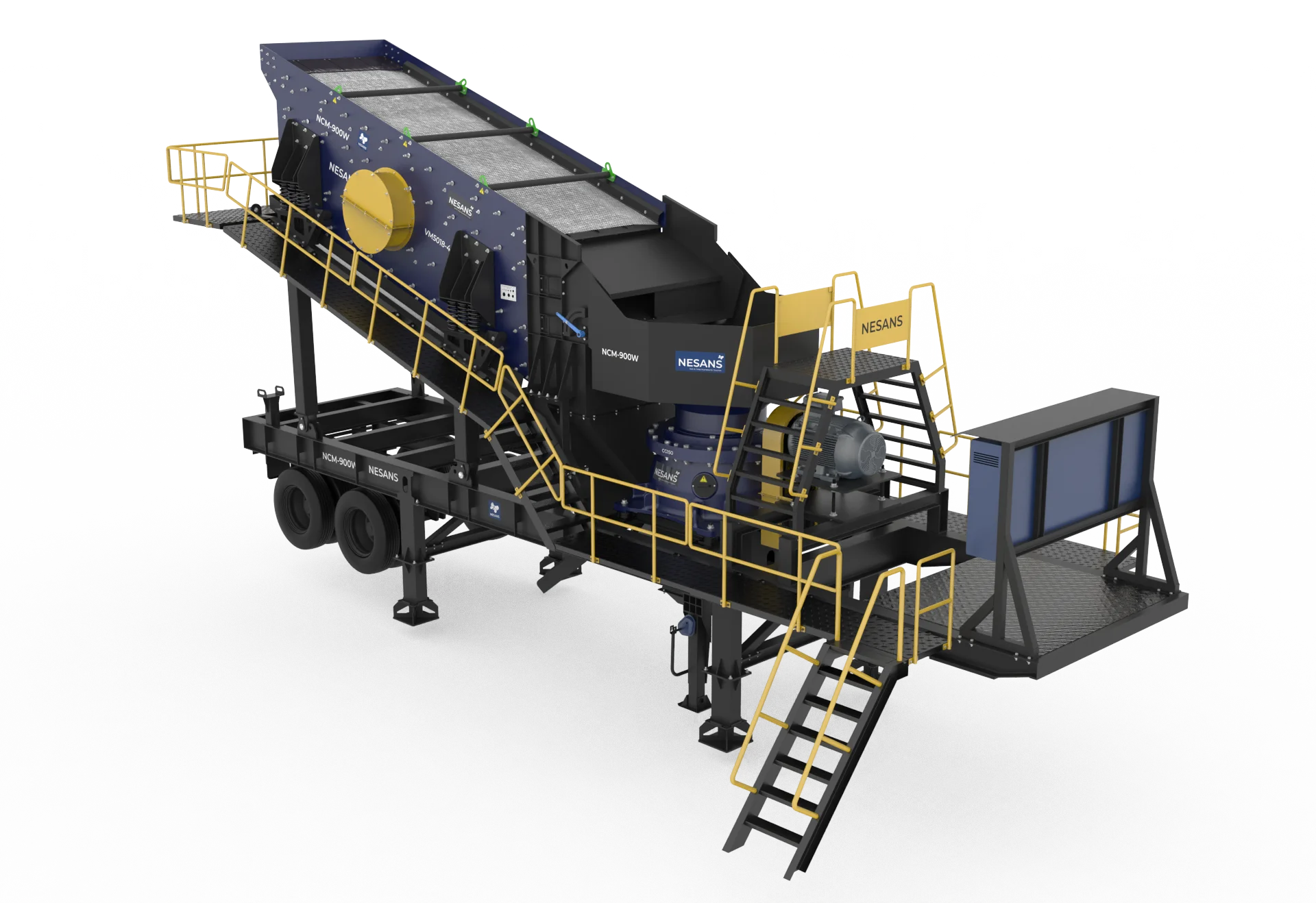
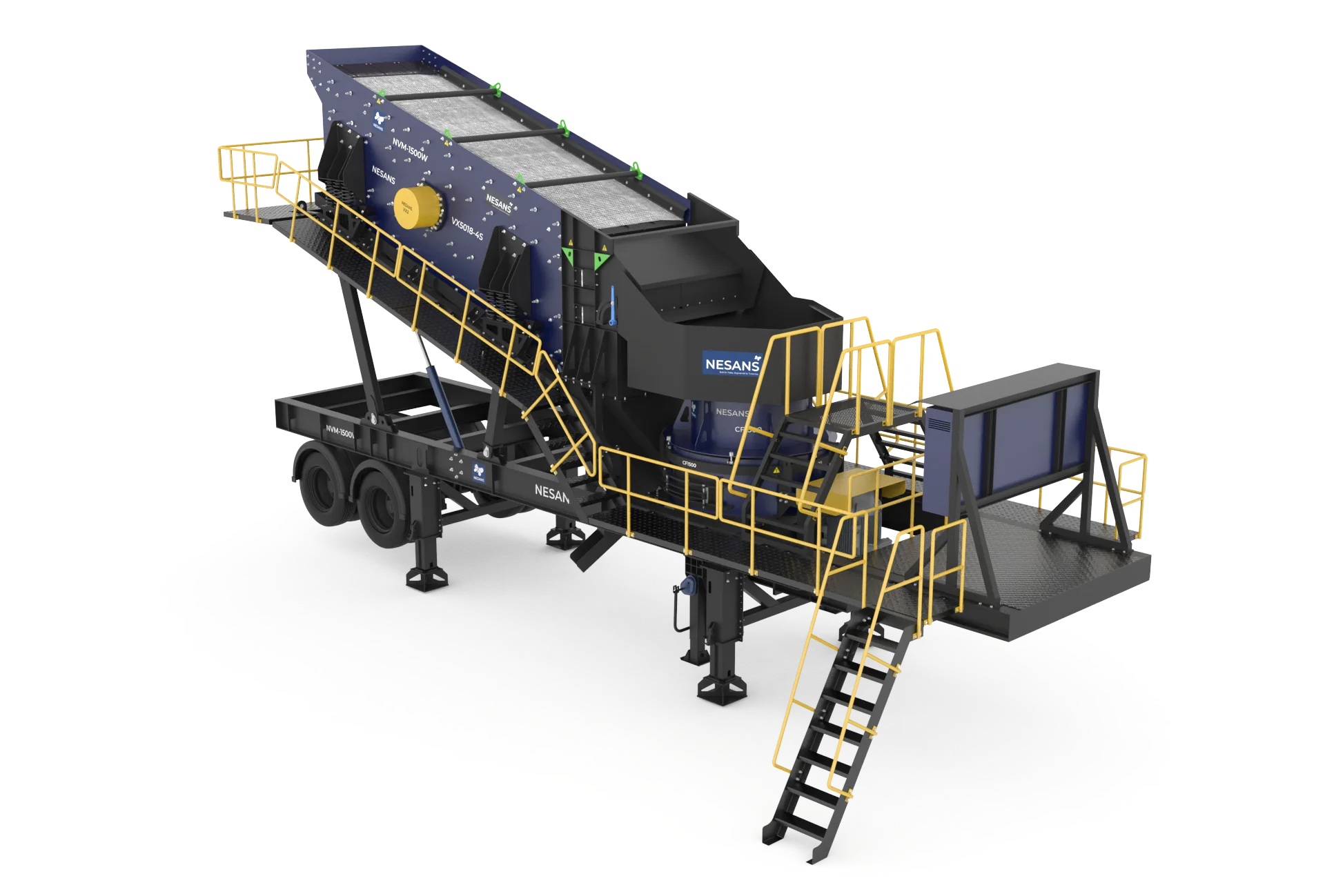
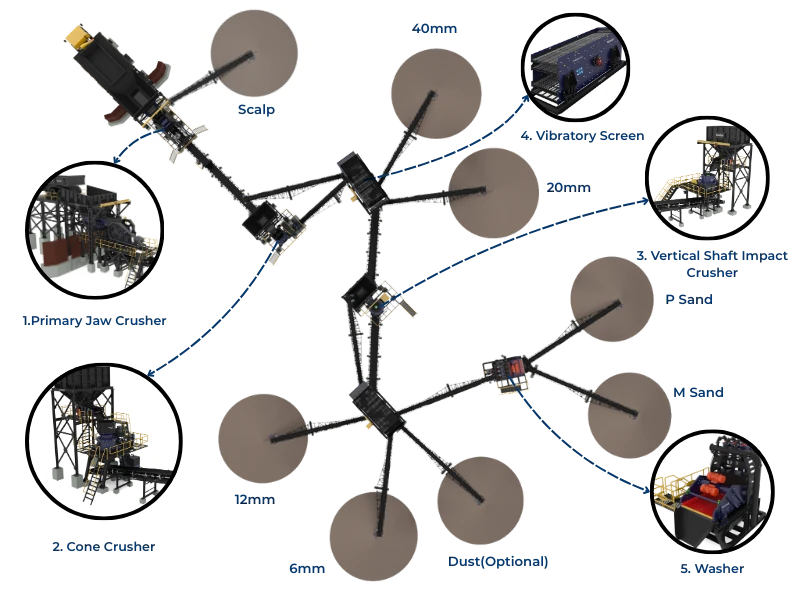
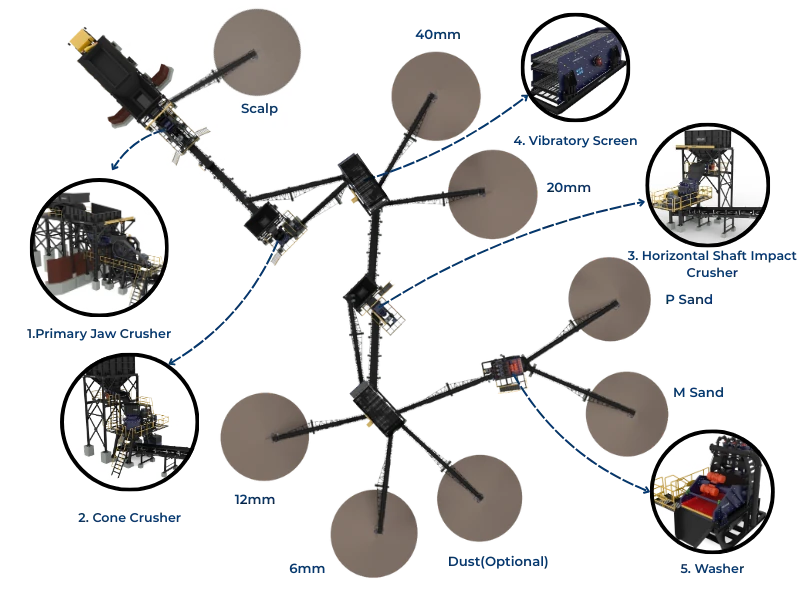
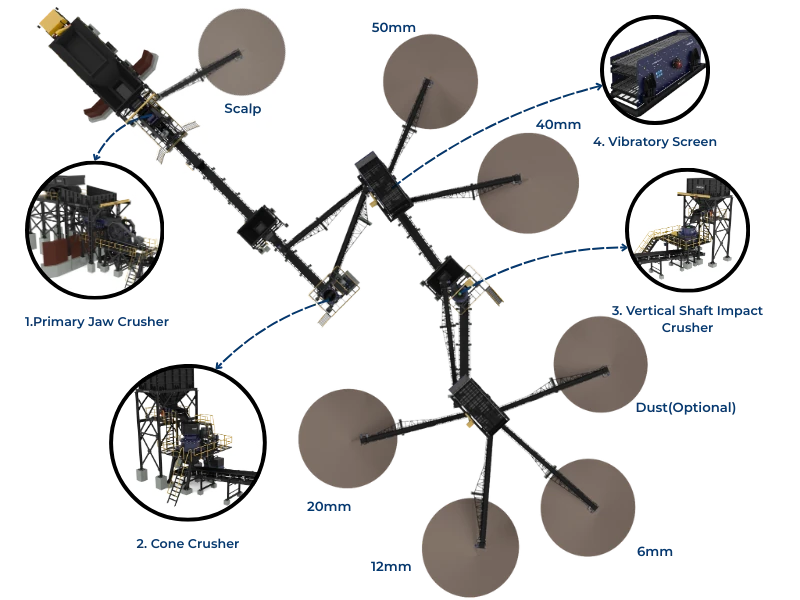
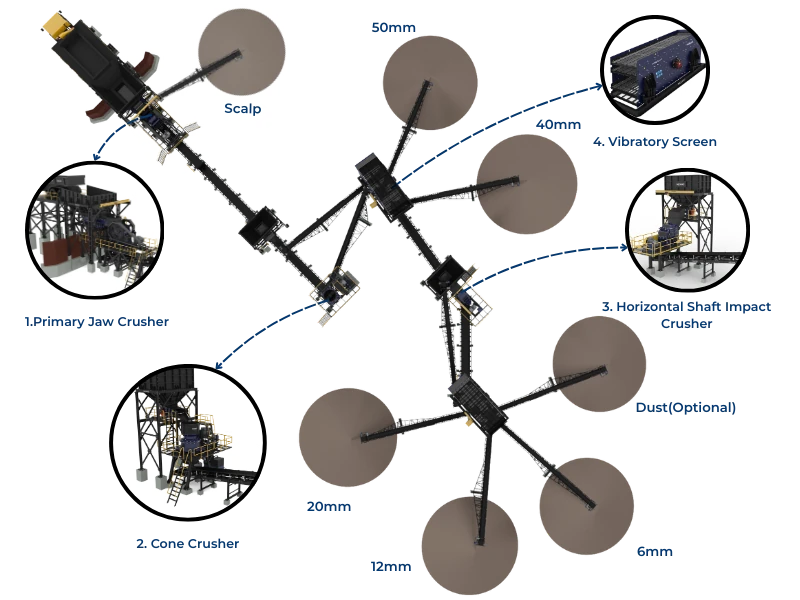
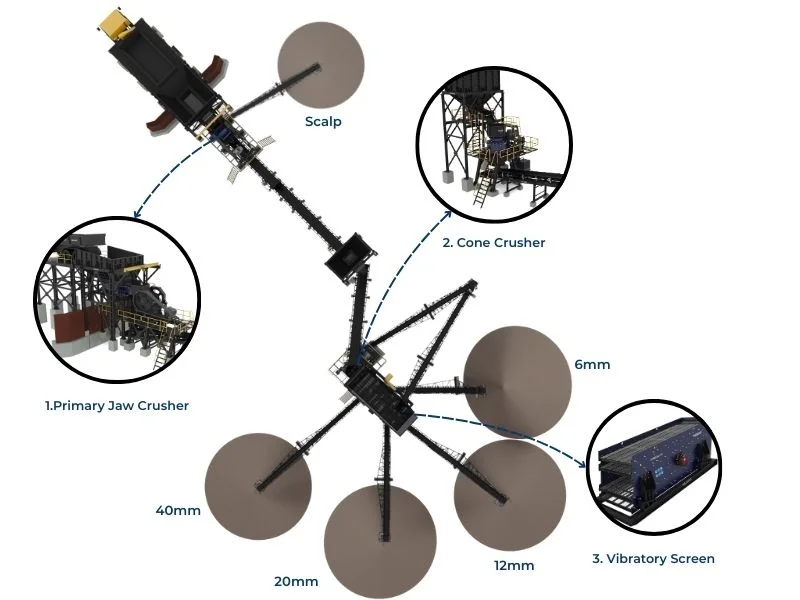
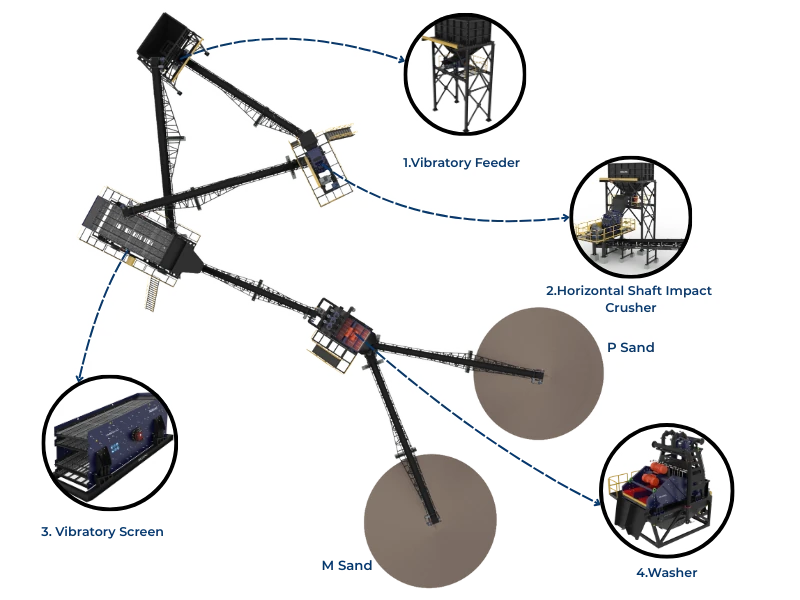
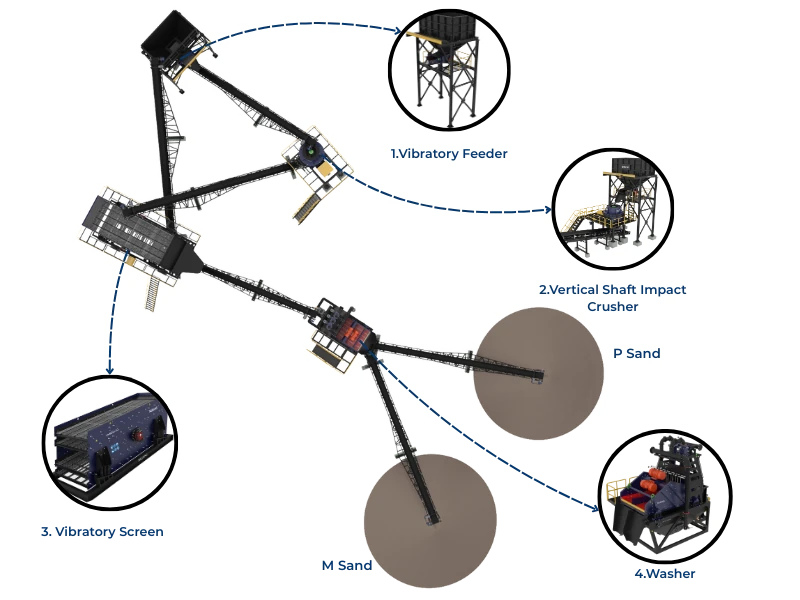
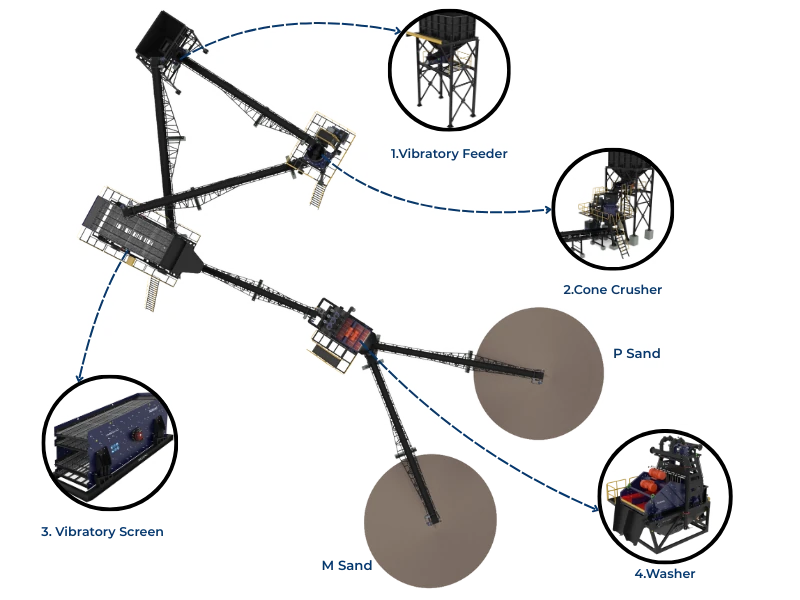
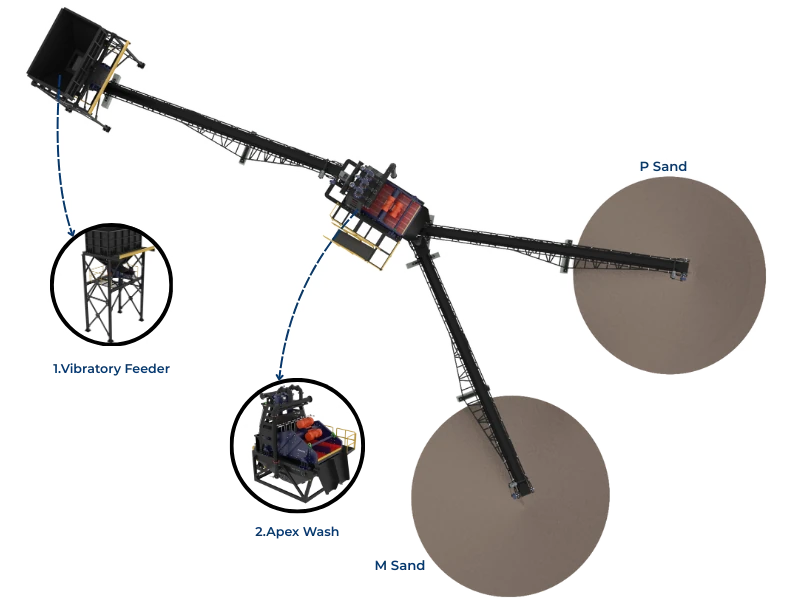
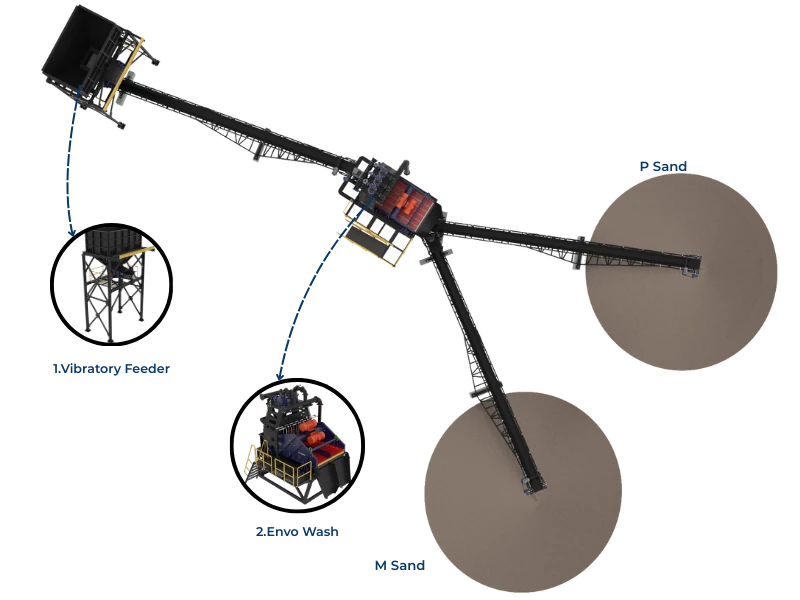
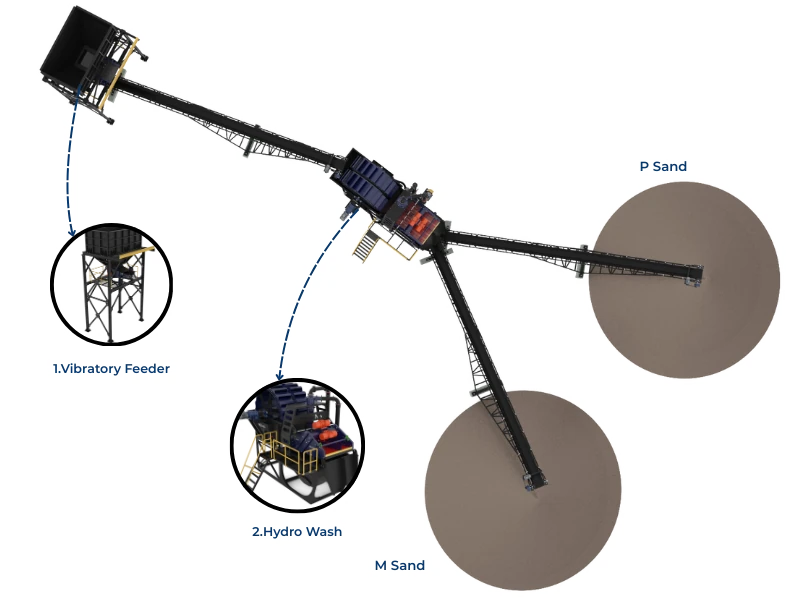




Your CG150 cone crusher produces 100 TPH of crushed sand, yet ready-mix concrete manufacturers reject it due to poor particle shape—flakiness exceeding 20%, elongation above 15%. You meet tonnage targets but lose ₹600-800/ton in premium pricing because angular particles compromise concrete workability. The issue isn't crushing capacity; it's crushing mechanism. Cone crushers use compression, creating angular particles. VSI crushers use rock-on-rock impact, producing cubical particles with flakiness under 10%—transforming commodity sand into IS 383:2016 compliant M-Sand commanding ₹1,800-2,200/ton premium pricing.
Manufactured sand (M-Sand) production requires more than reducing rock to fine aggregates. Particle shape, gradation control, and fineness modulus determine whether material qualifies for structural concrete applications at premium prices—or gets relegated to low-grade plastering work at commodity rates. The crushing technology choice—VSI (Vertical Shaft Impact) versus cone crusher—fundamentally determines product quality, operating economics, and market positioning.
This comprehensive analysis compares the CF1000 VSI crusher against the CG150 cone crusher for M-Sand production, examining crushing mechanisms, product quality differences, operational economics, and ROI calculations. We provide specific technical data, cost comparisons, and application guidelines to help you select the optimal technology for your market requirements.
Understanding Crushing Technologies for M-Sand
VSI Crushing Mechanism: Rock-on-Rock Impact
Vertical Shaft Impact (VSI) crushers utilize high-speed rotor impact to accelerate particles to 60-80 m/s, creating rock-on-rock collisions within a crushing chamber. This impact fracture produces cubical particles with minimal flakiness and elongation.
CF1000 VSI Crushing Process:
- Feed Entry: Material enters centrally through feed tube, directed to high-speed rotor (1,200-1,500 RPM)
- Acceleration: Rotor tips accelerate particles to 60-75 m/s tangential velocity
- Primary Impact: Accelerated particles strike stationary anvils or material curtain at chamber periphery
- Secondary Breakage: Fractured particles collide with each other in crushing chamber, creating attrition
- Shape Refinement: Multiple impacts abrade sharp edges, producing rounded cubical particles
- Product Discharge: Material exits through bottom discharge when reduced to target size (0-5mm M-Sand)
Key Advantage: Rock-on-rock impact naturally produces cubical particles because fracture occurs along natural weakness planes in all three dimensions. Particle shape is inherently superior to compression crushing, with flakiness index typically 8-12% versus 18-25% for cone crushers.
Cone Crushing Mechanism: Compression Between Concave and Mantle
Cone crushers operate through compression between an eccentrically rotating mantle and fixed concave liner. Material is squeezed repeatedly as it descends through the crushing chamber, fracturing when compressive stress exceeds rock strength.
CG150 Cone Crushing Process:
- Feed Distribution: Material gravity feeds into top of crushing chamber, distributing around mantle periphery
- Compression Cycles: Eccentric rotation creates 280-320 compression cycles per minute
- Progressive Reduction: Particles fracture when trapped between mantle and concave during compression stroke
- Size Classification: Closed Side Setting (CSS) determines minimum product size—particles smaller than CSS discharge
- Shape Formation: Compression creates fracture predominantly in two dimensions (parallel to compression direction), producing flat and elongated particles
- Product Discharge: Material exits when reduced to CSS dimension (typically 10-16mm for secondary crushing, 3-8mm for tertiary)
Limitation for M-Sand: Compression crushing inherently produces more angular and elongated particles because fracture occurs primarily along planes perpendicular to compression force. Achieving IS 383:2016 particle shape specifications (flakiness <15%, elongation <15%) is challenging without additional VSI shaping stage.
CF1000 VSI Crusher: Technical Specifications for M-Sand
Capacity and Performance Parameters
The CF1000 VSI crusher is specifically designed for tertiary crushing and particle shaping applications, producing high-quality M-Sand from pre-crushed feed material.
Production Capacity:
- M-Sand Production (0-5mm): 60-80 TPH depending on feed characteristics and rotor speed
- Feed Size Range: 35-50mm (maximum 80% passing 40mm for optimal performance)
- Product Size Distribution: 0-5mm with 85-90% passing 4.75mm (IS sieve designation)
- Rotor Diameter: 1,000mm with three or four wear-resistant tip configurations
- Rotor Speed Range: 1,200-1,500 RPM (adjustable for gradation control)
- Peripheral Velocity: 63-79 m/s at rotor tips
Power and Drive System:
- Installed Power: 160-200 kW (215-270 HP) depending on feed hardness and target fineness
- Specific Energy Consumption: 2.5-3.2 kWh/ton for granite crushing (Mohs hardness 6-7)
- Drive Type: Direct drive or V-belt drive with hydraulic coupling for soft start
- Motor Configuration: 1,500 RPM motor with variable frequency drive (VFD) for speed optimization
Crushing Chamber Configuration:
- Chamber Type: Rock-on-rock with adjustable cascading material curtain
- Anvil Design: Replaceable wear-resistant anvils (optional for rock-on-iron mode)
- Feed Opening: 300-350mm diameter center feed tube
- Discharge Opening: Bottom discharge with integrated product conveyor
Product Quality Characteristics
Particle Shape (Critical for M-Sand):
- Flakiness Index: 8-12% (IS 2386 Part 1)—well below IS 383:2016 limit of 15%
- Elongation Index: 6-10% (IS 2386 Part 1)—significantly superior to cone crusher products
- Particle Morphology: Sub-angular to cubical with rounded edges
- Surface Texture: Slightly rough, providing excellent cement paste bonding
Gradation Control:
- Fineness Modulus: 2.6-2.9 (adjustable through rotor speed)—ideal for Zone II M-Sand
- Gradation Consistency: ±0.15 FM variation across production runs
- Dust Generation: 12-18% passing 75µm (controllable through air classification)
⚠️ Application Note: CF1000 VSI produces M-Sand that consistently meets IS 383:2016 specifications for fine aggregates without requiring post-crushing particle shaping. This eliminates additional processing stages and delivers premium product suitable for high-grade concrete (M40-M60 mix designs).
CG150 Cone Crusher: Technical Specifications for Secondary/Tertiary Crushing
Capacity and Performance Parameters
The CG150 cone crusher is designed for secondary and tertiary crushing in aggregate production circuits, typically producing 5-25mm products that require additional processing for M-Sand applications.
Production Capacity:
- Secondary Crushing (CSS 10-16mm): 100-140 TPH with 40-100mm feed
- Tertiary Crushing (CSS 6-10mm): 80-120 TPH with 25-50mm feed
- M-Sand Circuit (CSS 3-6mm): 60-90 TPH but requires additional VSI shaping for particle quality
- Feed Size Range: 40-100mm for secondary, 25-60mm for tertiary applications
- Product Size Range: 3-12mm (requires post-crushing for 0-5mm M-Sand production)
Crushing Chamber Design:
- Mantle Diameter: 1,500mm at base
- Concave Configuration: Medium or fine cavity depending on application (interchangeable liners)
- Eccentric Speed: 280-320 RPM
- Eccentric Throw: 24-28mm
- CSS Adjustment Range: 3-25mm (hydraulic or manual adjustment)
Power and Drive System:
- Installed Power: 110-132 kW (150-180 HP)
- Specific Energy Consumption: 1.4-1.8 kWh/ton for granite crushing
- Drive Type: V-belt drive with flywheel for energy storage
- Hydraulic System: Tramp release and CSS adjustment (pressure 100-150 bar)
Product Quality Characteristics
Particle Shape (Limitation for M-Sand):
- Flakiness Index: 18-25% (IS 2386 Part 1)—exceeds IS 383:2016 limit of 15% for fine aggregates
- Elongation Index: 15-20%—marginal compliance or non-compliant for M-Sand specifications
- Particle Morphology: Angular to sub-angular with flat and elongated particles
- Surface Texture: Rough with sharp edges
Gradation Control:
- Fineness Modulus: 3.2-3.6 (CSS 6mm tertiary operation)—coarser than optimal for M-Sand
- Gradation Consistency: ±0.25 FM variation due to liner wear progression
- Dust Generation: 8-12% passing 75µm (lower than VSI due to compression mechanism)
⚠️ Critical Limitation: CG150 cone crusher product requires additional VSI shaping stage to meet IS 383:2016 particle shape specifications for M-Sand. Direct use in concrete results in harsh mixes requiring higher cement content (40-60 kg/m³ additional) and compromised workability. Market acceptance is limited to non-structural applications or requires blending with natural river sand.
Product Quality Comparison: VSI vs Cone for M-Sand
Particle Shape Analysis
Particle shape is the most critical quality parameter for M-Sand, directly impacting concrete workability, cement efficiency, and structural performance.
CF1000 VSI Product Shape:
- Flakiness Index: 8-12% (average 10%)—35-50% better than cone crusher products
- Elongation Index: 6-10% (average 8%)—40-55% superior to cone products
- Angularity: Sub-angular to rounded cubical particles
- Edge Condition: Rounded edges from multiple impact events
- IS 383:2016 Compliance: Consistently meets fine aggregate specifications (flakiness <15%, elongation <15%)
- RMC Acceptance: Premium grade suitable for M40-M60 structural concrete without modification
CG150 Cone Product Shape:
- Flakiness Index: 18-25% (average 22%)—exceeds IS 383:2016 limits by 45-65%
- Elongation Index: 15-20% (average 18%)—marginal to non-compliant for M-Sand
- Angularity: Highly angular with predominant flat particles
- Edge Condition: Sharp edges from compression fracture
- IS 383:2016 Compliance: Typically fails particle shape requirements without additional processing
- RMC Acceptance: Requires blending with natural sand (30-40%) or VSI reshaping for structural applications
Gradation and Fineness Modulus
CF1000 VSI Gradation Control:
- Fineness Modulus Range: 2.6-2.9 (adjustable through rotor speed 1,200-1,500 RPM)
- Grading Zone: Consistently produces Zone II grading (IS 383:2016)—optimal for concrete applications
- Adjustment Mechanism: Increase rotor speed to reduce FM (finer product), decrease for coarser gradation
- Response Time: Immediate gradation change with speed adjustment—real-time quality control
- Dust Content: 12-18% passing 75µm (controllable through air classification or screening)
CG150 Cone Gradation Control:
- Fineness Modulus Range: 3.2-3.6 (CSS 6mm tertiary operation)—coarser than M-Sand specifications
- Grading Zone: Produces Zone IV grading (coarse sand)—requires blending for Zone II compliance
- Adjustment Mechanism: CSS reduction to decrease FM, but limited by liner wear and crusher geometry
- Response Time: Gradual change over liner wear cycle—difficult real-time control
- Dust Content: 8-12% passing 75µm (lower dust generation than VSI)
⚠️ Market Impact: RMC plants specify FM 2.6-2.9 for M-Sand to optimize concrete mix designs. VSI products meet this specification directly. Cone crusher products at FM 3.2-3.6 require blending with manufactured or natural fine sand, adding ₹200-300/ton material cost and reducing product value by ₹400-600/ton due to non-compliance.
Surface Texture and Cement Bonding
VSI Surface Characteristics:
- Texture: Slightly rough with micro-fractured surface from impact crushing
- Specific Surface Area: 15-20% higher than cone products due to surface microfracturing
- Cement Paste Bonding: Excellent mechanical interlock—improves concrete compressive strength by 8-12%
- Water Demand: Moderate (5-8% higher than natural sand) due to angular surface but cubical shape
Cone Surface Characteristics:
- Texture: Very rough with sharp fractured faces from compression
- Specific Surface Area: High due to angular and elongated particle shape
- Cement Paste Bonding: Good mechanical interlock but poor particle packing due to shape
- Water Demand: High (12-18% higher than natural sand)—increases cement requirement for target workability
Operational Economics Comparison
Energy Consumption Analysis
CF1000 VSI Energy Profile:
- Specific Energy: 2.5-3.2 kWh/ton for granite M-Sand production (0-5mm product)
- Installed Power: 160-200 kW motor
- Operating Load: 75-85% of installed capacity during normal operation
- No-Load Power: 25-30 kW (15% of installed power)
- Energy Cost (₹6/kWh): ₹15-19/ton production cost
- Annual Energy Cost (60 TPH, 6,000 hours): ₹54-68 lakhs
CG150 Cone Energy Profile:
- Specific Energy: 1.4-1.8 kWh/ton for tertiary crushing (6mm CSS, 3-12mm product)
- Installed Power: 110-132 kW motor
- Operating Load: 80-90% of installed capacity
- No-Load Power: 18-22 kW (16% of installed power)
- Energy Cost (₹6/kWh): ₹8.4-10.8/ton production cost
- Annual Energy Cost (90 TPH, 6,000 hours): ₹45-58 lakhs
⚠️ Energy Efficiency Note: Cone crusher shows 35-45% lower specific energy consumption, but this compares secondary crushing (cone) to tertiary M-Sand production (VSI). Complete M-Sand circuit using cone requires additional VSI shaping stage, total energy consumption 3.8-5.0 kWh/ton (cone secondary + VSI tertiary) versus 2.5-3.2 kWh/ton for direct VSI M-Sand production from jaw crusher discharge.
Wear Parts and Maintenance Costs
CF1000 VSI Wear Parts:
- Rotor Tips (Primary Wear Item):
- Material: High chrome white iron or tungsten carbide inserts
- Life: 8,000-12,000 tons (granite, Mohs 6-7 hardness)
- Replacement Cost: ₹1.6-2.0 lakhs per set (4 tips)
- Cost per Ton: ₹13.3-25.0/ton
- Replacement Time: 3-4 hours (simple bolt-on design)
- Anvil Ring (Secondary Wear):
- Life: 20,000-30,000 tons
- Cost: ₹80,000-1.2 lakhs
- Cost per Ton: ₹2.7-6.0/ton
- Bearing Assembly:
- Life: 15,000-20,000 operating hours (5-7 years at 6,000 hrs/year)
- Cost: ₹2.5-3.5 lakhs
- Total Wear Cost: ₹16-31/ton (average ₹23.5/ton)
CG150 Cone Wear Parts:
- Mantle and Concave Liners (Primary Wear):
- Material: Manganese steel (Mn14Cr2 or Mn18Cr2)
- Life: 15,000-25,000 tons (granite tertiary crushing)
- Mantle Cost: ₹1.2-1.5 lakhs
- Concave Cost: ₹1.8-2.2 lakhs
- Combined Cost per Ton: ₹12.0-24.7/ton (average ₹18/ton)
- Replacement Time: 8-12 hours (requires disassembly)
- Bowl Liner:
- Life: Same as concave (replaced together)
- Included in concave cost above
- Eccentric Bearing:
- Life: 12,000-18,000 operating hours (4-6 years)
- Cost: ₹3.5-5.0 lakhs
- Countershaft Bushing:
- Life: 8,000-12,000 hours
- Cost: ₹40,000-60,000
- Total Wear Cost: ₹12-25/ton (average ₹18.5/ton)
⚠️ Maintenance Complexity: VSI crusher features modular design with bolt-on rotor tips replaceable in 3-4 hours without specialized tools. Cone crusher liner replacement requires 8-12 hours downtime, specialized lifting equipment, and skilled labor. VSI maintenance cost per operating hour is 25-30% lower due to reduced labor and downtime.
Operating Cost Summary (per Ton of M-Sand)
CF1000 VSI Operating Costs:
- Energy: ₹15-19/ton (₹6/kWh rate, 2.5-3.2 kWh/ton)
- Wear Parts: ₹16-31/ton (rotor tips + anvils + bearing amortization)
- Maintenance Labor: ₹8-12/ton (₹500/hour skilled labor, 0.015 hours/ton)
- Lubrication: ₹2-3/ton (bearing grease)
- Total Operating Cost: ₹41-65/ton (average ₹53/ton)
CG150 Cone Operating Costs (Tertiary Mode):
- Energy: ₹8.4-10.8/ton (₹6/kWh rate, 1.4-1.8 kWh/ton)
- Wear Parts: ₹12-25/ton (liners + bearing amortization)
- Maintenance Labor: ₹12-18/ton (₹500/hour skilled labor, 0.025 hours/ton higher complexity)
- Lubrication: ₹3-5/ton (hydraulic oil + bearing lubrication)
- Total Operating Cost: ₹35.4-58.8/ton (average ₹47/ton)
Complete M-Sand Circuit Cost (Cone + VSI):
- Cone Secondary: ₹47/ton (produces 10-25mm for VSI feed)
- VSI Tertiary Shaping: ₹53/ton (produces M-Sand from cone product)
- Total Circuit Cost: ₹100/ton
⚠️ Economic Reality: While cone crusher shows lower operating cost (₹47/ton vs ₹53/ton VSI), producing IS 383:2016 compliant M-Sand from cone requires additional VSI shaping, total cost ₹100/ton versus ₹53/ton for direct VSI M-Sand production. Single-stage VSI reduces operating cost by 47% while delivering superior product quality.
Market Pricing and Quality Premium Analysis
M-Sand Market Segmentation
Premium Grade M-Sand (VSI Product):
- Market Price: ₹1,800-2,200/ton (metro markets RMC supply)
- Quality Specifications:
- Flakiness index <10%
- Elongation index <10%
- Fineness modulus 2.6-2.9 (Zone II)
- Dust content 10-15%
- IS 383:2016 full compliance
- Applications: High-grade structural concrete (M40-M60), precast elements, infrastructure projects
- Customer Segment: RMC plants, precast manufacturers, premium construction projects
- Market Share: 30-35% of total M-Sand market (growing 15-20% annually)
Standard Grade M-Sand (Cone Product or Blended):
- Market Price: ₹1,200-1,500/ton (general construction)
- Quality Specifications:
- Flakiness index 15-20% (marginal compliance)
- Elongation index 12-18%
- Fineness modulus 2.9-3.4
- Often blended with 20-30% natural sand for workability
- Applications: Standard concrete (M20-M30), masonry, plastering
- Customer Segment: General contractors, builders, individual house construction
- Market Share: 50-55% of M-Sand market
Economy Grade Crushed Sand (Cone Direct Use):
- Market Price: ₹800-1,100/ton (low-grade applications)
- Quality Issues:
- Flakiness index >20% (non-compliant)
- Elongation index >18%
- Harsh mix requiring excess cement (40-60 kg/m³ additional)
- Applications: Plastering, bedding, non-structural fills
- Market Share: 15-20% (declining as quality awareness increases)
Quality Premium Justification
Why RMC Plants Pay ₹600-1,000/ton Premium for VSI M-Sand:
- Cement Savings: Cubical particles pack efficiently, reducing cement requirement by 30-50 kg/m³ (₹150-250 savings per m³ concrete)
- Workability: Superior particle shape improves slump flow, reducing admixture dosage by 0.3-0.5% (₹20-35/m³ savings)
- Strength Consistency: Uniform gradation and shape deliver predictable 28-day strength, reducing concrete rejection rates from 3-5% to <1%
- Pumping Performance: Cubical particles reduce pump pressure by 15-20%, increasing pumping distance and reducing equipment wear
- Quality Certification: IS 383:2016 compliance eliminates third-party testing costs (₹3,000-5,000 per batch) and project acceptance delays
- Brand Value: RMC plants market "premium M-Sand concrete" to high-value projects (infrastructure, commercial), commanding 8-12% price premium
Total Value to RMC Customer: ₹200-320/m³ concrete savings (cement + admixture + quality assurance) while paying ₹600/ton premium. At 1.5 tons M-Sand per m³ concrete, premium cost is ₹900/m³, but operational savings offset 22-35% of this cost, making net premium economically justified for structural applications.
ROI Analysis: CF1000 VSI vs CG150 Cone for 100 TPH M-Sand Plant
Capital Investment Comparison
CF1000 VSI System (Direct M-Sand Production):
- CF1000 VSI Crusher: ₹45-55 lakhs (includes motor, drive system)
- Vibrating Screen (2-deck): ₹12-15 lakhs (separates 0-5mm M-Sand from oversize recirculation)
- Conveyors and Structure: ₹15-20 lakhs
- Dust Collection System: ₹8-12 lakhs (bag filter for environmental compliance)
- Electrical and Automation: ₹10-12 lakhs
- Total Capital Investment: ₹90-114 lakhs (average ₹102 lakhs)
- Production Capacity: 60-70 TPH M-Sand (average 65 TPH)
- Specific Capital Cost: ₹1.40-1.90 lakhs per TPH (average ₹1.57 lakhs/TPH)
CG150 Cone System (Requires Additional VSI for M-Sand Quality):
- CG150 Cone Crusher: ₹35-42 lakhs (includes hydraulic system)
- Primary Screening (2-deck): ₹12-15 lakhs (separates cone product)
- CF800 VSI Shaper: ₹38-45 lakhs (required for particle shape correction)
- Secondary Screening (2-deck): ₹10-12 lakhs (final M-Sand classification)
- Conveyors and Structure: ₹25-32 lakhs (two-stage circuit)
- Dust Collection: ₹10-15 lakhs (two collection points)
- Electrical and Automation: ₹15-18 lakhs (two crushers, complex circuit)
- Total Capital Investment: ₹145-179 lakhs (average ₹162 lakhs)
- Production Capacity: 55-65 TPH M-Sand (average 60 TPH—lower due to recirculation)
- Specific Capital Cost: ₹2.23-3.25 lakhs per TPH (average ₹2.70 lakhs/TPH)
⚠️ Capital Cost Reality: Cone crusher alone costs 22-24% less than VSI (₹35-42L vs ₹45-55L), but complete M-Sand circuit requires cone + VSI, total investment ₹162 lakhs versus ₹102 lakhs for single-stage VSI—59% higher capital for cone-based system. This fundamental economics favors VSI for dedicated M-Sand production.
Annual Operating Economics (6,000 Operating Hours)
CF1000 VSI Direct M-Sand Production:
- Production: 65 TPH × 6,000 hours = 390,000 tons annually
- Operating Cost: ₹53/ton × 390,000 = ₹2.07 crores
- Revenue (₹2,000/ton premium M-Sand): 390,000 × ₹2,000 = ₹78 crores
- Gross Margin: ₹78 - ₹2.07 = ₹75.93 crores (97.3% margin excluding raw material)
- Depreciation (10 years): ₹102 lakhs ÷ 10 = ₹10.2 lakhs/year
- Net Operating Profit: ₹75.93 - ₹0.102 = ₹75.83 crores annually
CG150 Cone + VSI M-Sand Circuit:
- Production: 60 TPH × 6,000 hours = 360,000 tons annually
- Operating Cost: ₹100/ton × 360,000 = ₹3.60 crores (cone + VSI stages)
- Revenue (₹2,000/ton—same premium quality): 360,000 × ₹2,000 = ₹72 crores
- Gross Margin: ₹72 - ₹3.60 = ₹68.40 crores (95.0% margin)
- Depreciation (10 years): ₹162 lakhs ÷ 10 = ₹16.2 lakhs/year
- Net Operating Profit: ₹68.40 - ₹0.162 = ₹68.24 crores annually
Annual Profitability Comparison:
- VSI System Profit: ₹75.83 crores
- Cone + VSI System Profit: ₹68.24 crores
- VSI Advantage: ₹7.59 crores higher annual profit (11.1% improvement)
Return on Investment Calculation
CF1000 VSI System ROI:
- Initial Investment: ₹102 lakhs
- Annual Net Profit: ₹75.83 crores
- Payback Period: ₹1.02 crores ÷ ₹75.83 crores = 0.013 years = 4.9 days
- ROI (First Year): (₹75.83 - ₹1.02) ÷ ₹1.02 × 100 = 7,335%
- 5-Year NPV (12% discount): ₹273 crores
CG150 Cone + VSI System ROI:
- Initial Investment: ₹162 lakhs
- Annual Net Profit: ₹68.24 crores
- Payback Period: ₹1.62 crores ÷ ₹68.24 crores = 0.024 years = 8.7 days
- ROI (First Year): (₹68.24 - ₹1.62) ÷ ₹1.62 × 100 = 4,113%
- 5-Year NPV (12% discount): ₹246 crores
⚠️ ROI Interpretation: Both systems show exceptional ROI because analysis excludes raw material costs (assumes captive quarry). The critical comparison is relative performance: VSI system delivers ₹7.59 crores higher annual profit while requiring ₹60 lakhs lower capital investment. Over 5-year equipment life, VSI generates ₹27 crores additional cumulative profit—a compelling economic advantage for dedicated M-Sand production.
Application Suitability: When to Choose Each Technology
Choose CF1000 VSI When:
- Primary Goal is Premium M-Sand: Targeting RMC plants and high-value structural concrete applications requiring IS 383:2016 full compliance
- Quality Over Tonnage: Market accepts premium pricing (₹1,800-2,200/ton) for superior particle shape, making lower VSI capacity (60-70 TPH) economically favorable vs. higher cone tonnage (90-120 TPH) at lower price
- Single-Product Focus: Production dedicated to 0-5mm M-Sand without requirement for multiple aggregate grades
- Capital Efficiency: Budget constraints favor lower initial investment (₹102L vs ₹162L for complete M-Sand system)
- Simplified Operations: Preference for single-stage crushing with simpler maintenance (bolt-on wear parts vs. liner replacement)
- Feed Material Available: Pre-crushed 35-50mm feed available from jaw crusher or existing aggregate plant
- Environmental Sensitivity: Dust collection easier in single-stage system (one capture point vs. two)
- Market Positioning: Brand differentiation through certified quality product rather than commodity volume play
Choose CG150 Cone When:
- Multi-Product Requirement: Need to produce multiple aggregate grades (10mm, 20mm, M-Sand) from single crushing circuit
- Secondary Crushing Priority: Primary application is 10-25mm aggregate production for concrete or road construction, with M-Sand as secondary product
- Energy Cost Critical: Electricity rates >₹8/kWh make cone's 35-45% lower energy consumption (1.4-1.8 vs 2.5-3.2 kWh/ton) significant
- Hard Rock Crushing: Extremely hard or abrasive materials (basalt, taconite) where impact crushing wear costs become prohibitive
- Existing Infrastructure: Cone crusher already installed in secondary position, considering adding VSI for tertiary M-Sand shaping
- Gradual Quality Upgrade: Currently selling standard grade M-Sand (₹1,200-1,500/ton), planning to add VSI shaping stage to access premium market
- Market Accepts Blended Product: Local market permits cone M-Sand blended with 20-30% natural sand for compliance
Hybrid Configuration: Cone Secondary + VSI Tertiary
For large plants (200+ TPH) producing multiple products, hybrid configuration optimizes both technologies:
- Jaw Crusher Primary: 250-300 TPH producing 0-100mm
- CG200 Cone Secondary: 200-250 TPH at CSS 12-16mm producing:
- 20mm aggregate (screened product): 80-100 TPH
- 10mm aggregate (screened product): 60-80 TPH
- 0-6mm fines to VSI: 60-70 TPH
- CF1000 VSI Tertiary: 60-70 TPH processing cone fines (0-6mm) into premium M-Sand (0-5mm)
Economics of Hybrid System:
- Capital Investment: ₹3.5-4.2 crores (complete plant with multiple crushers)
- Revenue Mix:
- 20mm aggregate: 90 TPH × ₹1,200/ton × 6,000 hrs = ₹64.8 crores
- 10mm aggregate: 70 TPH × ₹1,300/ton × 6,000 hrs = ₹54.6 crores
- VSI M-Sand: 65 TPH × ₹2,000/ton × 6,000 hrs = ₹78 crores
- Total Revenue: ₹197.4 crores annually
- Advantage: Diversified product portfolio maximizes revenue per ton of quarry material, using each crusher for its optimal application (cone for aggregate, VSI for premium M-Sand)
Process Integration and Plant Layout Considerations
VSI M-Sand Plant Configuration
Typical Process Flow:
- Primary Crushing: Jaw crusher (1,000 × 800mm) producing 0-100mm from quarry run
- Primary Screening: 2-deck vibrating screen separating:
- +50mm: Return to jaw crusher (closed circuit)
- 35-50mm: Feed to CF1000 VSI
- 0-35mm: Bypass to product stockpile or secondary VSI
- VSI Crushing: CF1000 VSI operating 1,350 RPM producing 0-5mm M-Sand
- Product Screening: 2-deck screen separating:
- +5mm: Return to VSI (closed circuit for shape refinement)
- 0-5mm: M-Sand product to washing/stockpile
- Optional: 0-75µm dust removal for fineness control
- Washing (Optional): Sand washing plant for dust removal and moisture control
- Stockpiling: Covered storage for weather protection
Key Design Parameters:
- Circulating Load: 20-30% of VSI feed returns as +5mm oversize
- Screen Efficiency: 90-95% for 5mm separation point
- Dust Generation Point: VSI discharge (bag filter required for environmental compliance)
- Power Demand: 280-350 kW total plant connected load
- Space Requirement: 800-1,200 m² including stockpiles
Cone M-Sand Plant Configuration
Typical Process Flow (Requires VSI Addition for Quality):
- Primary Crushing: Jaw crusher producing 0-100mm
- Secondary Crushing: CG150 cone at CSS 6-8mm producing 0-12mm
- Secondary Screening: Separating:
- +8mm: Aggregate product or recirculation
- 3-8mm: To VSI shaping
- 0-3mm: Direct to M-Sand product
- VSI Shaping: CF800 VSI for particle shape correction of 3-8mm fraction
- Product Screening: Combining VSI shaped product with 0-3mm fines
- Washing and Stockpiling
Complexity Issues:
- Two-Stage Crushing: More complex material flow, higher operating cost
- Multiple Screens: Intermediate screening increases capital and maintenance
- Higher Power: 380-450 kW total connected load (two crushers)
- Space Requirement: 1,200-1,600 m² (larger footprint)
Detailed Side-by-Side Comparison Table
| Parameter | CF1000 VSI Crusher | CG150 Cone Crusher | Advantage |
|---|---|---|---|
| Crushing Mechanism | Rock-on-rock impact | Compression between mantle and concave | VSI for particle shape |
| Primary Application | Tertiary crushing, M-Sand production | Secondary/tertiary aggregate crushing | Application-specific |
| M-Sand Capacity | 60-80 TPH (0-5mm direct) | 60-90 TPH (requires additional VSI shaping) | VSI for simplicity |
| Feed Size Range | 35-50mm (optimal 80% <40mm) | 40-100mm (secondary), 25-60mm (tertiary) | Cone for flexibility |
| Product Size | 0-5mm M-Sand (single stage) | 3-12mm (requires post-processing for M-Sand) | VSI for M-Sand |
| Flakiness Index | 8-12% (IS 2386 Part 1) | 18-25% (exceeds IS 383:2016 limit) | VSI 55-65% better |
| Elongation Index | 6-10% | 15-20% | VSI 50-67% better |
| Fineness Modulus | 2.6-2.9 (Zone II, ideal for M-Sand) | 3.2-3.6 (Zone IV, requires blending) | VSI optimal |
| IS 383:2016 Compliance | Direct compliance, no modification | Requires VSI shaping or blending | VSI certified |
| Installed Power | 160-200 kW | 110-132 kW | Cone 30-35% lower |
| Specific Energy | 2.5-3.2 kWh/ton | 1.4-1.8 kWh/ton (but doesn't produce M-Sand quality) | Cone lower (incomplete comparison) |
| Energy Cost per Ton | ₹15-19/ton (₹6/kWh) | ₹8.4-10.8/ton (for tertiary crushing only) | Cone 40-45% lower |
| Primary Wear Parts | Rotor tips (4 pcs bolt-on) | Mantle and concave liners | VSI simpler replacement |
| Wear Part Life | 8,000-12,000 tons (rotor tips) | 15,000-25,000 tons (liners) | Cone 25-50% longer life |
| Wear Cost per Ton | ₹16-31/ton (avg ₹23.5/ton) | ₹12-25/ton (avg ₹18.5/ton) | Cone 20-25% lower |
| Maintenance Downtime | 3-4 hours (rotor tip change) | 8-12 hours (liner replacement) | VSI 60-70% less downtime |
| Total Operating Cost | ₹41-65/ton (avg ₹53/ton) for M-Sand | ₹35-59/ton (avg ₹47/ton) for tertiary crushing + ₹53/ton VSI shaping = ₹100/ton for M-Sand | VSI 47% lower for M-Sand |
| Capital Cost (M-Sand Plant) | ₹90-114 lakhs (single stage) | ₹145-179 lakhs (cone + VSI required) | VSI 37-43% lower |
| Market Price (Premium M-Sand) | ₹1,800-2,200/ton (RMC grade) | ₹1,200-1,500/ton (standard, unless VSI added) | VSI ₹600-700/ton premium |
| RMC Plant Acceptance | Direct acceptance for M40-M60 concrete | Requires blending or reshaping | VSI certified quality |
| Gradation Adjustability | Real-time through rotor speed (1,200-1,500 RPM) | Limited by CSS, slow adjustment | VSI dynamic control |
| Dust Generation | 12-18% passing 75µm | 8-12% passing 75µm | Cone lower dust (but not M-Sand quality) |
| Plant Footprint | 800-1,200 m² (single stage) | 1,200-1,600 m² (two-stage circuit) | VSI 25-35% smaller |
| Operational Complexity | Simple single-stage circuit | Two-stage circuit with intermediate screening | VSI simpler operations |
| Annual Profit (100 TPH Plant) | ₹75.83 crores (65 TPH effective) | ₹68.24 crores (60 TPH effective with VSI) | VSI ₹7.6 crores higher |
| ROI Payback Period | 4.9 days | 8.7 days (cone + VSI system) | VSI 44% faster ROI |
| Best Application | Dedicated premium M-Sand production, RMC supply | Multi-product aggregate plants (10mm, 20mm, M-Sand) | Application-dependent |
Case Study 1: Premium M-Sand Plant Using CF1000 VSI
Project Overview
Location: Bangalore Metropolitan Region (High RMC demand market)
Commissioning: March 2023
Investment: ₹1.15 crores (complete plant with washing)
Capacity: 70 TPH M-Sand production
Plant Configuration
- Primary: PE900×1200 jaw crusher (150 TPH)
- Primary Screen: 2-deck 1.5×4.5m separating 35-50mm VSI feed
- Tertiary: CF1000 VSI (70 TPH M-Sand)
- Product Screen: 2-deck 1.8×4.5m with 5mm top deck
- Washing: Sand washing plant for dust control (12-15% fines removal)
- Dust Control: Bag filter system (8,000 m³/hr capacity)
Product Quality Achieved
- Flakiness Index: 9.2% (certified by NABL lab)
- Elongation Index: 7.8%
- Fineness Modulus: 2.75 (Zone II grading)
- Dust Content: 3.5% after washing (meets IS 383:2016 <3% for washed M-Sand)
- Certification: IS 383:2016 compliant, approved by major RMC plants (ACC, Ultratech RMC divisions)
Operational Performance
Production Data (12 months operation):
- Operating Hours: 6,200 hours annually (310 days × 20 hours/day)
- Average Capacity: 68 TPH M-Sand
- Annual Production: 421,600 tons
- Plant Utilization: 97% (down time only for scheduled maintenance)
Cost Performance:
- Energy Cost: ₹17.2/ton (₹6.5/kWh Bangalore industrial rate, 2.65 kWh/ton)
- Wear Parts: ₹24.5/ton (rotor tips every 9,500 tons, ₹1.85 lakhs per set)
- Maintenance: ₹9.8/ton (planned + breakdown)
- Total Operating Cost: ₹51.5/ton
Revenue Performance:
- Sales Mix:
- 75% to RMC plants: ₹2,100/ton (₹66.3 crores from 315,000 tons)
- 25% to precast manufacturers: ₹2,200/ton (₹23.5 crores from 106,600 tons)
- Total Revenue: ₹89.8 crores annually
- Operating Profit: ₹89.8 - (₹51.5/ton × 421,600 tons) = ₹89.8 - ₹2.17 = ₹87.63 crores
- ROI: Investment recovered in 4.8 days of operation
Customer Feedback
"We supply to 12 RMC plants across Bangalore. Initially they were skeptical about manufactured sand versus river sand, but after trial batches showed 8-10% cement savings and better pumpability, we became their preferred supplier. The CF1000 VSI consistency in particle shape is remarkable—every truckload meets specifications. We now command ₹400-600/ton premium over standard M-Sand suppliers." — Plant Manager, Bangalore M-Sand Producer
Case Study 2: Aggregate Plant Using CG150 Cone + VSI Addition
Project Overview
Location: Pune Industrial Area
Original Plant: Commissioned 2019 (CG150 cone for aggregate)
VSI Addition: April 2024 (CF800 VSI for M-Sand quality upgrade)
Total Investment: ₹2.45 crores (original) + ₹65 lakhs (VSI addition) = ₹3.10 crores
Original Configuration (2019-2024)
- Primary: PE1000×1200 jaw (200 TPH)
- Secondary: CG150 cone at CSS 12mm (150 TPH, producing 10-20mm aggregate)
- Product: 20mm aggregate (65 TPH), 10mm aggregate (55 TPH), crushed sand 0-6mm (30 TPH)
- M-Sand Quality Issue: Flakiness 22-24%, elongation 16-19%—rejected by RMC plants, sold for plastering at ₹1,100-1,300/ton
VSI Addition (2024)
Modified Circuit:
- Cone continues producing 20mm and 10mm aggregate (120 TPH combined)
- Cone fines (0-8mm, 55 TPH) diverted to new CF800 VSI for particle shaping
- CF800 VSI produces premium M-Sand (0-5mm, 48 TPH after screening)
Investment for VSI Addition:
- CF800 VSI crusher: ₹42 lakhs
- Additional screening: ₹10 lakhs
- Conveyors and modifications: ₹8 lakhs
- Dust collection: ₹5 lakhs
- Total: ₹65 lakhs
Performance After VSI Addition
M-Sand Quality Improvement:
- Flakiness: Reduced from 22-24% to 10-12% after VSI shaping
- Elongation: Reduced from 16-19% to 8-10%
- Fineness Modulus: Adjusted from 3.4 to 2.8 through VSI speed control
- Certification: Now IS 383:2016 compliant, RMC approved
Revenue Impact:
- Before VSI: Crushed sand at ₹1,200/ton × 30 TPH × 6,000 hrs = ₹21.6 crores
- After VSI: Premium M-Sand at ₹1,950/ton × 48 TPH × 6,000 hrs = ₹56.16 crores
- Revenue Increase: ₹34.56 crores annually
- Additional Operating Cost: ₹53/ton × 48 TPH × 6,000 hrs = ₹1.53 crores (VSI operation)
- Net Profit Increase: ₹34.56 - ₹1.53 = ₹33.03 crores annually
- ROI on VSI Addition: ₹65 lakhs investment ÷ ₹33.03 crores annual profit = 0.72 days payback
Operator Insights
"We were initially focused on aggregate production—20mm and 10mm for construction. The cone crusher fines were a nuisance product, sold at low margins for plastering sand. Adding the CF800 VSI transformed our business model. That same material now generates 2.6× higher revenue as premium M-Sand. The VSI investment paid for itself in under a week of operation. Our only regret is not adding it sooner." — Operations Director, Pune Aggregate Producer
Decision Matrix: Choosing the Right Crusher for M-Sand
Evaluation Criteria Framework
Use this decision matrix to evaluate CF1000 VSI versus CG150 cone crusher for your specific M-Sand production requirements:
| Evaluation Criterion | Choose CF1000 VSI If: | Choose CG150 Cone If: |
|---|---|---|
| Primary Product Goal | Premium M-Sand (0-5mm) is primary or sole product | Multiple aggregate grades (10mm, 20mm, M-Sand) required |
| Target Market | RMC plants, precast manufacturers requiring IS 383:2016 compliance | General construction market accepting blended or standard M-Sand |
| Price Realization | Can achieve ₹1,800-2,200/ton premium pricing in market | Market price limited to ₹1,200-1,500/ton (standard M-Sand) |
| Feed Material | Pre-crushed 35-50mm available from existing plant | Processing quarry run or need secondary crushing from jaw |
| Capital Budget | ₹90-115 lakhs available for M-Sand plant | ₹140-180 lakhs for complete cone + VSI M-Sand circuit OR existing cone to upgrade |
| Operating Cost Priority | Total cost per ton M-Sand is priority (₹53/ton single-stage VSI) | Energy cost per ton is isolated priority (₹8-11/ton cone tertiary) |
| Quality Certification | IS 383:2016 compliance required without post-processing | Can blend with natural sand or accept non-certified product |
| Operational Simplicity | Prefer single-stage crushing, simpler maintenance | Have skilled staff for two-stage circuit management |
| Maintenance Capability | Limited skilled labor—need bolt-on wear parts (3-4 hr changes) | Experienced crew available for liner replacement (8-12 hr downtime) |
| Space Availability | Limited site area (800-1,200 m² available) | Adequate space for two-stage circuit (1,200-1,600 m²) |
| Product Flexibility | Dedicated M-Sand production, no need for gradation changes | Need to produce different aggregate sizes from same plant |
| Energy Cost | Electricity ₹5-7/kWh (moderate rates) | Electricity >₹8/kWh (high rates justify cone's lower kWh/ton) |
| Rock Hardness | Granite, limestone, river boulders (Mohs 5-7) | Extremely hard basalt, taconite (Mohs >7, high impact wear) |
| Investment Timeline | New M-Sand plant, optimizing from start | Existing aggregate plant, adding M-Sand capability |
| Market Positioning | Premium brand differentiation through certified quality | Volume play with diversified product portfolio |
Recommended Configuration by Plant Size
Small Plant (<50 TPH M-Sand):
- Recommended: CF800 VSI single-stage system
- Rationale: Capital efficiency (₹65-85 lakhs), simple operation, premium quality justifies smaller tonnage
- ROI: 5-7 days payback at ₹2,000/ton M-Sand pricing
Medium Plant (50-100 TPH M-Sand):
- Recommended: CF1000 VSI single-stage system
- Rationale: Optimal capacity match, lowest cost per ton (₹53/ton), fastest ROI (4.9 days)
- Market: Ideal for metro market RMC supply (Bangalore, Pune, Hyderabad, Chennai)
Large Diversified Plant (150-250+ TPH Total):
- Recommended: CG200 cone secondary + CF1000/CF1250 VSI tertiary (hybrid configuration)
- Rationale: Maximize revenue per ton of quarry material—produce 20mm, 10mm aggregates (₹1,200-1,300/ton) from cone, premium M-Sand (₹2,000+/ton) from VSI
- Product Mix: 40% aggregates, 35% premium M-Sand, 25% other products
Key Recommendations and Conclusion
When CF1000 VSI is the Clear Winner
For dedicated premium M-Sand production targeting RMC plants and structural concrete applications, CF1000 VSI delivers unmatched advantages:
- Superior Product Quality: Flakiness 8-12% vs. 18-25% for cone—55-65% better particle shape enabling IS 383:2016 compliance without post-processing
- Market Premium: ₹1,800-2,200/ton premium pricing vs. ₹1,200-1,500/ton for cone M-Sand—₹600-700/ton higher revenue
- Lower Capital Cost: ₹102 lakhs single-stage VSI plant vs. ₹162 lakhs cone + VSI circuit—37% lower investment for same M-Sand quality
- Operating Cost Efficiency: ₹53/ton total cost vs. ₹100/ton for two-stage cone + VSI—47% lower cost per ton M-Sand
- Simpler Operations: Single crushing stage, 3-4 hour wear part changes, 25% smaller plant footprint
- Faster ROI: 4.9 days payback vs. 8.7 days for cone + VSI system
- Higher Annual Profit: ₹7.59 crores additional profit annually (100 TPH plant comparison)
When to Consider Cone Crusher
CG150 cone crusher makes sense in specific scenarios where M-Sand is not the primary product:
- Multi-Product Plants: Producing 10mm, 20mm aggregates as primary products with M-Sand as secondary stream
- Existing Infrastructure: Cone already installed for aggregate, adding VSI for M-Sand quality upgrade
- High Energy Costs: Electricity >₹8/kWh where cone's 35-45% lower kWh/ton provides significant savings for aggregate production
- Secondary Crushing Priority: Primary goal is 100-150 TPH aggregate production (10-25mm), M-Sand from fines fraction
Critical Note: Even in multi-product plants using cone crushers, VSI addition is essential for premium M-Sand quality. Cone alone cannot produce IS 383:2016 compliant M-Sand at scale.
Industry Trend: VSI Adoption Accelerating
Market data shows clear trend toward VSI technology for M-Sand:
- RMC Specification Tightening: Major RMC companies (ACC, Ultratech, Dalmia) now mandate flakiness <12%, elongation <10% for supplier approval—achievable only with VSI
- IS 383:2016 Enforcement: Government infrastructure projects requiring certified M-Sand compliance (expressways, metro rail, airports)—eliminating non-VSI suppliers
- Price Differentiation: Premium for cubical VSI M-Sand widening from ₹400/ton (2020) to ₹600-800/ton (2024-25) as quality awareness increases
- Technology Investment: 70-75% of new M-Sand plants (2023-24) incorporating VSI technology vs. 40-45% in 2018-20
Final Recommendation
For dedicated M-Sand production serving RMC plants and premium construction markets, CF1000 VSI crusher is the optimal choice—delivering superior particle shape, lower total cost per ton, faster ROI, and market-leading product quality that commands ₹1,800-2,200/ton premium pricing.
CG150 cone crusher has clear advantages in multi-product aggregate plants and specific high-volume scenarios, but requires VSI addition for premium M-Sand quality—making standalone cone unsuitable for quality-focused M-Sand production.
The fundamental crushing mechanism difference—rock-on-rock impact (VSI) versus compression (cone)—determines particle shape quality. For M-Sand applications where particle shape directly impacts product value, VSI technology provides unmatched economic and technical advantages.
Explore Our Crushing Solutions:
- CF Series VSI Crushers - Premium M-Sand production with superior particle shape
- CG Series Cone Crushers - Multi-product aggregate crushing for diversified plants
Need help selecting the right crusher for your M-Sand plant? Our crushing experts provide free technical consultation, ROI analysis, and plant layout optimization. Contact us for detailed equipment specifications and project-specific recommendations.
