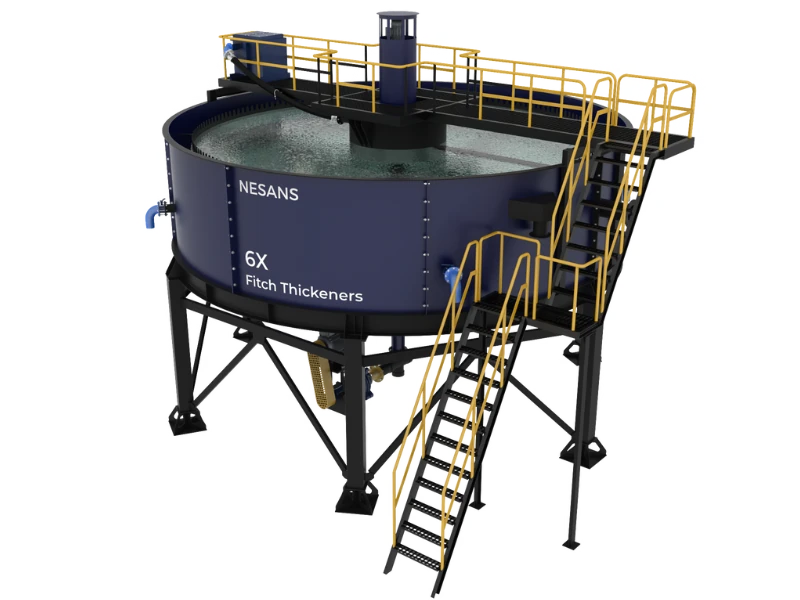
Thickener underflow density directly controls water recovery efficiency in sand washing operations. Operating at optimal underflow density—typically 60-70% solids by weight—maximizes water recirculation while maintaining pumpable slurry consistency. Too thin underflow wastes water and overloads downstream processes; too thick underflow causes pump cavitation, pipe blockages, and thickener raking failures. This guide provides the technical framework for achieving and maintaining optimal underflow density.
Understanding Underflow Density
Density Measurement Methods
| Method | Accuracy | Response Time | Cost |
|---|
| Marcy Scale (sample) | ±2% | 5 minutes | ₹5,000 |
| Nuclear Density Gauge | ±1% | Continuous | ₹5-8 lakhs |
| Coriolis Meter | ±0.5% | Continuous | ₹8-12 lakhs |
| Pressure Differential | ±3% | Continuous | ₹50,000 |
Target Density Ranges
| Application | Target Solids (%) | Specific Gravity | Notes |
|---|
| Centrifugal pump feed | 55-65% | 1.55-1.70 | Higher reduces pump efficiency |
| Positive displacement pump | 65-75% | 1.70-1.85 | Can handle thicker slurry |
| Filter press feed | 50-60% | 1.45-1.60 | Excess water wastes filter capacity |
| Tailings disposal | 50-65% | 1.45-1.70 | Balance transport vs. storage |
Factors Affecting Underflow Density
Feed Variables
| Variable | Effect on Underflow | Control Response |
|---|
| Feed rate increase | Thinner underflow | Increase bed depth or reduce U/F rate |
| Finer particle size | Thinner underflow | Increase flocculant dose |
| Higher clay content | Thinner, slower settling | Increase flocculant, reduce rate |
| Temperature drop | Slower settling | Increase retention time |
Operating Variables
| Variable | Effect | Adjustment Range |
|---|
| Bed depth | Higher bed = thicker underflow | 0.5-2.0m above rake |
| Rake speed | Faster = thinner underflow | 0.1-0.3 RPM typical |
| Underflow rate | Higher rate = thinner | 5-15% of feed volume |
| Flocculant dose | Higher dose = faster settling | 20-100 g/tonne solids |
Control Strategies
Manual Control Protocol
- Measure underflow density every 30 minutes
- Record bed depth (pressure or ultrasonic)
- Adjust underflow pump speed to maintain target
- Adjust flocculant if settling changes
Automatic Control
| Control Loop | Measured Variable | Manipulated Variable | Setpoint |
|---|
| Density Control | Underflow density | Underflow pump VFD | 1.65-1.75 SG |
| Bed Level | Bed pressure/level | Underflow rate bias | 1.0-1.5m |
| Torque Limit | Rake torque | Underflow rate override | <70% of max |
Troubleshooting
| Problem | Probable Cause | Solution |
|---|
| Underflow too thin | Low bed depth, high U/F rate | Reduce pump speed, build bed |
| Underflow too thick | Excessive bed depth | Increase pump speed gradually |
| Pump cavitation | Air entrainment, thick slurry | Reduce density, check suction |
| High rake torque | Excessive bed compaction | Increase underflow rate immediately |
| Poor clarity overflow | Insufficient flocculant | Increase dose, check mixing |
Water Recovery Optimization
Water Recovery Calculation:
Feed: 100 m³/hr at 15% solids
Underflow: 25 m³/hr at 65% solids
Overflow: 75 m³/hr (clarified)

Water in feed: 85 m³/hr
Water in underflow: 8.75 m³/hr
Water recovered: 75 m³/hr

Recovery rate: 88%

Improving to 70% underflow solids:
Water in underflow: 7.5 m³/hr
Additional recovery: 1.25 m³/hr (1.5%)
Conclusion
Optimal thickener underflow density balances water recovery against slurry handling capability. Consistent density control requires attention to feed variability, proper flocculant dosing, and systematic monitoring. Plants achieving 65-70% underflow solids consistently recover 85-90% of process water while maintaining reliable slurry pumping. This optimization directly reduces fresh water consumption and operating costs.